Series reviews…

December 18th, 2019

Reviewers rarely write them. Amazon promotes series (if only saying what the next book in the series is when you finish a book), but they want reviews for the individual books, which they just treat like other “products.” Smashwords lists series but never promotes them as such—in fact, they basically ignore evergreen books (older books that are as current as the day the author published them), so only the latest books in a series are promoted. And bookstores and libraries also ignore series for the most part.

Like Amazon, most retailers, online or otherwise, now treat books like products and ignore series and other literary aspects associated with books, so none of this should come as a surprise. But hardly anyone writes series reviews either, so I thought I’d write a few here, especially because I’ve binged on some recently (they’re excellent for doing just that).

The order in the following is ugly, bad, and good, so play Morricone’s score backwards (the leit motif still sounds good).

The ugly: The Kate Redman series. I started bingeing on this, but ran into a bit of a roadblock. Celina Grace or her publisher became sloppy. When I tried to download yet another book in the series (it met my $6 threshold, but many don’t), I found a corrupted file residing on my Kindle. Returning to Amazon, I saw it announced there that the book has a “quality control” problem. I thought I’d lost my money, and everyone knows Amazon’s return policy sucks. But the next day the file seemed okay. Did Amazon magically change it? Scary if true. Still, fair warning.

That said, let’s talk about Grace’s Kate Redman character. Compared to the principals of the other series listed here, she’s the most conflicted, a thirty-year-old with a lot of baggage who can’t deny the attraction she has for her boss or get past it. Frankly, there’s too much focus on Kate’s hang-ups. I like complex characters, but those hang-ups become tiresome the farther I go into the series. I’ll keep reading, though, at least the ebooks under my $6 limit (for the book that was initially corrupted, even $5.99 is too much for 262 equivalent pages). Stay tuned.

The bad: A, B, C, etc. is for whatever. Okay, I’ve never binged on this series—Big Five prices are exorbitant—but let me consider this long crime trek through the alphabet by Sue Grafton and say why it’s bad (in that, it has a lot in common with other over-extended American crime series). I haven’t read many of these books, thank goodness, so it’s only fair to say why they turn me off.

Grafton’s is a “good” series to illustrate what an author should not do: Don’t keep a series going even when new books in the series are formulaic and uninteresting and simple variations on what has come before. Authors should know when to stop. (I suppose readers should know when to stop reading such series too. I did.)

I mostly blame the Big Five for all these flawed series. Those publishing conglomerates continue to publish them because they’re moneymakers—an uncritical fandom continues to buy the books, unwilling to try something new, just like the author of this series. I hate to criticize dead artists, but she only stopped because she passed away in 2017. I pass belated condolences on to her family, friends, and fans. She was an interesting person and into my preferred hard-boiled style of mystery and crime writing, but I just grew tired of the series.

More on similar series later.

Top o’ the good: The Kirby/Langdon series. In contrast, author Daniella Bernett has a winner here—books with original twists on traditional crime stories I found extremely entertaining. No old-style PIs or forensics experts here as main characters. Instead, they are Kirby, an investigative reporter, and Longdon, a jewel thief. A British inspector (his name really belongs in the series’ name) firmly places these books firmly into the category of Brit-style mysteries even though the author is American. The villain(s) vary from novel to novel as the author fills in background material and develops the main characters, including Kirby and Longdon’s on-again, off-again romance (Kirby often mentally beats herself up for having fallen for that rascal rogue Longdon). The mostly European settings vary from novel to novel too, and the plots are intriguing and entertaining. (Note: Daniella was my most recent interviewee to grace this blog and is December’s featured author on the Black Opal Books home page.)

Second place among the good: The rural mysteries series. Author Diana J. Febry takes the reader into the English countryside where her principal characters often find a murder to solve in spite of the peaceful setting. (You have to wonder how, like Cabot Cove, so many murders occur there, but I learned to not question that too much because the plots are fine.) Fiona can’t decide whether to make a play for her boss Peter, but, at the end of the series (so far), he’s divorced, so we might see a bit more romance in future books. Again, each book in this series is well plotted, and each novel tells us more about the main characters. Another winning series readers might not know about…and it might just satisfy readers’ appetites for cozies, although there’s nothing cozy about the crimes considered.

A tie for second among the good: The Yorkshire murder mysteries. Author J. R. Ellis has also created some highly entertaining stories also in a rural setting for the most part, namely the Yorkshire area, where old mills once clothed the English public and mineral spas pampered English aristocrats (as if they needed more pampering, poor devils). I find DCI Oldroyd more interesting than Rankin’s Rebus and James’s Dalgliesh. More interesting than most crime fighters, in fact.
Read the rest of this entry »

Why Star Wars is bad fantasy…

December 17th, 2019

Fantasy films have been moneymakers for Hollywood recently—the Marvel, Harry Potter, and Star Wars series come to mind. The Marvel movies, based on that venerable comic book enterprise, don’t pretend to be serious—both DC Comics and Marvel Comics were once kids’ introductions to fantasy. I like the origin stories the most because I missed them in my comics reading as a kid. The Harry Potter series of books represent Rowling’s verbose description of a magical world, a bit juvenile at the beginning but darker as it went along, and so verbose that they made two movies of the last book. She has tried to keep it going—is that Broadway show as verbosely boring as those later novels? The series had examples of Deus ex Machina all the way through it. Magic is the epitome of fantasy, of course, and Rowling wouldn’t argue with that classification. But the Star Wars movies really turned me off. None of Lucas’s or Disney’s hype calls them fantasies. What’s more, they’re bad ones.

First, there’s the rampant plagiarism of sci-fi classics and action traditions. I consider ninja classics’, Edgar Rice Burrough’s, and Isaac Asimov’s influences plagiarism, but I suppose the statute of limitations applies and prevents the last two writers’ estates from taking legal action. You’d think Japan would make a national outcry about the ninja-like material too, but that’s not the first time Hollywood has distorted that tradition, turning reality into fantasy.

Second, there are glaring absurdities. Consider that freaky, sizzlin’ light saber. It’s not really a saber, of course—it’s not curved. While ninja warriors might covet such weapons, they are absurd weapons in that galaxy so far, far away. By the way, some wag said that Star Wars isn’t really fantasy because it’s in this universe, but Harry Potter occurred on Earth and no one denies it’s fantasy, so I’ll ignore that argument. But back to the light saber: Remember this scene from an Indiana Jones movie? An evil ninja-like combatant threatens Indy, swishing his sword back and forth in a menacing display of speed and skill. Indy pulls out his gun and plugs his attacker. Now translate that to Star Wars. I’d just pull out my blaster (or ray gun, or whatever they call it) and blast the guy with the light saber who’s threatening me, just like Indy did. Swords were appropriate for the Jedi warriors on Burroughs’s Martian stories that Lucas plagiarized, but they’re absurd in Star Wars (yes, Lucas plagiarized even the name Jedi as well as the concept).

Third, while we still have princes and princesses in the modern era (a particular nasty prince in Saudi Arabia and the British queen’s son are modern and anachronistic examples of princes), Lucas’s use of them is also absurd. They turn Star Wars into one big formulaic fairy tale. Of course, the entire Star Wars social structure is absurd, including the Senate and Empire, both stolen from Asimov and morphed into ugly fantasy. Whatever those speeds obtainable by the Millennium Falcon are, empires are hard to maintain among the stars. Loose trade unions a la the EU are only possible because the starships in use are the fastest means of communication—and that’s not fast enough to grip that galaxy far, far away in the iron hand of Lucas’s evil empire.

Fourth, the fantasy world of Star Wars doesn’t have consistent rules. Rowling also fails at that in her fantasy series, but it’s not so obvious as Star Wars. Lucas and other Star Wars directors fail miserably at this in their movies—or maybe their screenwriters are the real culprits. (Most Hollywood screenwriters have no idea how to write a good fantasy, so their screenplays are bad ones.) A fantasy universe has to have a consistent set of rules. Each Star Wars director makes them up as he goes, especially Lucas.

I’m not against fantasy. I just want it to be done right. I’ll read it and watch it on the silver screen if it is done right. Star Wars doesn’t do it right. And don’t come at me saying, “It’s not fantasy. It’s sci-fi.” It’s not sci-fi, it’s bad fantasy. Viewers are delusional if they think it’s sci-fi. And they should also realize it’s bad fantasy.

***

Comments are always welcome.

Want some really good fantasy? Check out Veiled Memory by S. P. Brown (a sequel is on the way) and Kilts and Catnips by Zoe Tasia. The first fantasy describes a dark conspiracy involving Celtic runes that are mysteriously ancient; the second takes a few Celtic legends and plops them down into a modern setting. I reviewed both in this blog. They’re writing comrades at Black Opal Books, but I’ve discovered that searching through small press catalogs is a great way to find new and exciting authors…at least new for me. And you can avoid the overwhelming lists at Amazon that way. Black Opal Books are available wherever books are sold, and directly from the publisher. Support indie publishers like Black Opal.

Around the world and to the stars! In libris libertas!


Writing mysteries and crime stories…

December 12th, 2019

The beginning: a crime is committed. The end: a crime is solved. Fill in the details.

This, of course, is an extreme case of simplification, where the Devil really is in the details. I knew that before I wrote my first mystery, Teeter-Totter between Lust and Murder in the “Detectives Chen and Castilblanco Series.” (Technically, The Secret Lab—see below—was the first one published, but that’s a YA sci-fi mystery.) You might have thought that The Midas Bomb, #1 in the detective series, was a mystery? Not in a pure sense; it’s a mystery/thriller, as many of those detective novels are. #2, Angels Need Not Apply, is almost a pure thriller. (I don’t see genres as hard boundaries, just key words to describe stories.) So when I had the idea for #3, I approached it with some trepidation.

I can’t remember if one of Christie’s novels or Asimov’s Caves of Steel was the first adult mystery I read. I say adult because I dived into that Hardy Boys series as soon as I learned to read, which occurred before the first grade, thanks to my mother. In any case, the samples in the mystery and crime genre that I’d read were numerous by the time #3 became a project, but I felt I still needed to learn more about writing in that genre before doing so. Responsible writers always have those doubts when tackling a new genre (I went through the same process with that YA novel).

I’m guessing they have a course on mystery writing in an MFA program—do they? No matter. At the time, there was plenty of available material about writing mystery and crime stories, some of it common to all genre fiction, other material delving into specific aspects—all “out there” and free. Here I’m not going to go into the various requirements for writing a mystery or crime novel. Those interested can find books and articles on the subject just like I did. But I have to confess, I learned more from osmosis. With a critical eye, I latched onto things I liked and rejected those I didn’t just from reading mystery and crime stories.

I’m going to go out on a limb here: Asimov, who had the benefit of following Christie, was better at mystery and crime writing than she was. I know…blasphemy! But that’s my opinion. Dame Agatha was an early pioneer although there were predecessors (Father Brown and Sherlock, for example) and well worth reading, but old Isaac knew all the devilish details required of a modern mystery or crime story. Besides the two robot mysteries Caves of Steel and The Naked Sun, he wrote many traditional mysteries. His Black Widowers stories are modeled after a club he belonged to, essentially a book club that studied mystery writing.

I took those two sci-fi mysteries featuring Earth detective Elijah Bailey and android Daneel Olivaw and compared them to Rankin’s Rebus oeuvre and James’s Dalgliesh, for example, and saw a lot of commonality. I doubt that Ian or P.D. ever read Isaac, but that doesn’t matter. Louise Penny and other writers also showed me how it’s done—things to emulate and things to avoid. All those mostly American  writers of hard-boiled crime stories also taught me via osmosis.

I have no shame. I selected what I liked as a reader and emulated it as a writer, giving my own spin, of course. My characters are often a bit more diverse, my villains are often complex gals or guys, and my plots often contain uncomfortable and current themes as well as complexity—no cozy mysteries from me.

I’ve had a lot of fun following that winding path from the crime to its solution…and I will continue to do so. I love to read in this genre, and I will continue to write in it.

And, as a nod to Dr. Asimov, my alter-ego A. B. Carolan writes YA sci-fi mysteries. Perhaps they’re more related to those Hardy Boys stories; I’d like to think they’re what those YA novels should have been. (I’d have probably liked them a lot more!) But A. B. writes them with a twinkle in his eye, and you can see that same twinkle in every picture of Dr. Asimov.

Am I trying to upstage other writers? Nope. I just want to tell original stories mostly my own way, but, as Newton said, I stand on the shoulders of giants. I don’t think any of them will mind that.

***

Comments are always welcome.

Evergreen Bridges. What’s that mean? Many readers don’t realize that three of my series plus two bridge novels make one huge series. The Golden Years of Virginia Morgan provides a bridge between the “Detectives Chen and Castilblanco Series” and the “Clones and Mutants Trilogy,” while Soldiers of God provides one between the last series and the “Chaos Chronicles Trilogy” (now available as an inexpensive ebook bundle). Of course all these books are evergreen, as current today as when I wrote them…and you can read them in any order. They offer many hours of reading entertainment, from mystery and thrills to far-out sci-fi,  and they are available wherever ebooks are sold.

Around the world and to the stars! In libris libertas!


News and Notices from the Writing Trenches #176…

December 11th, 2019

Happy holidays. We’re now heading into year’s end activities. This is often a stressful time for many, so don’t let it be. Like Thanksgiving, it’s time to enjoy being with family and friends. They are more important than anything else. So relax and enjoy the good times, but think about those who don’t have it so good. We’re all on spaceship Earth together.

Art and history in danger? Whether seeing the floods in St. Mark’s Square in Venice or the flames of brush fires driven by ferocious Santa Ana winds approaching the Reagan library in California, extreme weather events driven by climate change seem like the new normal. While one must agree that preventing loss of human life is more important, saving our heritage is too. Through knowledge of our past and understanding of our present, we can chart our way through the troubled waters of the future. Human beings haven’t been the dominant species on planet Earth very long. Let’s make sure we can stick around for a while longer.

Binge reading with the Brits. I’m guilty. Recently I binged with Daniella Bernett’s Kirby/Longdon mysteries and Diana Febry’s rural mystery series, both British-style mystery series. I’m onto more of Celina Grace’s books in the Kate Redman series, although I’m not reading them in order; and I’ve recently discovered J. R. Ellis’s Yorkshire mysteries. With the exception of Bernett, these are all British authors, and even her series’ books are Brit-style mysteries.

Do you binge in your book reading? I tend to do it when I’m exhausted from my own novel writing and need to get some good quality R&R. I suppose most people use streaming video—“Let’s watch all the Sopranos episodes!” My love affair with reading is more driven by what I call a good book, one that allows me to use my own mind to visualize what’s happening in a novel. I don’t want to see someone else’s vision, especially on my TV screen. But that’s just me. We all approach our R&R in different ways.

Holly Berry Show. This year I was unable to participate with a book booth in this seasonal event at the beginning of November, but I contributed indirectly. I hope everyone had a great time. The winners of the two raffle baskets will also have some of my novels to read and enjoy this holiday season…and maybe share with family and friends.

Son of Thunder. Reviews are coming in. Here’s one recent Amazon review: “Son of Thunder is a follow-up of sorts to Rembrandt’s Angel, but it stands alone. It seems quite different from what I’ve read by Steven M. Moore before (and I’ve read most of his works), but in a very good way. Three stories are being told simultaneously, the timelines separated by centuries. Each was exciting and rewarding in its own way. The modern tale is a detective story, perhaps in the vein of Dan Brown, but even more it reminded me of Eric Mayer and Mary Reed’s John the Lord Chamberlain stories (set in the Roman Empire of Justinian). I love those stories, and I loved this one also. It may be the best work I’ve read by Mr. Moore. I couldn’t put it down after a while. I just wanted to know what happened in 1st century AD, 15th century AD and 21st century AD. The religious elements were worked into the plot seamlessly, and the art history gave it a framework to make the whole novel work. If you like historical mysteries with a touch of Dan Brown-type speculation, this is the book for you.”—S. D. Beallis in his five-star Amazon review.

Read the rest of this entry »

Binge reading…

December 10th, 2019

Binge reading is fun, and it’s even more fun when you do it with a series. Recently I binged on Bernett’s Kirby/Longdon mystery series, Febry’s rural mystery series, and am currently on Grace’s Kate Redman series—there are enough books in the latter that I probably can’t finish them before 2020, but they’ll be waiting for me then. (Note added during publication: Some books in the Kate Redman series are a bit expensive for my reading budget. I recently discovered J. R. Ellis’s Yorkshire mysteries, which are a real bargain…and fantastic mysteries. I’ll get back to Celina Grace, I’m sure.)

A good series allows a reader to jump in anywhere, of course. I binged on the first two in order; for the third, I’m (was) jumping around a bit. (And I’m now reading J. R.’s books in order.) All these books can be read independently, though, and they don’t contain that eighth deadly sin, cliffhangers.

I know some readers insist on reading a series in order (reviewers often get hung up on that too). Obviously authors write them that way, although my mystery/thriller The Midas Bomb changed considerably in going from first edition to second to match the rest of the series. As more novels are published in a series, the principal characters develop—a series fails if that is not the case. But the stories are what’s important, so it’s also fun to read a later book and then backtrack to read a previous one. With a prequel, an author formalizes that kind of reading.

I cheated on Son of Thunder. Yes, the “Esther Brookstone Art Detective Series” is a spin-off from my “Detectives Chen and Castilblanco Series,” but Son of Thunder is both a prequel and sequel to Rembrandt’s Angel. Okay, maybe it wasn’t cheating, just a trick played on readers who want to binge on a series by reading it in order. And, by the way, I’m already working on the third Esther Brookstone novel. Maybe I’ll pull some more rabbits out of the hat with that one too.

You see, a lot of my scientific work dealt with nonlinear phenomena. Engineers love to linearize everything, but Nature isn’t linear. It’s much more complex. Bat chirps are nonlinear signals that scientists (engineers reluctantly?) have learned to mimic for radars. Nonlinear equations create fractals; rogue waves in the ocean are nonlinear phenomena. And so forth. Why should a book series…or even the plot of one novel…be linear? Life itself isn’t linear, and fiction should seem as real as life.

Maybe some readers find it confusing if they don’t read a series in order. They’ll probably dislike what I did in Son of Thunder. In the prequel parts, they’ll learn more about Esther’s past as an MI6 spy in East Germany. They’ll also visit the first century and the Renaissance and see their influences on Esther’s quest to find St. John’s tomb. I don’t do simple. Life is too complex, and I want my novels to reflect that complexity.

But back to the series I binged on. They’re complex. They’re full of back story, for example, as I learn about a character’s past or past events. Flashbacks and back story are nonlinear phenomena. They give complexity to even just one novel, and they’re necessary to maintain the flow of a series. I look for that in my reading, and I practice that in my writing.

So go ahead, binge, even if you’re looking for complexity. A good series won’t put you into a formulaic rut. Look for those good series and binge away!

***

Comments are always welcome.

Evergreen Series. The “Detectives Chen and Castilblanco Series” is an ideal candidate for series binging. Dao-Ming Chen and Rolando Castilblanco are two NYPD homicide detectives whose cases in the Big Apple often have national and international repercussions. Chen and Castilblanco have different backgrounds and different motivations, but they form a dynamic crime-fighting duo that bad guys fear. Start with The Midas Bomb that begins with two murders and introduces the arch-villain Vladimir Kalinin, an evil hedge fund operator who wants to exploit both terrorism and illegal immigrants in his evil and greedy agenda. Like all evergreen books, the books in this series and others of mine are as current as the day I wrote them, if not more so. Wall Street abuses and immigrant exploitation are but two examples. The entire series is available on both Amazon and Smashwords and wherever ebooks are sold.

Around the world and to the stars! In libris libertas!

Steve’s shorts: Dr. Carlos and the Cruise Ship Doctor…

December 5th, 2019

Dr. Carlos and the Cruise Ship Doctor

Copyright 2019, Steven M. Moore

Carlos Obregon hadn’t been on a passenger liner for years. He was bit bored with the whole trip—no shipboard duties, no obnoxious crewmembers to bother him, and no captain he could badger. The food was okay, and at least some passengers offered interesting conversation.

The Chief Medical Officer of the survey starship Brendan was going to a conference. He did that every decade or so, either on the Brendan’s layovers, or by taking some of the extensive leave he rarely used. He didn’t do it to present research results, though; he just posted those whenever Brendan made port somewhere in the ITUIP, the near-Earth trade union that financed the starship’s survey voyages.

The cruise ship’s doctor was a bit annoying at first. Nice enough guy but lacking experience. Obregon ran into Brodsky the first day out, even before they left the solar system.

“Arlamati anatomy,” the young man said, peering over Obregon’s shoulder at the tablet’s screen. “Complex reading for a tourist.”

Obregon turned and looked up at him. “Complex enough that I don’t need the interruption. Say, maybe you can tell me how to keep their second heart from shutting down when working on the first. They’re synched.”

Brodsky hesitated. “I’ve never attended to an Arlamati patient. They’re rather reclusive. Never seen one  on a cruise ship before either. I guess I’d electrically trick the second heart so that it seemed the first heart was still beating.”

“Hmm. Could be.” Obregon closed his tablet and stood. “See you around.”

***

When Brodsky returned to his quarters later on, the first thing he did was to call up Obregon’s bio. The man’s a legend! Why isn’t he a professor at one of ITUIP’s major medical schools?

He now recalled reading some seminal reports by Carlos Obregon when he was a medical student. The physician was an expert at treating ailments of Humans exposed to ET pathogens and an expert on treating ETs’ medical ailments.

He next looked up Arlamati anatomy, soon finding what he was looking for. He smiled. The old man tricked me! The Arlamati male had three hearts, not two, that beat out a waltz as they pumped blood around the body. The smaller males didn’t need all that plumbing, but evolution had created the three-heart system for the massive females, each one the sole figurehead of an Arlamati colony.

Brodsky smiled. He’d have to get to know the famous man a bit better.

***

“Don’t devalue experience,” Obregon told Brodsky, eyeing the young doctor over the brim of his tea cup.

“Yes, I understand that. I know I won’t get much experience in this cushy job, but it’s a start at least.”

“Use it to find your space legs, but keep studying. Learning is a life-long pursuit, and our lives are super-long now.” Obregon chuckled. “I’m sounding like an old man, right?”

“The voice of experience,” said Brodsky. “I have to get back. We have two possible cases of food poisoning.”

“Where did that come from? And maybe it’s something else?”

“Food poisoning is the tentative diagnosis. A pair of Tali. I grew up among Tali. They’ll eat anything.”

Read the rest of this entry »

Reviews for Mind Games by A. B. Carolan…

December 4th, 2019

[Note from Steve: In an attempt to declutter my web page “Books & Short Stories,” I’m going to start collecting some significant reviews for each book or series in the blog category “My Reviews.” When all is said and done, readers can search for a book title or series and see the reviews. This might be doubly important, because good reviews I’ve received are often NOT on Amazon. I exclude all reviews by trolls, of course, most of which have zero content and contain only vitriol—Lord knows why. You’ll find most of those on Amazon and its sister-site, Goodreads…along with other good reviews!]

“This is a wonderful book not only for young adults, but for everyone. It has a wonderful story line that keeps you turning the pages to find out what happens next. It is a wonderfully thrilling journey following a young girl and her quest. Her multitude of experiences and how she handles them make this an excellent book.”—Rebecca, in her five-star Amazon review

“An awesome, fast-paced story that will compel you from the first page to read all of the way through. And so difficult to put down! There are such wonderful characters in this story you become invested in their adventures and their well-being. I highly recommend this!!”—Dr. Patricia Eroh, in her five-star Amazon review.

“This one is a good sci-fi mystery. Della is a young girl who has to find out what happened to the man who raised her, Ferdie. She is on a distant planet with few humans, and she is the exception, being able to psychically read peoples’ minds. She also can do various other unusual things. The story at first is a little hard to follow with all the different alien activities and places. But then, as Della is captured and transported to Earth, it gets easier to read and more interesting. I like the way she uses her gifts to escape and know what people are thinking. She quickly makes some allies who agree to help her find her friends from the other planet. Meanwhile, she’s trying to solve the mystery of why Ferdie was murdered. It’s a wild adventure and quite a different story than most, and those who enjoy sci-fi and mysteries will enjoy this book, Mind Games.”—Lee Broom, in her four-star Amazon review

Mind Games is a fast-paced sci-fi mystery novel. The author jumps right into the story with Della coming ‘home’ to find her foster father dead on the floor. She’s numb from the shock of this because, while they live in the Domes, murder is a rare thing. She knows that he has a past, but she never once thought that it was something worth being killed over. She’s immediately determined to find out who killed him, why, and is more than willing to break the promise she once made to him to not use her psi skills to do so.

This is the second book that I have read by this author and I have to say that overall I enjoyed it the most. The storyline is not slow and moves at quite a bit of a clip. I enjoy the pace of the story as it keeps me engaged, but I do feel that some opportunities are missed with descriptions and further exploration. Della is an engaging character, and I like that she is using her unique skills, but I wanted more. Every time she exercises her abilities the other characters are quick to accept and seem completely okay with what she is capable of. I wanted some sort of reaction in more than just then like “oh wow you have psi abilities.” There is a nice amount of mystery and even danger in this story as Della is seeking information that a specific group doesn’t want her to have.

While this is a decent book overall, it is not without its flaws. I wanted an actual description of Della. We get bits and pieces here and there, but I wanted to know what she really looked like. I feel like there are some missed opportunities with this book, but I also feel that this book is meant more for teens and preteens as well. There is some danger, but nothing to the extreme.

I am rating this book 4 out of 5 stars. I enjoyed this book, but as I said before I feel that there are some missed opportunities with this story. There could have been some more drama written in, more intense moments, and even some expounding on the planets, and aliens.”—Seraphia, in her four-star Amazon review.

***

Comments are always welcome.

Mind Games by A. B. Carolan. Androids with psi powers? What could go wrong? Della arrives at her home in the Dark Domes on the planet Sanctuary to find her adopted father murdered. She vows to find his murderer. She had promised him to never to use her psi powers but now decides to use them to begin her sleuthing, which carries her to other planets in ITUIP, the Interstellar Trade Union of Independent Planets. Friends help her along the way to avenge her father’s death. Available in print and ebook format at Amazon and in ebook format at Smashwords and all its affiliated retailers (iBooks, B&N, Kobo, etc.). This novel is part of the “ABC Sci-Fi Mystery Series” by the same author, which contains two previous novels The Secret Lab and The Secret of the Urns, both “evergreen books”—sci-fi is always current!

Around the world and to the stars! In libris libertas!


Car, train, ship, or plane?

December 3rd, 2019

Inspiration for this post doesn’t come from the Fast and Furious franchise or the new Matt Damon movie, Ford vs. Ferrari. It’s about the relationship between settings and conveyances.

A love affair with cars is much more muted in Europe than in the US. Sure, Europeans love fast cars—just try to drive on the Autobahn sometime, or on those UK and Irish back roads—but trains play a more important role. As a young traveler in frugal tourist-mode before and after conferences, I’d buy a Eurorail pass. Sleeping on the train to avoid hotel costs and waking up in a new European city or even country let me see a lot of Europe, at least the part outside the Iron Curtain (you’ve already read about some of my experiences in ex-Iron Curtain countries, which are much more recent). Train travel around Europe is easy, and it’s the way a lot of Europeans travel. As an author, you can neglect this cultural tradition at your own peril if your story is set in Europe. Even those opening scenes in Goldfinger made that mistake as the film’s directors pandered to American audiences—the villain’s Rolls Royce was still a car, after all, and James Bond’s famous Aston Martin was a fast car. (When I saw From Russia with Love, I thought, “How appropriate! Bond’s on a train.” Or was that The Spy who Loved Me?)

Traveling is part of culture in the US and abroad. A lot of us in the States like to get from point A to point B fast. “Fast” is always a bit of a stretch when we add on commuting time to airports, traffic in airports, and airline delays, whether due to weather (can’t control that) or faulty maintenance of the aircraft, cancellations, or TSA security (something should be done about those). I found train travel in Europe a welcome respite from European plane travel, but not so much in the US (once a strike by Allitalia when I wanted to fly from northern Italy to Madrid didn’t add to my appreciation for European plane travel—I had to go the long way around, back to Rome and then on to Madrid). For one thing, the US is just too big. For another, the options for train travel are minimal.

Car travel is different—more personal, less costly in general, and more dangerous, statistically, the danger directly proportional to speed as well as traffic density, no matter how many safety features the car has. Touring is also an easy way to see more countryside—train tracks are fixed and planes fly only between certain cities and fly so high that you can see very little.

The mix in Europe is a bit more logical and better than in the US. Eisenhower didn’t help with his gift to US auto manufacturers, the creation of the interstate highway system, but the dominance of car travel in America would probably have occurred anyway. Americans love cars and often see them as a status symbol. Europe is more compact and geared to offer travelers all options, including ferries to carry their cars and trains and ships cruising between various ports.

The US used to be more into trains and ships. The easiest way to Gold Rush Country in California (I’m looking at one of my father’s paintings of an old building from the area where gold was discovered) was by ship around the tip of South America (not so easy even by today’s standards, and you can do it via the Panama Canal). Once that golden spike was hammered into place in the cross-country railroad, trains connected the East Coast to the West, and vice versa (again, not so easy or fast, but the car didn’t exist at the time).

Read the rest of this entry »

I’m not Dr. Asimov…

November 28th, 2019

Before I get into the subject of this article, let me wish everyone a wonderful and safe Thanksgiving. We tend to lose the meaning of this holiday that leads into the commercial end-of-year rush, starting with Black Friday…or earlier! It should be a time for personal contemplation about having family and friends and to give thanks for what we have in our lives. It’s not political or commercial but spiritual, a time to recognize our common humanity, something we share independently of political proclivities, religious preferences, or sexual orientation. We are all on spaceship Earth together, and we have a lot to be thankful for. Now, to the article….

While the sci-fi master Isaac Asimov certainly motivated me to write sci-fi—I read his first robot novel Caves of Steel at age twelve—I’m not Dr. Asimov. The ex-biochemist was also a master at writing popular science books that explained current science. I’ve failed miserably at that! A few blog posts, but not one book.

Like him, I’m a fan of Science News. Scientists are now super specialized in general, so we have to turn to more popular works like anyone else to see what other scientists are doing. I think both Isaac and I had that in common—we kept up with general scientific and technology progress in spite of our specializations. But the sci-fi master was already a generalist with many popular science books to prove it.

Of course, those books were also a respite from his sci-fi writing. His Foundation series is evidence for that. He wrote the Foundation trilogy, robot novels, and End of Eternity, and then he took a vacation of several decades to write all those popular science books. After that period, he returned to sci-fi and completed the Foundation series, bringing all those earlier novels together and continuing to write more, creating a masterful oeuvre the likes of which will never be seen again.

“Decades” is the key word. Like King and other famous genre fiction writers, Isaac Asimov got an early start. That’s difficult to do nowadays. I won’t complete two publishing decades until 2026…if I make it that far.

I’ve been tempted to write a few popular science books, but so much in that area is available now. In short, there’s no lack of authors and books explaining science. There’s also an apathy among readers who might otherwise read such books. Most people no longer care how things work; they just use the science and technology without thinking about it. There’s some interest in space science and astrophysics beyond sensationalism and controversy (is Pluto a planet?), but there’s also a societal disease where people think science is just belief and it’s responsible for society’s woes. And then there are the naysayers, deniers of global warming and climate change, or believers that the world was made 6000 years ago when humans were contemporaries of the dinosaurs (those fossils came from Noah’s flood, don’t you know?).

I would have a hard time channeling Dr. Asimov in such a toxic anti-science environment. True science is secular, but we’re becoming a belief-based society, even though the beliefs contradict facts. In one of the first Foundation books, there’s a scene where the principal confronts an archaeologist, telling him to prove his assertions by going out and digging up the evidence. The “scientist” refuses, saying that theories (his beliefs) are enough. Our scientists today haven’t gone to those extremes, but many in society have, denying scientific evidence while creating their own “theories” (intelligent design is the perfect example of an oxymoron, because the people who champion this belief ignore facts).

No, I’m not about to hit my head my head against the brick wall of public opinion. Let’s face it: it’s a lot more fun to write fiction that includes or extrapolates current scientific knowledge, allowing astute readers to see the possibilities in a fictional context. I just hope that my stories are enough to make Dr. Asimov happy. One can popularize science in many ways—mine are just a bit different than some of the old master’s.

***

Comments are always welcome.

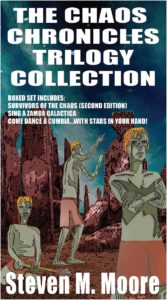
Evergreen Series: “The Chaos Chronicles Trilogy.” Survivors of the Chaos starts with a dystopian Earth controlled by multinationals and their mercenaries, and ends with an expedition to the 82 Eridani star system. Sing a Zamba Galactica begins with first contact where Humans meet the strange ETs they name Rangers, and ends with a mercy mission where Humans convince one strange collective intelligence to cure another. In Come Dance a Cumbia…with Stars in Your Hand!, a Human industrialist is bent on controlling near-Earth planets in the Galaxy, and Humans and their ET friends must try to stop him. Centuries of development in near-Earth space are covered in these novels, all three evergreen books; sci-fi is always current! And all three novels are contained in the ebook bundle, The Chaos Chronicles Trilogy Collection, a bargain you can find wherever fine ebooks are sold.

Around the world and to the stars! In libris libertas!

Reviews for the “Mary Jo Melendez Mysteries”…

November 27th, 2019

[Note from Steve: In an attempt to declutter my web page “Books & Short Stories,” I’m going to start collecting some significant reviews for each book or series in the blog category “My Reviews.” When all is said and done, readers can search for a book title and see the reviews. This might be doubly important, because good reviews I’ve received are often NOT on Amazon. I exclude all reviews by trolls, of course, most of which have zero content and contain only vitriol—Lord knows why. You’ll find most of those on Amazon and its sister-site, Goodreads…along with more reviews!]

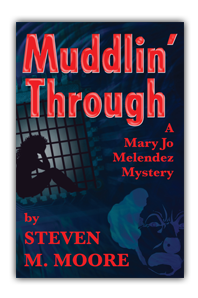
Muddlin’ Through (MJM #1)…

“Steven M. Moore takes ex-military master at arms Mary Jo Melendez and puts her through the ringer! She is given trial after trial and muddles through, as the title suggests. This was a bit of a change of pace for Moore, who seems to usually write more tightly woven stories, but it had his usual interesting characters, a series of geographically diverse settings and plenty of action. Did I buy it all? Well, I did while I was reading and what more can you ask? Perhaps this is not Moore’s best, but it’s really good, s fun, quick, exciting read!”—S. D. Beallis, in his five-star Amazon review

“A wrongly convicted woman seeks to clear her name, experiencing a series of adventures along the way. Moore creates an excellent and deep character in Mary Jo. Strong and smart, yet conflicted, she retains her humanity when her enemies lose theirs — all across the globe. I really enjoyed reading this novel, and recommend it to readers who enjoy intrigue.”—Debra Miller, in her five-star Amazon review

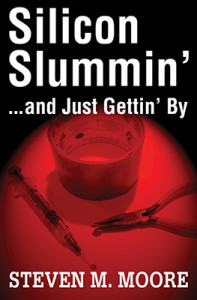
Silicon Slummin’…and Just Gettin’ By (MJM #2)…

“I’m a big fan of Steven M. Moore’s work, and enjoyed Mary Jo Melendez’s first adventure. But this one took the series to an even higher level for me. It combined a bit of serial killer horror (no really graphic violent scenes, though) with an excellent thriller which draws upon Moore’s SF/tech background. In this one, Mary Jo’s myriad of misadventures in the first book are coming back to haunt her. There are people who want to know what she knows…and one guy who appears to be simply fixated on her.

In this book you get your usual mix of Moore’s interesting characters who, when forced to interact with each other, find that they somehow become better and/or stronger people. Mary Jo leaves of trail of devastation in her wake, but none of it is precisely her fault. She’s a victim of circumstances that are as interesting and compelling as anything Moore has written to date. I really enjoyed this book. Looking forward to see what happens to Mary Jo in the future.”—S. D. Beallis, in his five-star Amazon review

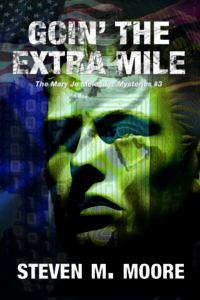
Goin’ the Extra Mile (MJM #3)…

“It all begins with an attempted kidnapping of her two adopted children, and things only get heightened when her entire family is abducted. The Chinese are after Mary Jo and they want answers that she can’t give them. They want the MECHs that she helped, but she can’t give them information that she has no idea of knowing. Too bad they aren’t buying that she doesn’t know and will do whatever it takes to acquire what it is that they want.

Goin’ The Extra Mile by Steven M. Moore is the first book that I have read by this author. This book is book three in the Mary Jo Melendez mystery series, but I don’t feel like it is imperative that I read the first two books in the series. The author does a good job at filling in details in the right places so that I can have a bit of backstory as well. I like how much of a mystery and thriller this story is. The author really keeps the reader on the edge of their seat as they follow along with Mary Jo and Marguerite Fontaine, a French physician. This story is gripping from beginning to end as Mary Jo faces so many obstacles to try and reclaim her family. This story spans more than one country and keeps the reader engaged.

I enjoyed this book immensely. I will give this warning…the story switches back and forth between Mary Jo and Marguerite. There are no defining points of when this will happen. At first, I didn’t like these unexpected transitions and wanted them defined so I’d know, but the more I read I found I actually appreciated them. The switches kept me on my toes as I didn’t know what to expect with the turning of the page/beginning of the next chapter.
I am rating this book 5 out of 5 stars. I don’t read a lot of mystery espionage novels, but this book is worth picking up. It will keep you intrigued from beginning to end. So if you like a story with a woman who will do whatever it takes to get her children back and some adventure mixed in grab this book!”—Seraphia in her five-star Amazon review

Read the rest of this entry »