Books within books…

February 25th, 2020

Books in bookcases that you tilt to open secret rooms, books with weapons or drugs inside, books that contain secret codes—these are ways books appear in genre fiction plots. A Bible or Koran in a religious character’s study, Kama Sutra or Marquis de Sade’s Justine in a sexual predator’s lair, or Josemaria Esciva’s work for a religious fanatic—these are more examples of books that might be found mentioned in a novel.

One reason I loved the movie The League of Extraordinary Gentleman was that it had many literary references. Books within a book can make that book better too. Even a house that has a library or study with many books is a positive, and stories like Shadows of the Wind turn me on.

Something comes to mind, though. I save my sagging bookshelves now by reading mostly ebooks. Those “books within a book” examples can apply to ebooks too, of course—in fact, you might find code hidden in an ebook easier than in a print version. But why bother? Have you ever looked at the “Documents” folder on your Kindle? Most people don’t, and spies might not even think of looking there!
And I’ve never seen an e-Bible or e-Koran. Why not? Maybe they exist. Dunno. I’d probably have them on my laptop, though, so I could refer to them when I’m writing. I took the quotes in Son of Thunder from an old print Bible on my bookshelf (I only had to refer to St. John’s gospel, of course).

“Books within a book” is a phrase that covers a wide gamut, of course, because authors use books as props in many ways. Their might be less of them as time passes, though. But I thought LPs would disappear from books too. They won’t, because they’re still popular. And that’s the point. Print books are still popular.

Some of this popularity is due to Big Five policies where the e-book version is offered at a reduced price if the reader buys the print version, sort of a lame BOGO in my mind’s eye. There are plenty of readers who want to read print versions and eschew ebook versions. That preference is doomed. For one thing, it’s bad for the environment. For another, print versions don’t last. Any librarian will tell you that. I’ve donated new versions for dog-eared ones with torn covers at our local library, but that tactic has limitations. The Midas Bomb has a second edition that has both print and ebook formats, but other second editions are only in ebook formats. Hopefully the acquisitions librarian considers buying ebook versions—I offer them at a reduced price for libraries on Smashwords!
I think print versions will go the way of the dinosaurs for many reasons. Books might disappear altogether with the onslaught of video games, streaming video, and VR total immersions. But if books have any staying power, it will be via ebooks loaded onto those tiny computers we call smart phones—maybe with sound, odors, and video clips included? Those phones are getting bigger, and Samsung offers one that folds. Maybe for coffee table books?

I’ll never know how it all turns out, of course. I won’t care about tech when I’m dead. I’m not sure I care much about it now!

***

Comments are always welcome.
“Mary Jo Melendez Mysteries.” Ex-USN Master-at-Arms Mary Jo has had a harried life. In Muddlin’ Through, she takes a security job at a NJ firm and is framed for her sister and brother-in-law’s murder by a secret US agency when Russian agents steal the MECHs (“Mechanically Enhanced Cybernetic Humans”). In Silicon Slummin’…and Just Gettin’ By, she not only has US and Russian agents again to contend with in her new CA security job, but also a stalker. And in Goin’ the Extra Mile, China steps in to pursue the MECHs, kidnapping Mary Jo’s husband and children to find out where they are. These three novels of heart-pounding action typify what I mean by “evergreen books”—novels that are as fresh and current as the day they were published, if not more so. Available in .mobi (Kindle) format on Amazon, and in all ebook formats on Smashwords and its affiliated retailers (iBooks, B&N, Kobo, etc.) and library and lending services (Scribd, Overdrive, Baker & Taylor, Gardners, etc.). Come and meet the MECHs!

Around the world and to the stars! In libris libertas!
Useless copyrights?

February 20th, 2020

I often wonder what copyrights are good for in today’s publishing industry. Almost all fiction books (and probably all books) list the author(s) as the copyright holders. Whether authors are self- or traditionally published, what recourse do they have? If someone “steals” their intellectual property (that can assume many forms), is an author going to take that someone to court? Better said, can an author convince a lawyer to take that someone to court?

Unless a book is making a lot of money, I doubt it. In that case, I guess a lawyer might even do a pro bono representation, or, if the author is already rich, s/he can pay a lawyer a lot of money. Today it seems doubtful that most authors would be willing to spend money on a lawyer, though.

Maybe movie rights on the line? Ah, but that usually means the book has made a lot of money! Hollywood won’t even look at a good story unless it’s already popular. In fact, popular is the only requirement for Hollywood—the story doesn’t even have to be good. The Goldfinch and Gone Girl come to mind. So we’re back at square one: most authors will have to shrug and forget about legal recourse because wiping out the royalties they’ve received just isn’t worth it.

I guess I don’t know how copyrights work…or are supposed to work! I’m a mongrel, so I have some traditionally published books as well as self-published books. Will my publishers go after someone who steals my material? They have even less motivation to do so! They might for some book, again because it’s making a lot of money (not mine!). But usually not in general. Of course, a traditional publisher usually takes in 85% of the royalties compared to the author’s 15%, so they might be a bit more motivated than their author.

But really, on a per-book basis, does it make sense for either author or publisher to fight a copyright violation? Not usually. Book pirates and other unscrupulous people know that, of course, and go wild, stealing intellectual property at will.

What constitutes a copyright violation? We can find analogies in the music business. We have seen cases where one singer takes a melody, puts different words to it, and then publishes it as a new song. It might even be less that a melody, just a guitar riff or background beat. That’s what a book pirate does when he takes a PDF version of a novel, strips off the author’s name and copyright info, and sells it as his own. And it is a copyright violation as much as stealing prose from a fiction book.

Unless an author is also a lawyer who can represent her or his own case, it just doesn’t make sense to go after the crook. That still doesn’t change two facts: (1) a copyright violation is morally reprehensible, and (2) it means an author is losing royalties, no matter how few they are. It is stealing, it’s a crime, but nobody apprehends the perp and it doesn’t make economic sense to go after him anyway.

But the music industry has shown a way to go after copyright violators: class action lawsuits. Get enough authors and publishers together and we can create a case that will interest any lawyer, or even a team of them. Of course, that still depends on the amount of money involved, not the number of plaintiffs. Other than class action lawsuits, I believe copyrights are useless. Does all this negativity depress you? In the famous words of Mick Mulvaney, get over it! Your only reward for telling your stories is usually only the storytelling itself. That’s all there is. Get over it!

***

Comments are always welcome.

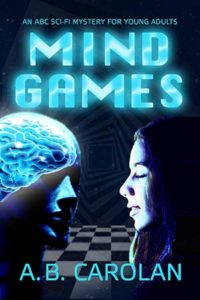
Mind Games. Androids with ESP? What could go wrong? As a gifted teenager tries to find the murderer of her adopted father, she discovers an evil conspiracy bent on controlling all of near-Earth space. A.B. Carolan’s terrifying novel gives new meaning to technology run amok where government programs have unintended consequences. This is the third book in the “ABC Sci-Fi Mysteries” and is available in print and Kindle format on Amazon and in all ebook formats at Smashwords and its affiliated retailers (iBooks, B&N, Kobo, etc.) and lenders and library services (Scribd, Overdrive, Baker & Taylor, Gardners, etc.).

Around the world and to the stars! In libris libertas!
 

Mini-Reviews of Books #44…

February 19th, 2020

[Note from Steve: Two very different books today—more evidence for my varied reading tastes, I suppose—I’ll read most anything that attracts my attention. One is a mystery, the other is a sci-fi thriller, and they are both excellent…and excellent examples of evergreen books.]

Just Another Termination. Linda Thorne, author. I’d been meaning to read this for some time, but I was distracted a bit by my recent binge reading of series. I’m happy to say that it’s like a fine wine, aging nicely on my Kindle and giving me a great deal of reading pleasure just recently.

Judy Kenagy is an HR director in a small firm who had bad experiences at two previous companies. One was taken over and the new owners drove out a young employee who subsequently committed suicide, giving Judy a condition something like PTSD. And her last company had a dingbat psycho CEO who thought everyone was her slave. She hopes to get beyond these experiences in her new post, but when she checks up on a usually reliable employee who doesn’t show up for her shift and finds her murdered, her past haunts her. As HR director, she has to work with the local police, led by the able Carl Bombardier. They work together even when the body count increases.

This suspenseful and well plotted tale with ordinary everyday characters thrown into extraordinary situations will keep the reader guessing. And there are themes never touched befor in a mystery/crime story. The evil ex-boss reminded me of a dean I once had to work with, and I loved the police chief, an able man dedicated to his job, as is Judy, who let me get on the other side of HR work.

The Voyage of the Stingray. Richard Steinitz, author. Who’d have thunk it? Finding books to read on LinkedIn. An email thread with this new author led me to this excellent book. While I read it, I couldn’t help thinking Tom Clancy would be smiling if he could read it. Clancy’s Hunt for Red October set the bar high for submarine stories; this book moves it up a notch. Hunt for Red October was a thriller; this book is a sci-fi thriller, the sci-fi being in the author’s unusual submarine design (that makes sense, according to an ex-admiral quoted in the book).

The USS Stingray’s captain and lead character is Lt. Commander James Jefferson. He’s in charge of training the new boat’s crew and running several test dives and maneuvers. And the crew never has time to celebrate their successful completion either, because they are soon sent on their first black ops mission, where most of the suspense occurs.

I don’t know enough about submarines except for a wee bit of family history, but everything here seems authentic. There are a few situations that might test readers’ credulity, but they are easily explained away by the USN’s haste to deploy the new boat and send it on its first mission. Great plot, great characters, authentic settings and dialogue…what more could you ask for?

***

Comments are always welcome.

Mind Games. Androids with ESP? What could go wrong? As a gifted teenager tries to find the murderer of her adopted father, she discovers an evil conspiracy bent on controlling all of near-Earth space. A.B. Carolan’s terrifying novel gives new meaning to technology run amok where government programs have unintended consequences. This is the third book in the “ABC Sci-Fi Mysteries” and is available in print and Kindle formats on Amazon and in all ebook formats at Smashwords and its affiliated retailers (iBooks, B&N, Kobo, etc.) and lenders and library services (Scribd, Overdrive, Baker & Taylor, Gardners, etc.).

Around the world and to the stars! In libris libertas!
The double meaning of “Mensa”…

February 18th, 2020

In the 1/23/2020 edition of The NY Times, there appeared the story about how three-year-old Muhammed Horyz Nadzim was elected to Mensa, that snooty Brit-originated group of so-called geniuses (the story might have appeared elsewhere as well). I guess that Mensa needed some publicity, and more power to the kid. But his mother had the right attitude, saying that whatever her son went on to become, she would be proud of him.

You see, that Mensa and other snooty organizations like Phi Beta Kappa are irrelevant to most people’s lives, including mine. That kid will have to decide what he wants to do and strive to make it happen, just like anyone else. And whatever he does, Mom will be proud! Ivy colleges, exclusive men’s clubs, and society pages don’t create productive and contributing members of society. People must create their own realities. Sure, some people like Papa Bush or Albert Einstein are born with silver spoons in their mouths or are gifted with extreme intelligence and/or skills, but if they don’t set out to do something, that something won’t be handed to them. They have t work for it. (Let’s ignore those few that inherit old wealth. They’re mostly irrelevant too.) That’s more true today than ever before in human existence.

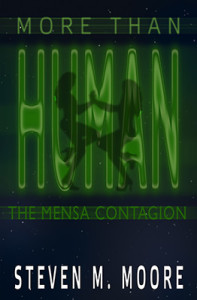
Yes, I had the above Mensa in mind when I created the title for my sci-fi novel, More than Human: The Mensa Contagion, but only in the sense that the “Mensa” in my title was a bit of a stick-it-to-you directed toward that organization of so-called geniuses. You see, the “Mensa” in that title is really the name of a constellation that can be seen from South Africa. From that direction an ET virus comes that creates Homo sapiens 2.0, a new breed of humans that ends up creating a new society on Earth that makes a lot more of a difference than any members from any exclusive club ever will.

I choose my book titles carefully. In my works in progress (WIPs), I have one working title at the start and collect other possibilities as I go. While I do the same thing for characters’ names, a book’s cover and title are the first things readers see at online retailers. They’re important. (In bookstores, it might be the print version’s spine, which is part of the cover.)

There is a trend toward short titles these days, but they often fall short (I couldn’t resist the pun) because they fail to indicate the book’s content. The best title is a short blurb, something that catches the eye of readers and tells them what the book is about. My best is The Midas Bomb, book #1 in the “Detectives Chen and Castilblanco Series.” It’s short and states what happens in the book, the best of both worlds. (Read the book to see why.)

More than Human: The Mensa Contagion for all its length is only half-right. “More than Human” implies Homo sapiens 2.0, but I wanted to qualify that. “The Mensa Contagion” accomplishes three things. First, it differentiates my book from Theodore Sturgeon’s famous sci-fi novel about ESP (I’ve only rarely included ESP in my sci-fi tales). Second, it indicates the source of the ET virus. And third, like I said above, it’s a slap at that other Mensa. You can see how much fun one can have with titles!

Why is my title only half-right? Because the book is really in two parts. The first deals with the contagion’s arrival and its consequences. The second describes what those new humans end up doing—they colonize Mars! I suppose that second part might be more attractive to some sci-fi readers than the first. It’s probably what led one reviewer to say the book reminded her of Kin Stanley Robinson’s Mars trilogy. I’m humbled by that statement, just like I am by reviewers who compare me to Dr. Asimov. In fact, More than Human: Mars and Beyond was one candidate for the title! But I wanted to say how Homo sapiens 2.0 came to be as well as describe the source of the contagion. The stick it to that other Mensa was just frosting on the cake.

Read the rest of this entry »

Robots and androids…

February 13th, 2020

Note from Steve to Cupid’s minions: Tomorrow is St. Valentine’s Day. Help guide the little cherub’s arrows (Cupid, not the saint) to their targets. Don’t disappoint your significant other. Fair warning!

***

Czech writer Karel Čapek’s 1921 R.U.R. (“Rossum’s Universal Robots”) was the first story about robots (it introduced the word, in fact), published long before Isaac Asimov made robots and androids famous in his novels. They are good and bad guys in sci-fi and hated by union workers and everyone else who fear the loss of their jobs to automation. They’ve even become comedy figures: “Danger, danger, Will Robinson!”

I don’t have a good name for it (perhaps the psychiatrists who psycho-analyzed Donald J. Trump can help here), but there exists a phobia about robots. I’d guess androids have a worse rep—they look and often act too much like humans! Blade Runner, one of two of the greatest sci-fi movies ever made (the other is Alien), plays on that fear (so does Alien, in fact). (Maybe that’s why Hollywood shortened Phillip K. Dick’s title, “Do Androids Dream of Electric Sheep,” to the ambiguous Blade Runner.) I, Robot, the movie that has little to do with Asimov’s story, almost made robots into evil Nazi mobs…or mechanical zombie hordes. Hollywood just loves to ruin good literature.

I have robots and androids in some of my sci-fi tales. Their roles are mostly to serve man (without the meaning of the classic short story “To Serve Man” by Damon Knight, which is about that other phobia, evil ETs). In fact, my AIs are a bit more iffy (HAL started that trend in 2001, I suppose, but redeemed itself in 2010, by far the better movie). There’s no reason an AI can’t be a demagogue that wants to be king and control an army of robots and androids to the detriment of human beings. US presidents shouldn’t have a monopoly on that.

But back to my oeuvre: From the automated bar at the beginning of Sing a Zamba Galactica to a rebel leader in Rogue Planet, my androids mostly work for humanity or are indifferent, neither bad nor evil. In a sense, the cyborgs in the “Mary Jo Melendez Mysteries” (the “Mechanically Enhanced Cybernetic Humans,” or MECHs) are just androids with human brains (that might be a better solution than Asimov’s positronic brains)…and good guys too. Yet, to make robots and androids more human, I wanted to create some who can either be good or bad characters in a story.

As many of you know, my alter-ego A.B. Carolan is in charge of my YA sci-fi mysteries now. The latest entry, the third book in the “ABC YA Sci-Fi Mysteries” series, is titled Mind Games. That robot/android phobia is an important theme. As in most of my treatments of themes, A.B. covers both sides: There’s a good android, a cop (not all that different from Asimov’s Daneel Olivaw). There are bad androids too, but humans made them that way (that’s usually the case—someone writes the programs!). But the central question is a bit more than robot/android phobia: What could possibly go wrong if androids had ESP? (That’s another theme in A.B.’s book, of course.) Not even Data had ESP.

R.U.R.’s legacy will continue long into the future as sci-fi continues to use robots, androids, and AIs as characters, reflecting their importance for our future lives and well being. I’m not sure they’ll be equipped with ESP, but what if future soldiers are no longer human but invincible robots with ESP who can read the thoughts of their human adversaries? Now there’s a tale of military sci-fi for you that moves far beyond Terminator and I, Robot. (Maybe Trump will populate his Space Force with them around his fifth term?)

***

Comments are always welcome!

Mind Games. In this third book in the “ABC YA Sci-Fi Mysteries” series, A.B. Carolan’s main character finds her adopted father murdered. She’d agreed to hide her ESP powers, but she breaks that promise to find his killer. The pursuit involves three planets and requires many friends who comes to her aid. In uncovering the extent and perpetrators of the conspiracy is a sci-fi thrill ride you won’t want to miss, whether you’re a young adult or an older sci-fi addict who’s young-at-heart. Available in print and ebook formats from Amazon, and in ebook format from Smashwords and all its affiliated retailers (iBooks, B&N, Kobo, etc.) and lenders and library services (Scribd, Overdrive, Baker & Taylor, Gardners, etc.).

Around the world and to the stars! In libris libertas!
Steve’s shorts: Autocrat…

February 12th, 2020

[Note from Steve: A bit of dark comedy to brighten your day…]

Autocrat

Copyright 2020, Steven M. Moore

NYPD Police Commissioner Declan Kerry frowned as he answered the rant of his counterpart in DC with one of his own.

“You’re complaining about his little July 4th parade? ICE has us doing their dirty work for them ever since he made Congress pass that law ending sanctuary cities. And he’s here this very afternoon! We have to have our counterterrorism unit deployed around his damn tower at all times, but, when he’s here, the costs skyrocket. That narcissist is killing our budget.”

“Hey, I can’t stop him from giving a speech at the UN. He wants to blast the French president again with another speech. Okay by me, as long as he gets the hell out of my town. I just wanted to tell you not to pay too much attention to helping the FBI in bringing in your rogue senator. The president wants to try him for treason like all the others who dared to cross him. It’s the firing squad if your senator is caught.”

“Don’t worry, my dear. We treat the FBI just like DHS and ICE: slo-mo on any help, if any. We pretend to go along, but we drag our feet. Thanks for the FYI, though. I’ll put out the word to look the other way if anyone spots the senator. Maybe he can get all the way to Canada.”

“Good talking to you, Declan.”

“Resist, my old friend.”

Kerry leaned back in his desk chair and sighed. How he despised this president, now in his fourth term as absolute dictator. Kerry had known that the vote in the Senate would only embolden the SOB. He’d even tweeted about how he’d just keep getting four more years. Bolton, Kelly, and Romney, his old friends, had already faced the firing squad. His city was now a sanctuary city for himself. How long can I last?

His how-much-I-despise-thee counts were interrupted by his aide, who entered breathlessly without knocking. Bad omen.

“What is it, Bobby?”

“He’s gone and done it now!” the aide said.

“What’s he done?”

“He got out of his limo and shot someone on Fifth Avenue. We must arrest him.”

“Can’t. He’s not above the law. He is the law!

After the aide left, Kerry took the rough draft of his resignation letter out of a drawer. He had another paragraph to add. Maybe it will be my epitaph?

***

Comments are always welcome.

Mind Games. In this third book in the “ABC YA Sci-Fi Mysteries” series, A.B. Carolan’s main character finds her adopted father murdered. She’d agreed to hide her ESP powers, but she breaks that promise to find his killer. The pursuit involves three planets and requires many friends who comes to her aid. In uncovering the extent and perpetrators of the conspiracy is a sci-fi thrill ride you won’t want to miss, whether you’re a young adult or an older sci-fi addict who’s young-at-heart. Available in print and ebook formats from Amazon, and in ebook format from Smashwords and all its affiliated retailers (iBooks, B&N, Kobo, etc.) and lenders and library services (Scribd, Overdrive, Baker & Taylor, Gardners, etc.).

Around the world and to the stars! In libris libertas!
Young adult literature…

February 11th, 2020

We have left the days of Nancy Drew and the Hardy Boys far behind. Today’s young adult readers are more sophisticated and have a lot more on their plates than their parents and grandparents had at the same age. Although tween and teen angst have morphed a bit, it’s only that the names have changed—that angst has always been present in one form or another. The same can be said for fads and cultural heroes.

The Harry Potter series started out as fantasy fiction focused on tweens and grew to be directed to older readers as the main characters grew. (The villains remained constant, though, discounting Draco Malfoy, who was but a carbon copy of his nefarious father, an adult.) The last Potter books are dark battles between good and evil. Although more verbose than a Stephen King work, those books are on a par with that King-like horror/fantasy genre—Carrie, for example. (King isn’t considered a YA author, but many of his books are YA. It is yet another example.)

The twelve-to-eighteen age group is now reading just about anything (if they read at all and avoid social media, computer games, and streaming video), so does “young adult literature” even make sense? Given that adults who are young at heart also enjoy such targeted books, I have to wonder. My alter-ego A.B. Carolan has adopted a different point of view: the only distinguishing characteristic of young adult novels today should be that their main characters are young adults in that age group worrying about things appropriate to that group! By the very definition of good characterization in a novel, young adults will identify with those characters. That revolution was started with Heinlein’s Podkayne of Mars, and A.B. Carolan continues that revolution.

In that sense, “young adult” isn’t even a genre. It’s only a descriptor indicating the age of the main characters. Thus you have YA romance, YA mysteries, and so forth. A.B. writes YA sci-fi mysteries a la Asimov’s Caves of Steel and The Naked Sun, but, in A.B.’s books, the main characters are young adults. Adults can love reading them as well because they were once young adults and can identify with all those YA interests and angsts. I reread Podkayne not long ago and even got more from it than when I read it as a kid. And it has staying power far beyond those Potter fantasies.

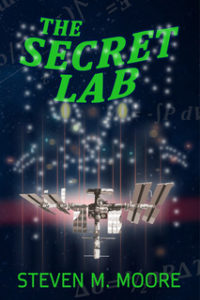
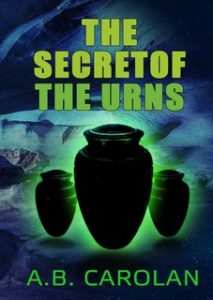
A.B. could have written a series that starts with a tween and ends up with an eighteen-year-old just like Rowling. Instead he opted for a different focus: his main characters are different in each book, going from tweens in The Secret Lab to older teens in The Secret of the Urns and Mind Games. These books form a series only because all the books are part of what’s called the “ABC YA Sci-Fi Mysteries”—they occur centuries apart in the same future depicted in the “Chaos Chronicles Trilogy.”

I know many YA authors will probably disagree with me on these points. For those who do, we’ll just have to agree to disagree. Young adult literature is no longer the same as those Nancy Drew and Hardy Boys books. Denying that change makes no sense.

***

Comments are always welcome.

“ABC YA Sci-Fi Mysteries.” This evergreen series contains A. B. Carolan’s three books, The Secret Lab, The Secret of the Urns, and Mind Games. They are full of sci-fi adventure and suspense as three different heroines solve out-of-this world mysteries. They can be found in print and ebook format on Amazon and in ebook format on Smashwords and all its affiliated retailers (iBooks, B&N, Kobo, etc.) and library and lending services (Scribd, Oveerdrive, Baker & Taylor, Gardners, etc.). Hint for tweens and teens and their school librarians: Reading these is fun…and can serve as easy book reports!

Around the world and to the stars! In libris libertas!


Are there problems with “evergreen books”?

February 6th, 2020

First, a definition: An “evergreen book” is one that is as fresh and current as the day the author published it, or even more so. 1984 is a good example. Okay, a historical event might not be current as far as plot goes, but the themes in a historical fiction can be. “…the day the author published it…” means the copyright date of the first edition. For example, my very first book, the sci-fi thriller Full Medical , was first published in 2006, but it now has a second edition. Both versions are evergreen. Many books you’ll see on my web page “Steve’s Bookshelf” are early books or unique books from authors’ oeuvres, books that are evergreen.

Maybe critics consider evergreen books to be inferior in an author’s oeuvre because of the assumption that an author improves with each book. Harper Lee’s To Kill a Mockingbird belies that assumption (her other book was a late prequel), and my Full Medical is as good as later books with its cloning theme all the more important today. Critics pontificate a lot because they can’t write fiction.

The only problem with evergreen is age discrimination. For example, it’s now 2020, so any book with a 2019 copyright or older is considered old by readers, reviewers, and marketing services. People discriminate against “old,” and they’ve defined “old” to include evergreen. Some books are old—sci-fi from the early twentieth century with bug-eyed Venusians invading Earth is old, but these books can also evergreen because their themes can be current even if their tech isn’t.

You might think that if a book has an ebook version, it’s evergreen. After all, ebooks are a recent phenomena in the publishing world. That’s not a hard and fast rule, though. Even the Big Five “reprints” old books, including many “classics,” as ebooks, and some of them, like Jane Austen’s drivel, are hardly evergreen. As SOP, a reader can only tell a book is evergreen by its blurb and using a “peek inside.” (I suppose, in that sense, no cozy mystery is evergreen, because I never find fresh or current themes in those books. I can just hear the screams!)

Second, age discrimination means, in particular, that readers don’t normally buy evergreen books. I don’t know about other authors, but that kills my business model. I set out on my publishing journey with the assumption that I could finance the next book using the royalties from my previous books. That does not work for me, and it probably doesn’t work for many other authors either. I guess everything has to be new and shiny bright for today’s readers?

Whether self- or traditionally published, there are costs, many of them the same. One big one is the author’s website. Another is editing. Finally, there’s marketing. All necessities. There are incidental, smaller costs as well, too many to enumerate. Per book, they don’t have to add up to much unless you OD on marketing (marketing “experts” love us to do that!). If this business model makes any sense at all, I should be well off. It doesn’t, though, because no one pays attention to evergreen books.

I guess I’m an exception. I’m an avid reader, and I find a lot of worthwhile reading in evergreen books. I recognize that I can’t read that many books per year (I average between 50 and 100), so chances are, by the time I “discover” a book, it’s already evergreen! (There are hundreds of books published every week, just in case you didn’t know.) I read evergreen, but others don’t.

Readers who don’t read evergreen don’t know what they’re missing…including my own books. But that’s life in the writing trenches.

***

Comments are always welcome.

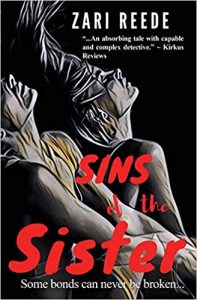
Zari Reede’s Sins of the Sister. Now evergreen (published in December, 2018), but a damn good book! Talk about current themes. Part mystery, part thriller, this story about a detective and her sister will keep you guessing. It moves at a fast pace, so hold on to your recliner. I won’t say much more for fear of spoilers, but this is a great example of what readers might miss if they don’t do evergreen. Available at Amazon.

Around the world and to the stars! In libris libertas!

Book review of Saralyn Richard’s A Palette for Love and Murder…

February 5th, 2020

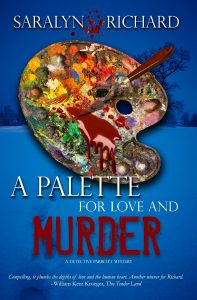
A Palette for Love and Murder. Saralyn Richard, author. This well-plotted mystery and crime novel, along with its excellent characterization, is even better than the author’s first, Murder in the One Percent, which is saying a lot (the latter won a prize). Shortly after I reviewed that first book, I asked the author about plans for a sequel. She promised one, I eagerly awaited it, and here it is—and it’s a winner too!

My readers probably know that stolen art (The Collector and Rembrandt’s Angel) and lost art (Son of Thunder) are among my favorite themes. Here the story starts when two pieces painted by Brandywine Valley artist, Blake Allmond, are stolen. Detective Parrott takes the case, and the game’s afoot. I felt right at home immediately. The author even mentions the stolen artworks from the Isabella Stewart Gardner Museum in Boston (they play an important role in The Collector). (We used to live in the Boston area and were shocked when we heard about that 1990 theft.)

Having read book #1, I also felt right at home with Detective Parrott from the West Brandywine PD. But another important character is now added to his life, his new wife Tonya, who suffers from PTSD due to her service in Afghanistan. She plays an important role in the story in addition to providing a bit of romance in her cop husband’s life.

Yet this is a murder mystery, so we need a murder victim. Allmond is murdered even before Parrott can interview him about the stolen paintings. This sets up a tense situation between NYPD and the local Brandywine police because the former are in charge of the murder investigation, the latter are in charge of investigating who stole the artworks, and, as you might expect, they step on each other’s toes due to the overlap of the cases.

Suspects start appearing: a ne’er-do-well nephew of the murdered artist; that artist’s live-in girlfriend, an ex-nun with a past; the nephew’s girlfriend and her brother, a landscaper at the artist’s estate; and the owner of an art gallery who was jilted by the artist’s sister. Which ones stole the paintings? Which ones murdered the artist? And how are they related? You now have a hoppy IPA for any lover of murder mysteries!

Parrott continues his expert sleuthing in a way that would make his old alter-ego Hercule Poirot proud. (Okay, the author doesn’t exactly mention that, but the analogy is sound.) Moreover, he’s my kind of guy! He likes his coffee “…delicious, strong and woodsy, and almost scalding…” (I’m not sure about the “woodsy”—I’m not partial to “chicory coffee,” for example, although I drank some in Orleans once just to try it). The author echoes several of my drinking preferences, in fact. The serving of Santa Margherita Pinot Grigio reminded me of a night in Boston’s North End where everyone in our four-member dining party drank a full bottle; the requisite visit to Mike’s Pastry followed (but we didn’t see Bill Clinton); and public transportation was used afterwards.

Readers, led along by Parrott, have to face lots of twists and turns as the two cases near resolution. Like many mysteries, there are some thriller elements in this story, probably more so than in the first book, which is more a classic Christie-like who-dun-it. Sexual relationships are a bit more complicated here too, to say the least, and are something Christie would never have written about. None of those are explicit, although some are implied in the paintings considered. Neither is the violence explicit, but the story is one for our times, and features the differences between one-percenters and the rest of us, as well as the similarities.

I put this book down with reluctance after reading most of it in one sitting, thereby forcing myself to take my time and savor the last few chapters in the next day’s reading. It’s that kind of book. You probably will feel the same way.

***

Comments are always welcome.

Just a note about availability: The above book is available in ebook and print format at Amazon and from the publisher, Black Opal Books; it will also be available real soon in all ebook formats at Smashwords, as well as all their affiliated retailers (iBooks, B&N, Kobo, etc.) and lending and library services (Scribd, Overdrive, Bakers & Taylor, Gardners, etc.); and it will be available at your local bookstores (if they don’t have it, ask them to order it). I read the Kindle version.

Around the world and to the stars! In libris libertas!


Is the book American Dirt controversial?

February 4th, 2020

I’ve taken a stand against the anti-cultural appropriation crowd in this blog before, but with the attacks on the new book American Dirt, it’s time to reaffirm that stand! This book is controversial, but only because its subject is immigration, which is hotly debated now in the US and around the world, mostly by far-right drum-beaters who want none of it.

The consequences of the anti-cultural appropriation crowd’s unfair and egregious attack on an author and publisher is just creating a meaningless distraction that plays into Trump’s hands. Their vitriol is having exactly the opposite effect of what they want: the book was #4 in sales on Amazon last time I checked! in spite of Oprah’s recommendation and defense of the book from another Hispanic author, threats on the author’s life (her publisher cancelled a book tour) only reaffirm how far they’re willing to go to stifle free expression. Now even Book Club Oprah is cowed by them.

Of course, the whole anti-cultural appropriation is a storm in a teacup, meaningless malarkey. First, Jeanine Cummins, the book’s author, has a Puerto Rican grandmother. While I prefer to call Puerto Ricans Americans, unlike some politicians (notably POTUS, who probably uses the s-word in private), reasonable people will say that Ms. Cummins has every right to tell stories related to her Hispanic-American heritage. The anti-cultural appropriation nuts dispute that.

Read the rest of this entry »