Vladimir Kalinin…

January 30th, 2020

[Note from Steve: Lots of spoiler alerts here. Of course, they just might pique your interest in some evergreen books. Proceed at your own risk.]

Vladimir Kalinin has a lot of staying power in my books. He makes his debut in The Midas Bomb, and his presence is felt through the rest of the “Detectives Chen and Castilblanco Series,” The Golden Years of Virginia Morgan, the “Clones and Mutants Series,” Soldiers of God, and several works of short fiction, including “The Phantom Harvester” (see the list of free downloadable PDFs on my “Free Stuff & Contests” web page). He might be all that other Vladimir wants to be—debonair, ageless, strong, and wily. But that other Vladimir has neither the brains nor a softer side; that other Vladimir is a psychotic sociopath in comparison.

Kalinin, like many of us, is a product of his upbringing. As a boy in the time of Yeltsin, he murdered an old soldier for an overcoat because he was cold. He was on his way to wealth and power in Russia when that other Vladimir and the oligarchs went after him and made him flee his home country. But he wasn’t to be denied. Through legal and illegal Machiavellian machinations, Kalinin becomes a force on the world stage who drives authorities crazy by creating mayhem, even among Putin and his oligarchs.

While his cloning business provides him longevity (Full Medical), it also was thwarted by several main characters. His plans to develop super-soldiers produces one who hates him (Evil Agenda). And his plans for world domination using a weapon derived from an ET artifact go boom (Soldiers of God)! There’s no lack of grandiose plans, and he’s got an able aide in an old IRA bomb-maker. Yet he doesn’t quite make things click…fortunately.

Kalinin fails once to assassinate a U.S. president (The Midas Bomb) and goes after a candidate who doesn’t want to play along with him (The Golden Years of Virginia Morgan), but he gets her later on when she becomes president. That doesn’t make any difference in the long run because ordinary citizens always seem to step up to foil his plans.

Like many villains, Kalinin is a lonely man. His aide and confidant is a constant in his life, but he can’t ever seem to have a meaningful relationship. He might have had one with the Russian terrorist in The Midas Bomb, but she is killed by Castilblanco. And he loses his protégé in No Amber Waves of Grain.

You can’t say Kalinin doesn’t try. And his revenge against the oligarchs is largely successful. It’s mostly carried out in the novels Gaia and the Goliaths and No Amber Waves of Grain. In general, his failures are because he doesn’t have good help; except for that close aide, they’re largely incompetent.

Kalinin is a complex character, good at times but mostly evil, with weaknesses that work against his brilliance. It was fun to watch him develop through many books. Sometimes villains are more interesting than main characters, for both readers and writers.

***

Comments are always welcome.

Angels Need Not Apply. Vladimir Kalinin is only in the background doing his scheming in this novel where a terrorist from The Midas Bomb and a cartel leader team up to create mayhem and murder. The cartel leader is a villain I created before I saw a picture of El Chapo, but it’s uncanny that they look similar except for my character’s Yosemite Sam mustache. I’d say my villain is more evil than El Chapo too, and that’s saying something! Available at Amazon in .mobi format and at Smashwords in all ebook formats as well as the latter’s affiliated retailers (iBooks, B&N, Kobo, etc.) and library and lending services (Overdrive, Baker & Taylor, Gardners, etc.).

Around the world and to the stars! In libris libertas!

Steve’s shorts: O Canada…

January 29th, 2020

[Note from Steve: A meaningful and romantic short story for our time…]

O Canada

Copyright 2020, Steven M. Moore

Frank Schultz finished reading the papers. He took a sip of his Earl Grey while he waited for his wife Evelyn to finish.

“Everything seems to be in order,” she said. “Are you ready to sign, Frank?”

He nodded. They smiled at their financial consultant.

“The proceeds from the house sale will be converted to an annuity. Together with your pensions and Social Security checks, you should have no problems.” After they signed, he said, “When are you leaving?”

“We already signed the lease for the Toronto apartment,” Frank said. “And we have our airline tickets. We don’t want to stay another day in this country.”

“I understand,” said the consultant.

***

Son Tim and his family made an appearance at the hotel that evening.

“No second thoughts?” he said, offering drinks to his mother and father.

“I gave it my best, son,” Frank said. “As a soldier in Iraq—never saw any WMDs. As a mayor and congressman fighting against pollution and fossil fuels—like ramming my head against a wall. And now Americans have gone completely insane and re-elected this guy. It’s not the same country. My grandparents came here after fleeing the Nazis. They knew it was time to get out of fascist Germany. I know it’s time to get out of here before the U.S. becomes completely fascist.”

“Nice speech, Dad, but we’re not Nazis.”

“No, but what’s happening now looks like 1930s’ Germany. Good people like you can’t stop it, and this man’s party and supporters might as well wear brown shirts. I’ll say it again: You should come with us. Get out while the getting’s good.”

“I have a good job here.”

“As a slave to a huge and indifferent corporation. And that’s what the workers at Bayer and Mercedes-Benz and other German companies said when Hitler came to power.”

“You’re sounding as extreme as the red-hat people.”

“Nope, I’m the voice of reason crying alone in a toxic wilderness created by fascists. But I know when I’m licked.”

Tim thought a moment. “Well, it’s not that long a drive. We’ll visit.”

“Maybe. He could build a wall there too. But thanks. It would be nice to see the grandchildren once and a while.”

***

Frank put the two heavier suitcases down in the hall and indicated the door.

“Welcome home, Evy. Sorry I can’t carry you across the threshold.”

His wife laughed. “Don’t be silly.” She went right in and put the carry-ons down. “I want to move some of this furniture around before the movers arrive. That will be enough exercise for our backs.”

Frank plopped into a chair instead—his new recliner. “I’ll be a lot happier here.”

She went in back of him and wrapped her arms around his neck.

“Me too. I always liked Canada. Now we get to live here.”

“Correction: Now we have to live here to maintain our sanity.” He looked up and to his side and smiled as he patted one hand. “Love you, kid.”

“Love you too.”

***

Comments are always welcome.

Want more short fiction? Visit my “Free Stuff & Contests” web page to see a list of free PDF downloads. You will also find in that list my free course “Writing Fiction.” Take a look at the contests too. You might want to enter.

Around the world and to the stars! In libris libertas!

My book marketing woes…

January 28th, 2020

I have many book marketing woes. Everything I try confirms two things: (1) Self- and traditionally published small press authors have a tough time getting their books noticed; in fact, most authors do, even Big Five authors, unless the authors are among the Big Five’s anointed. (2) For the rest of us, having a successful book (whatever that means these days) is like winning the lottery because of #1. It’s fortunate that I derive so much joy from storytelling that I can say, “To hell with marketing ideas and sales figures—just let me write!”

That’s all rather general and not uncommon for most authors with very few exceptions, famous and otherwise. However, some authors, especially newbies, think that all they have to do is rip off a novel and they’ll become rich (one measure of book success, I suppose). But I have some particular woes that are worth mentioning and should give those authors pause for thought.

In what comes after, authors now must do most of the marketing. By “after” I mean after publication and before the author passes on to write advertising for harps. The latter caveat is because death doesn’t do any author any good, literally or in her or his books’ successes. Those books might become wildly popular, as in Jane Austen’s case where twenty-first century fans of her schmaltzy nineteenth-century romance novels are all the rage among some readers. Believe me, old Jane, wherever she is, doesn’t give a rat’s ass, although whatever publisher owns rights to her books is tickled pink right now. We see many examples of nostalgia movements. All the creators of those works involved are probably asking, “Where the hell were the readers when I was alive?”

But I digress. Not only do most authors have to market their books after they’re published, they’re the only ones who will do so, and that costs money most of them don’t have. Maybe Grisham can afford to take off for a year on a nationwide tour (he did for his first book—he was already a rich lawyer—and he’s still doing them, but he doesn’t pay for them anymore), but most authors cannot do that. And, assuming an author is traditionally published, the publisher will rarely pay for any kind of book marketing, let alone nationwide or international tours. For self-published authors, they’re on their own a priori.

Marketing help just focuses on one book. I have yet to see one publicist who will help authors promote their entire oeuvre (maybe Jane if she were still alive, or Grisham himself in his later tours?). Many genre fiction books are evergreen—they’re as fresh and current as the day they were written. Okay, maybe historical fiction can’t be called current, but its themes often are, and they usually interpolate between real historical events in a clever way. I suppose authors with just one book are okay with that, but ones with more than one book shouldn’t be.

Read the rest of this entry »

Movie Reviews #83…

January 24th, 2020

Knives Out. Rian Johnson, dir. (He’s also the screenwriter.) Readers of mystery and crime stories will love this! At times lampooning the genre in general and Dame Agatha’s mystery novels in particular (or is this honoring Christie?), it’s deadly serious too—emphasis on “deadly.”

It follows trailblazer Christie’s standard formula—indeed, the standard formula for most mysteries, even today. A murder is committed, but is it a suicide or a homicide? Local cops think it’s the former. Old man Harlan’s nurse Marta (played by Ana de Armas) thinks she did it. The plot device that she cannot tell a lie without upchucking is used effectively throughout the movie. And PI Benoit Blanc (played by Daniel Craig—work on that southern accent, James Bond) has to gather the clues and make sense out of them. (Note: Ana de Armas will appear with Craig in the new Bond movie.)

Suspects are introduced. They’re all the old man’s family (he’s played by Christopher Plummer), except for the nurse and the housekeeper. Gaps are filled in with flashbacks so the viewer can see more clues, giving the story a more modern veneer. The family is rather dysfunctional too. I thought the masturbating white-supremacist kid was a comical touch (you’d never find that in a Christie novel!); he provided some damning evidence as did other family members. That and the fact that Marta’s mother is an illegal immigrant plop this tale about one-percenters and old wealth right into modern times. To bring mystery-loving writers on board (as if the above isn’t enough), Harlan is a famous old writer of mysteries (that could be real life) who’s filthy rich (that’s mostly fiction—few writers are rich, let alone filthy rich), so the family has a lot to fight over after he dies. Kudos to the screenwriter.

The cast is superb; their acting and the plot hold your interest all the way through. But details are important here. Look for them. Readers of mystery books are good at that, but the visuals might be a bit distracting to amateur sleuths here, unlike in a book. I think I’ll see the movie again on cable if it ever appears there (I don’t use Netflix or any other streaming video service—I’d rather use that money to buy more books to read, or enjoy the big-screen experience). I felt right at home with the Wellesley, MA settings, a different mansion used for inside and outside filming. Lots of old wealth up there in that liberal bastion (why “liberal” doesn’t mean “progressive,” at least not in New England—just consider Ted’s NIMBY attitude toward windmills in Nantucket Bay, to speak ill of the dead, which is appropriate in a mystery sometimes).

Only one complaint (besides Craig’s corn-pone accent), and it’s a big one: The director obviously admires the mystery genre. You’d think with all the good mystery stories out there (one fairly recent one has a similar plot—see below), he’d make his life simple by choosing one of those. Coming up with those twists and turns can’t be easy, but all mystery writers have to have those skills. Do screenwriters think they’re the only ones who can write?

However, if you ever wanted to see a great mystery on the silver screen, even though it might be like one you’ve read before, this is a prime candidate. It’s gotten great reviews. Unfortunately, as in the book business, that doesn’t seem to mean a damn thing anymore.

***

Comments are always welcome.

Murder in the One Percent. Shall we tally this in the account of “great minds think alike”? As I was watching the above late 2019 movie, I noted the similarity of the movie’s screenplay with this book that I previously read and reviewed (July 12, 2018; it was published in early 2018 and has won awards since then). In fact, Saralyn Richard’s mystery tale could have been the script for the above movie! Her story also starts with a murder at a birthday party and the suspense builds from there as her Detective Parrott takes on the role of Hercule Poirot. You’ll also find that her story is similar to and better than the movie with its many twists and turns, and going along with the first post this week, she hits the themes of wealth inequality and race a bit more skillfully (Marta is Hispanic; Parrott is black…and Knives Out has only one black actor in its cast). Best of all, Murder in the One Percent is a book, so I could hit the rewind button and pick up those clues I missed. A sequel is now available.

This is one of many great books from the great authors at Black Opal Books, including mysteries. Available in ebook and print format on Amazon or at the publisher, and in ebook format at Smashwords and all the latter’s affiliated retailers (iBooks, B&N, Kobo, etc.) and lending and library services (Scribd, Overdrive, Baker & Taylor, Gardners, etc.).

Around the world and to the stars! In libris libertas!

Lack of resolution…

January 23rd, 2020

The twists and turns in a mystery story often delight readers of that genre. I like to include surprises at the beginning as well as the end too. The one at the beginning of Teeter-Totter between Lust and Murder is one of my favorite beginnings, while the shocker at the end is too, a denouement that Christie might have enjoyed if she were writing today. Because thrillers are close cousins to mysteries, the surprises abound in them too—the closet scene in Aristocrats and Assassins was a lot of fun to write.

But are you ever let down when the twist not only surprises but fails to resolve things? Or resolves them in a way that shows the crime wasn’t all that bad after all? The author has led you to believe something insidious is going on, but it’s not? I prefer just the opposite in both my reading and writing. If anything, I want the PI or detective to uncover something more insidious, not less. And I prefer it to be something that could be prejudicial for a lot of people—many potential victims who were saved by the principal character’s actions.

Serial killers just aren’t that interesting to me as characters in my writing for that reason. No major novel of mine contains that kind of character. The key word is “serial.” That means the crimes occur in linear fashion. Sure, the perp can speed things up as he becomes more arrogant and taunts the police. Those plots make me say, “Hmm, they’re going to have to stop him before he strikes again.” Too predictable. By the way, the serial killer is usually male, so casting a female in that role could represent an interesting novelty. It might be fun to guess who the killer is too—some surprises can be created in that way—but in general plots with serial killers are overdone. Yet, if the author ends the book with the capture and conviction of the supposed killer but includes another killing with the same MO, setting the stage for another boo, this creates a total lack of resolution and deceives the reader, a type of cliffhanger that leaves me frustrated.

I can summarize my points in the following way: I have a lot of fun when an author moves from small crimes to bigger ones and the big ones are solved almost by accident. That shows the main characters, the PIs or detectives, are human and didn’t realize what they were up against. Real life is like that.

I can even summarize more succinctly and even amplify: I love complexity. When something small unexpectedly becomes big, that’s complexity. When things become nonlinear or oscillatory—the plot goes back and forth and up and down—that’s complexity. Often a local crime has national and international ramifications, and a team of characters have to rise to the occasion and halt what’s going on. And it all has to be resolved in the end, or I feel swindled.

I admit this might be rare in current mystery or crime novels, more than the simple sequence of A = a crime occurs and B = the perpetrators are caught must be present to catch my interest…and B can’t be a swindle. That simple sequence might be appropriate for a short story, but novels need more meat to them for me to be all in.

These are observations I’ve made over a lifetime of reading mystery and crime stories. They’re my preferences, not rules written in stone. And what some readers take as too complex is what others take as too simple. That’s what’s wonderful about reading: every reader can react differently to a story.

***

Comments are always welcome!

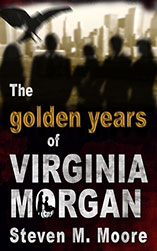
The Golden Years of Virginia Morgan. Plenty of resolution in this bridge book between my “Detectives Chen and Castilblanco Series” and the “Clones and Mutants Trilogy” that’s full of important themes—retirement (what will U.S. government agencies do in the future with agents who know too much?), autumnal romance (can people over fifty find love?), and shadowy conspiracies (are they the government’s or some other actors’?). The action and suspense start on page one and don’t stop. Available in ebook format on Amazon and Smashwords and all the latter’s affiliated retailers (iBooks, B&N, Kobo, etc.) and lending and library services (Scribd, Overdrive, Baker & Taylor, Gardners, etc.).

Around the world and to the stars! In libris libertas!


Steve’s shorts: The Music Woman, Part Two…

January 22nd, 2020

[Although The Music Man musical features a male character who’s basically a shyster, have you ever wondered why Broadway never had a music woman? Maybe Funny Girl, Mame, and Hello Dolly come close—the latter two from Jerry Herman, who just passed on—but Detective Castilblanco knows a music woman…]

The Music Woman

Copyright 2020, Steven M. Moore

Frank Dobson was interested in the disappearance and possible death of Nick Bellini and just about everything else we’d talked over with Sulli.

“He’s a bit scatter-brained, I’d say,” Dobson said. “Is that just due to the kidnapping, or is he always that way?”

“Not exactly the clearest thinker on the planet,” I said. “His one redeeming quality is that he loves Big Fogg. In his own way, of course. Wouldn’t know how to exist without her, I imagine. She maintains their financial stability and keeps him from sinking into the morass of his stupid conspiracy theories. But I can understand why snitches are paranoid.”
“We’ve got nothing on tracing the owners of those SUVs. They could be mob vehicles. They like big, fast cars too, just like we do. Good reasons for that.” Dobson thought a moment. “I’d like to make sure Bellini is dead, though.”

“The father or the son?”

“The father. The Surgeon’s rep is current knowledge. We know he’s alive; DEA was just checking him out. He has a large FBI case file, but we don’t have enough on him to bring him in—never have. By we, I mean the anti-mob fellows, of course. I’m just on a kidnapping case, which we know is really a kidnapping now. Where do we go from here?”

“Find out where Giancarlo is and question him, I guess. Let’s start with that DEA intel.”
“Intel? You ex-military. I am too. Marines.”

“Navy. Long ago.”

***

Big looked at the dinner the huge oaf placed before her. “I’m vegan, you fool.”

The big man shrugged. “So don’t eat. Not my problem. It’s slop anyway. All our five-star chefs are busy elsewhere.”

He laughed at his own joke. Big didn’t smile.

“I’ll eat the bread. Get me some green tea.”

“Green pee, did you say?” The man laughed again. “I’ll ask Giancarlo if he needs to wee-wee, ma’am.”

The thug turned and left the room.

“She ain’t going to eat it,” the thug told Giancarlo. “Just the bread. Asked for some green tea.”
Giancarlo laughed. “Tough old bird, isn’t she? She can play a mean fiddle, though. Ever heard her play?”

“Couple of times. I think the bass is the most important part of an ensemble. Keeps everything together.”

Giancarlo nodded, thinking that his father’s men—his men now—often surprised him. They might be thuggish assassins, but some had some culture. He remembered his mother’s frantic call….

“That night after you came to see me play, you gave me this number in case I ever needed help. I think some toughies are after me because I refused to deal drugs for them. I’m off to a gig and called an Uber. I’m too scared to take the subway. I might need that help you offered.”

Thus began a hellish night and early morning where he’d saved his mother from the clutches of the gang right in front of the nightspot where she was going to play. She’d let the group down, but she felt worse about what had happened to the Uber driver. Nice guy. Fate wasn’t there for him.
He stared at the door to her room. He hardly knew his mother. She knew why she was in there; he’d told her. But he knew she was getting stir crazy. Rightly so. Like many New Yorkers, she needed to be prowling the city, which she did mostly at night because of her gigs. Unbeknownst to her, he’d gone to a few before he had enough courage to introduce himself. A mobster afraid of meeting his mother? He smiled at the thought.

He had to admit he felt little affection for her. His father had tried to teach him to hate her, but he didn’t see any reason to do that. Theirs was just another relationship that hadn’t worked out. He’d had a few himself. She seemed to have a good one with that slob Sulli, though. Sometimes strange relationships are solid ones.

He figured his father was as much to blame as she was. They’d both been too young. He remembered the court hearings, the angry words, the bad emotions. She had been better off without his father. But was I better off without my mother? Life often puts you in situations where you have few choices for your future.

“Get her some green tea,” he ordered.

***

I knew Chen hated to do it, so I gave her company. They knew her at Grasso’s mansion. Giulio, the old man, had possessed a few redeeming qualities, but the son Tony was uncouth and probably a lot more evil. We’d never nailed him for anything, and Dobson had said the Feds were unsuccessful too. After taking many losses and with competition from gangs, the mobs were hunkering down and staying under the authorities’ radars.
Some knuckle-dragging muscleman showed us into the library we knew so well. Never knew if the father had read any of those leather-bound first editions or only saw them as an investment, but I was sure the son hadn’t read any. I tried to remember where the CCTV camera was. Didn’t matter. We were there for information. Who cared if they filmed it.

“My dear Detective Chen,” Tony Grasso said, offering a hand to Chen. She ignored it. He turned to me.

“And Detective Castilblanco. It’s always a pleasure.”

He pulled a leather chair away from the front of his desk, spun it around, and plopped down to face us. We were on a two-person leather sofa facing the desk. Nice and cozy.

“What can I do for you representatives of New York’s finest today?”

“Giancarlo Bellini. We need to speak to him. Do you know where he is?”

“Giancarlo is a busy fellow. He doesn’t have too much time for social chitchat. What do you think he’s done?”

Not “What has he done?” but “What do you think he’s done?” Grasso protected his mob lieutenants as long as they served him well. The form of the question already implied innocence. Any detective could see right through that. He could be a DC spin doctor, though.

“Do you have the video ready?” I said to Chen.

She set up her phone and handed it to Grasso. “Hit the little arrow.”

“I’m familiar with technology, my dear.” He watched the video. He smiled at us when he finished. “Crime is down in the Big Apple, you know, so it pains me to see such a violent encounter. But what do you two think I’m watching here?”

“There are two possibilities,” I said. “One: Elizabeth Ellen Fogg AKA Big Fogg AKA Big is being kidnapped by gang members. Or Two: Your people are kidnapping her to protect her. I’m inclined to vote for the second interpretation because the Uber driver had also been asked to sell drugs for the gang, and he’s dead.”

Grasso nodded and thought a moment. “I suppose you realize that people in my business have no use for these street gangs who, shall we say, represent non-traditional johnnies-come-lately without a shred of human decency? They’re a danger to the status quo.”

I shrugged. “I don’t need a sociological analysis of modern crime trends, especially from you, Tony. Just answer the question: Did Giancarlo kidnap his mother?”

“His mother?” Grasso looked surprised. “Big is his mother? He likes opera just like his father did, not jazz. All this surprises me.” He examined his fingernails that were professionally manicured to perfection as far as I could tell. “If all you say is true, he’d kidnap her to protect her if a violent street gang was threatening her. That’s my take.”

I’d pass that “just like his father did” on to Frank Dobson. Papa Bellini was dead indeed.
“Agreed,” said Chen. “But the gang could find them. We’d rather have Big under our own protection. I’m sure Sulli would also prefer that.”

“Ah, yes, Reggie Sullivan. He’s useful when he has information for us, dangerous when it’s for the NYPD or the Feds. That lecherous leprechaun leads a charmed life.” Grasso thought a moment. “As I said, Giancarlo is a busy fellow, so I’m not sure what he’s up to or where he is.” He took a business card from his suit pocket and wrote on the back. “Here are two addresses. He’s made a bit of a home away from home for himself in an old warehouse in East New York, one of the properties Amazon was going to buy. I would first check his flat on the East Side and then there.”

Grasso handed Chen the card after he used the chair arms to push his considerable bulk up. I’d known him since he was a skinny teen who could still get into a Ferrari. Too many cannolis, I guessed.

“Good luck, detectives. You might need it. These gangs are violent. Of course, I wouldn’t mind if you manage to eliminate a few gang members when you go after them. Every little bit helps. All for the greater good.”

We watched him leave the library.

“The old man would have at least offered us a drink,” said Chen.

“As much as he touts the good ole times, he’s much more of an uncouth thug than his father. And much more arrogant. His organization isn’t that much different from a street gang now.”

***

Two scantily clad women lolling around in Giancarlo’s flat informed us that he was at the warehouse. I called Frank Dobson.

The FBI insisted on using their SWAT. Thought they might not trust NYPD’s. I didn’t know how many the New York office had, but figured the Feds could afford it, and it was mostly their kidnapping case.  I guessed Dobson would justify the expense that way.

They had the presence of mind to park the van labeled “F.B.I. S.W.A.T.” a few blocks away from the warehouse. I also liked that they would be the first ones to enter the old building. Chen and I had our vests on, but they were the pros, after all. Probably had better vests too.

“Looks quiet,” Dobson whispered to me.

We were standing behind an SUV very similar to the one in the video. Ford instead of Chevy. Still a black, gas-guzzling behemoth. NYPD now had many hybrids, from little squad cars to bigger vehicles. FBI just had SUVs. Probably didn’t need all that space like ICE that had to haul whole immigrant families away for deportation. Thanks to Buddha, NYC was a sanctuary city.

“We need to scout out the firepower inside,” I said.

“Maybe there’s not much if we have this right. If Giancarlo’s just trying to protect his mother from that gang, he might only have a few trusted men with him.”

“They’re the mob, Frank,” said Chen. “They could get trigger happy even if their intentions are good.”

He nodded and gestured toward one SWAT member. “Henry, go take a peek and see what we’re dealing with.”

Henry went to do Dobson’s bidding, peered through several dirty warehouse windows, and then returned.

“Four perps, one younger. Maybe the Surgeon?”

I nodded. “No woman?”

“None in sight. Just the four men.”

“Then we have overkill,” said Dobson. “We can split up, covering front and rear.”
“Shoot only when threatened,” said Chen. “Not telling where Big is.”

But no shots were fired. When the three of us entered the warehouse from the front, the SWAT fellows had the four men covered. Their guns sat on the table.

Read the rest of this entry »
Themes revisited…

January 21st, 2020

Stephen King puts plot above themes in On Writing. As a reader and writer, I disagree. My themes drive my plots, and I look for that in my reading. In my little course “Writing Fiction” (free PDF download—see the web page “Free Stuff & Contests” at this website for a complete list, including free short fiction) and elsewhere, I mention themes v. plot. Themes should wind in and around the plot to make the latter more meaningful. A book without a plot rarely interests me when reading genre fiction. A book without a theme might be palatable if it has a great plot, but having no theme is already one strike against it. A book with interesting themes and a good plot is really worthwhile reading.

Stephen King’s books often suffer from lack of themes; that’s why Misery is so much better than Carrie, to name two of his books I’ve read (the third, that verbose cellphone disaster, was a complete waste of my time). Yeah, I know, that lack of themes helps him appeal to a broad range of readers, almost as much as his established branding (name recognition). Gets him some movie deals too. Nothing controversial about his stories, just horror without themes.

Many readers don’t like to think about the important issues of the day that often correspond to themes. In their defense, they might be in overload with those issues, with social media and news services blasting them out every hour of every day. Reading might be their only escape, their reclusive avoidance mechanism or ostrich-head-in-the-sand syndrome. These readers might also avoid social media and news services completely for the same reason, or focus exclusively on just one news service that agrees with their narrow views about the world.

That’s a reader’s choice, of course. It’s still a free country (although how long that will continue is debatable as more and more people avoid the issues of the day). Literature traditionally has dealt with serious themes, and an enlightened reader can learn from books. Especially genre fiction, where learning about issues is woven into an entertaining story. I write for readers like that—let’s call it meaningful entertainment.

But readers can do what they want. My problem lies more with authors who write Cream-of-Wheat stories for the masses and avoid themes completely. (Screenwriters often do the same thing!) There are degrees of that: King isn’t as bad as Nicholas Sparks. Reading and literacy only make sense if fiction serves to comment and/or educate as well as entertain.

Read the rest of this entry »

Martin Luther King Day…

January 20th, 2020

Martin Luther King Jr.’s legacy lives on and has become more important in these days of strife in the U.S. Let’s all work to achieve the fair society he envisioned where everyone has equal opportunity to rise to their potential and improve their skills in a society free of poverty, hatred, and bigotry. He had that dream; let’s make it reality!

“Last chance to buy…”

January 16th, 2020

From cars and condo developments to kids’ toys, consumers are often told it’s their “last chance to buy.” It’s a bit of threatening marketing that appeals to those who want to own something no one else can have in the future, or whatever audiences the marketing mavens are targeting with such slogans.

It’s often BS. Think about it: If that marketing campaign is successful, why wouldn’t they continue to sell the product? Twenty years ago we saw a Blue Man performance in Boston that was supposed to be their last one, but a few days ago I just saw an ad for a Blue Man performance. They’ve been going strong for twenty-plus years! (Like old rock groups and the cast of Hamilton, the Blue Men are probably no longer the original performers, of course.)

Ads and advertisers lie all the time—it’s not just the sign of the times; it’s in their DNA. The sign of the times is clear, from where an actor lies about a mugging and a noose to get publicity (I bet the KKK loved that!) to a president whose lies number in the thousands or one huge whopper from one: “I did not have sex with that woman!” (hmm, that was more than twenty years ago, come to think of it). Advertising and marketing mavens have a lot in common with politicians, I guess—if it’s the DNA, maybe it goes all the way back to Neanderthals breeding with Cro-Magnons?

One can write this off as morality waning around the world—religious groups lie all the time too, or support people who do! I wonder what chimpanzee tribes use to go to war with nearby tribes. They weren’t in the Garden with Eve and Adam and the snake, the precursor of snake oil salesmen, so they weren’t tainted by that original sin, lying.

But I digress. Lying is a reflection on human societies and particular groups in general and how inured we’ve become to people doing it through the ages. How it became part of business—advertising, in particular—is a phenomenon that sociologists probably can’t explain even if they tried. Oh, they might throw down a few ivory-tower theories—ask four sociologists why advertisers tend to lie and you’ll get four different answers, or five, if one expert is from Harvard (asking sociologists at least puts some science into it, although many schools have separate business and media schools).

In the book business, there are more liars out there who aren’t advertisers. (Don’t get me wrong. You can find good, honest marketing help. But you can also find many more marketing mavens who aren’t so good and are ready to steal your money.) Books and book publishers and retailers can also lie. As you browse through Amazon’s lists or bookstores’ shelves, you’re likely to see famous authors’ endorsements and statements like “If you liked Reacher, you’ll like X,” all misleading or lying to potential buyers. You’ll also see titles listed with descriptions beside the titles that are variations on the following: “X is a great, dark mystery with a lot of surprising twists”; or worse: “X is the best mystery you’ll ever read!” Add a bit more verbose BS and you’ll have a book blurb.

Is this false book advertising or just ad-speak? And is it a consequence of the prevalence of lying in our culture? Maybe like other lies and deceit, readers have become inured to these marketing lies. I can imagine readers and authors complaining about my calling them lies, so call it hype if you want. That marketing word takes some of the moral sting out, I guess. I could also call it BS. In any case, I ignore most of it in my book buying…or purchasing anything else, for that matter.

In a previous article, I discussed book critics. If anything, they lie by omission, unless there’s a critic around who reads every new book published. Most of them are just out to please Big Five publishers, so anything they write about a book is to be taken with a grain of salt. Publishers tell them to jump, and they jump. That’s a general phenomenon across all the arts now.

But back to those marketing mavens. Authors seek their services, so the mavens sell that more than they sell the books with those services, which are generally lame anyway. And unlike lawyers, some of which do pro bono work, marketing mavens want their money up front and will make special offers of packages with “last chance to buy” their special book promotion AKA spam packages of a hundred thousand tweets. They will also make promises something like “Turn your book into a bestseller.” The first is a lie; they keep offering those packages. The last is a lie too because it implies they have the silver bullet—they don’t because no one does. Forget about it! If you fall victim to one of these scams, I’m sorry. Watch out for those robocalls!

What can we do about lying in general or lying in advertising? Not much. It’s part of the culture now. Liars must think lying works for them, so maybe what we have to do is to prove them wrong by not believing their lies. That X-Files mantra applies: Trust no one. Or, at least, use this mantra: Trust but verify. You can usually uncover the underlying BS.

***

Comments are always welcome.

“Writing Fiction.” Authors often have to do their own marketing, whether self- or traditionally published. They can do a lot of DIY and ignore the marketing mavens. Mark Coker, CEO of Smashwords, and Penny Sansevieri, CEO of AME, have many tips for doing that in their books–they’re often free (don’t spend your good money on marketing books). I also have a few tips in my short course “Writing Fiction,” which has a section on book marketing. That’s always free. It, and many other PDFs, including short fiction, can be downloaded for free. For a list, see the “Free Stuff & Contests” web page at this website.

Around the world and to the stars! In libris libertas!

Steve’s shorts” The Music Woman, Part One…

January 15th, 2020

[Although The Music Man musical features a male character who’s basically a shyster, have you ever wondered why Broadway never had a music woman? Maybe Funny Girl, Mame, and Hello Dolly come close—the latter from Jerry Herman, who just passed on—but Detective Castilblanco knows a music woman…]

The Music Woman

Copyright 2020, Steven M. Moore

I’d just put Ceci and Pedrito to bed after reading to them a bit from Tom Sawyer when Sulli called.

“Help me, Rollie! I need help! They kidnapped Lizzy.”

I thought a moment, but then remembered. Reginald “Reggie” Sullivan calls his significant other Lizzy, although everyone else calls her Big Fogg or simply Big. Her birth name is Elizabeth Ellen Fogg. Nickname’s a joke perpetrated by her fans. She’s just under five-feet tall and has the body of a twelve-year-old. She has streaks of gray in her hair, though, and can slap a bass fiddle around with the best of them.

Although many would call him a snitch, I usually tried to be nice to Sulli and call him an informant. I’d known both Big and him for a while. Even had them over to the house once for dinner, and I’ve sat in on a few of her gigs…pleasure, not for work.

I felt closer to Big and not just for her musical gift. She was friendlier than Sulli and kept their little family afloat. What Sulli took in from informing didn’t amount to much, and he’d usually spend it on food and drink. Big was the stable breadwinner in that relationship. Personally, I’d have tossed the guy out—don’t look for logic in relationships. Just consider my wife Pam and me.

I looked at my watch. Time for bed, Mr. C. I could imagine Sulli holding his smart phone. His pajamas were always a la mode—striped boxers and a sleeveless muscle shirt maybe leftover from his childhood, it was so short.  His enormous beer belly would be hanging over the waistband, a three-day shadow on his face, and indecipherable stains on both sleeping garments I never wanted to think about.

“Isn’t she off to a gig?”

“That’s just it! The manager of the night club called and said she never arrived. The rest of the group have no idea where she is.”

I wondered if someone was using Big to get to Sulli. I’d always been afraid someone would take him out. Wouldn’t recommend him to a life insurance company, that’s for sure. The bad guys don’t like snitches. Hell, we cops can hardly tolerate them. He didn’t pal around with the bad guys, but he kept his eyes and ears open, so someone was bound to figure things out.

I was able to calm him down enough to elaborate on what he knew. Where’s the gig? What group was she playing with? Who’s the manager of the club? And so forth. He had some answers. I’d have to get the others on my own.

Big had left their apartment with her instrument. Sulli said he blew her a kiss from their second-story window when she got into the Uber. Uniforms had found that vehicle in the Bronx, the driver dead and turned into a cyclops. The murder weapon, wiped clean, was tossed onto the passenger seat. Big’s bass was still in the back seat. Yep, looked like a violent kidnapping and a pro job, but why?

The dead driver made it a homicide, but it was out of my precinct’s jurisdiction. I contacted the detective in charge of the case.

“In twenty-four, we’ll turn it over to the FBI for the kidnapping. We’ll then be focusing on the murder case.”

“It’s obvious they’re connected. Can’t you keep the feebies out of it?” I’d had some run-arounds with FBI agents in the past. Thought they mostly got in the way. And it was hard to argue that they should be involved. No state lines had been crossed as far as I knew, although that never stopped them before. And they did have more experience with kidnapping cases, if that’s what this was. Moreover, they were cops just like us, but their precinct was a bit larger and covered 300+ million people. Never wanted to be an agent.

“I know Sulli. Can’t trust him. And he often tends to get excited, not to mention being a conspiracy theorist. Perfect for the FBI, Rollie.”

“I know Sulli too. Didn’t think this sounded like his usual paranoia, though. Even with all his faults, he loves Big.” I thought a moment. “Who’s the FBI agent you’re going to finger?”

“Who knows? Someone in the New York office.”

He hung up. And people think authorities work together! Knew this detective too. He was a dickhead who barely tolerated any minorities. As a Puerto Rican, I was as much an American as he was—I’d even been born in Manhattan. He needed to go police somewhere without any diversity.

***

By the time I knew who the agent would be the next day, I’d confirmed most of Sulli’s version of the facts, talked to the nightclub owners and the manager, and interviewed the members of the jazz group. It was more convenient to meet the agent in a deli where I could get an early lunch.

I’m a big guy, but Frank Dobson was huge—NFL-nose-tackle big. Crushed my hand in a handshake affably, flashing a smile that showed perfect white teeth and a great personality. Knee-jerk reaction: I liked this guy.

“Heard a lot about you from other agents, Detective Castilblanco.”

“Call me Rollie. Good things or bad?”

“Generally good from the troops in the trenches, and I don’t much care what the boss-men think. They’re the reason we take flak, after all. You didn’t hear that last from me.”

I smiled. “Hear what?” Plopped into my chair. “Want to order something?” He shook his head for food but wanted coffee. “Well, down to business. I’ll tell you what I got so far. You tell me what you got.”

“My part’s easy. Zilch. Nil. Nada. We just started. And I can’t figure out what the motive might be.”

“Maybe to get to Sulli.” I had to explain the role he played in my life since I’d inherited him from another FBI agent, one who became Chen’s boyfriend but committed suicide, never recovering from his kid’s murder. “Otherwise, I’m in the same boat. Some facts, but no real leads.”

He thought a moment after I finished my spiel. Good thing, too. My pastrami on rye had arrived along with his coffee. I checked for my spicy mustard. Barely adequate. Might not need my Tums. “Your theory is as good as any. Did he piss someone off recently?”

“You mean, besides Big or me? Who knows? Probably not any more than normal, if his lifestyle can be called normal. Sulli’s a weasel, like I said. A big slob who tries to keep both sides happy and profit from them both as well. He has some moral underpinning, but that won’t get in his way if he can sell info to lowlifes about other lowlifes, or even bad cops.”

“How much have you used him?”

“Off and on. So have other cops. To continue the metaphor of questionable animals in the zoo, he’s also a sly fox. Info is money to him, but he won’t give you the time of day if he thinks his nuts are in danger.”

“Could he have pissed off one of those lowlifes without realizing it?”

“Being an informant doesn’t come with good health insurance, or life insurance, for that matter.”

“And his woman knew he was a snitch?”

“Never asked her. I don’t like to get mixed up in other people’s relationships.”

“So…how do you want to proceed?”

He eyed me over his mug’s brim as I took another huge bite. Chewed slowly and thought. What a difference! Sometimes the feds came into a case like a stampede of water buffaloes. Repeat: I liked this guy!

“Don’t expect anything from that other detective,” I said. “He’s letting you do the hard work about the kidnapping. The kidnappers are his killers, so easy-peasy, his case will be solved when we find them. How much do you know about the Big Apple?”

“New in the office this year. I’m fresh out of Quantico. Before that, I was a cop in the Big Easy.”

“Then I’ll be your eyes and ears on the street. Sulli’s too emotionally involved to help out there. Let’s both do our thing, although I’ll have to work the case on the sly. We’ll trade phone numbers and keep in contact. Work for you?”

“Sounds like a plan.” He pointed to the crumbs on my plate. “Are you doing lunch after that?”

“Probably not. I asked if you wanted something.”

“I’m on a diet. Watch the waistline, detective. Your days as a lean and mean SEAL are long gone.”

I watched him walk out of the deli. The SOB had researched me! Guessed he liked what he saw, except for my waistline.

***

I had to fit Big’s kidnapping into my regular caseload. Frank Dobson and his FBI minions discovered one clue. Two black SUVs could be seen on a CCTV video made across the street from the club by a CCTV security camera. They blocked the Uber car’s front and rear. Two thugs sporting ski masks jumped out and attacked. Big was thrown into the SUV in the rear, and both sped away.

“Good work. I haven’t had any help from the uniforms, so I couldn’t check for videos.”

“Probably why they had ski masks on. The plates were stolen, by the way.”

I nodded. A pro job. What was Big into? Or, why did someone have so much against her that they would organize such an op?

“Either mob or a government agency,” I said to Frank. “What do you think?”

Read the rest of this entry »