ABC Shorts: Alpha-Omega-1…

April 11th, 2018

Alpha-Omega-1

Copyright 2018, A. B. Carolan

[Note from Steve: Have you read Asimov’s Second Foundation? I think A. B. was inspired by it to write this short short story. Or is it a sort of inverse “Flowers for Algernon”? After you finish, see if you agree with either perception.]

Omega-1191 stared at the image. “It’s so small,” she said. “Was I once that small?”

Epsilon-9349 laughed. “We all were. All clones start out as one cell. You, I, everyone. Alpha-Omega-1 is exceptional, though, because I’ve convinced you to go natural—conception with a sperm and an egg. I can’t tell you which Alpha provided the sperm, of course.”

“We’re not violating any laws, are we?”

“None that anyone cares about anymore here on our planet. The Colonization Protocol was a set of rules enacted centuries ago to speed up a colonial planet’s population growth. Moreover, it was created on Earth, and Earth is no more, so why worry?” And a bit late to do so, she thought.

“It does seem right, doesn’t it?” said Omega-1191. “You’ll check that there are no genetic defects?”

“Just as we do with standard cloning. Mutations are possible in either case, especially here. Our planet receives a higher cosmic ray bombardment than Earth and also has a weaker magnetic field, diminishing protection from the solar wind.”

“Can I watch it grow?”

“Why don’t you visit us every two weeks? It’s an interesting process.”

***

Alpha-Omega-1 was born 271 standard days later. In three standard years, Omega-1191 watched him grow, and everyone noted he was an exceptional child. He was fascinated with numbers, factoring them into primes and constructing exotic numerical sequences to amuse himself. He also started creating elaborate holographic art forms and complicated but wonderful musical compositions.

“There are mutations,” said the doctors. “We have to watch them and make sure they’re viable.”

At five, Omega-1191 first felt Alpha-Omega-1 within her mind, his feelings of love for her. He could fetch things for her simply by thinking about doing it.

The doctors were worried. She heard talk about euthanizing her son because they considered him a human aberration—not only abnormal but also a mutant. He read their thoughts and later told her they wanted to do that because they were scared.

When Alpha-Omega-1 told his mother they were coming for him, she fled to the mountains with her son.

***

At twelve, Alpha-Omega-1 left his mother in the mountains.

“Where will you go?” she had asked him.

By that time her son didn’t walk or run anymore like normal children. He’d figured out anti-gravity and exhibited many other strange skills.

“I’ve been reading history, mother,” he’d told her. “I’ve decided to emulate Alexander the Great. He did it all wrong, though. I’m leaving to conquer the galaxy, and I’ll do it right.”

***

The Midas Bomb and Full Medical are now on sale at Smashwords—first books offered in the “Great Spring Thaw Sale.”

In libris libertas!

Goodreads, LinkedIn, and all that…

April 10th, 2018

[This article is the second in a series about social media use by authors. Feel free to comment.]

Let’s see: I’ve disparaged Twitter—it’s mostly useless, for authors directly participating at least (your publicist might use it, though); and I’ve given my advice to use Facebook in a limited sense (you could limit it to just an author page—if they start charging, forget about it). What’s left?

Goodreads. This massive website for discussing books and reading used to be a lot better, but it’s gone downhill since Amazon took it over. It’s never been user friendly and allows cliques to develop without any adult supervision.  Anyone can form a group, and some of them are huge.  Groups are run by a monitor (maybe more than one for large ones), and submonitors often control subsections of groups. Rarely you’ll come across monitors or submonitors who are snarky individuals, little despots who like to flaunt their power.

Authors should promote their books in the sections allocated to them, of course, but the definition of promotion is often distorted by monitors. I was censored in one chat thread about sex and romance in books just for mentioning my opinion as both reader and author—no mention of my books, so not really promotional at all.

Groups can be political too. I was kicked out of a discussion group for expressing an opinion contrary to the monitor’s (I can’t even remember what the thread was about, or what pissed him off—a mountain out of a molehill, to be sure, but the little tyrant booted me out without any explanation).  You never know when someone will get their hackles up and go after you. Back away from such people. They’re not worth your time.

Read the rest of this entry »

News and Notices from the Writing Trenches #157…

April 5th, 2018

Review of Leonardo Da Vinci. Last time I promised a review of Isaacson’s magnificent book. You’ll find it here:

http://www.bookpleasures.com/websitepublisher/articles/8630/1/Leonardo-Da-Vinci-Reviewed-By-Steve-Moore-of-Bookpleasurescom/Page1.html

Bottom line: I liked it more than the Einstein or Jobs bios.

Romance and erotica. I don’t write it. If you like it, fine, but I don’t write in these genres per se. A bit of romance is present in some of my novels, but I wouldn’t consider them racy. My characters are very human, though, so, if the story calls for it, there’s some romance.

Read the rest of this entry »

All is not sweet at old Mt. Sugar…

April 3rd, 2018

This article is about Facebook and is part one of two in a series on how authors can use social media. Please don’t blast me with your comments just yet: I’m not breaking my New Year’s resolution to avoid political op-eds (they take time to research I’d rather spend on fiction writing). This article is about Facebook and therefore about writing, at least for me. (OK, blast away with your comments after reading the article. That’s OK.)

Like many authors, I have a Facebook author page. You can “Like” it, but you can’t comment (comments are only accepted on this blog).  It’s a nice complement to this website where I can announce articles in my blog, post comments about important books in my life (not mine—consider them mini-reviews), and let readers and writers know about my own books (including any sales I might have on Smashwords).

Facebook is a tool that’s there, so I use it. So should every author, unless s/he’s an old mare or stallion in the Big Five’s stable, writers like J. K. Rowling or Stephen King, ones they consider the “sure bets.”  Facebook allows me more freedom than Twitter, which I refuse to use. I also post in my regular Facebook account, but you have to be a “friend” or a “friend of a friend” to see those posts. On Facebook these days, that doesn’t mean all my friends agree with me on everything, but, like true friends, we can agree to disagree and move on. I recommend this limited approach to Facebook for all authors.

Facebook’s business model expects me to use Facebook advertising (sorry, Mr. Zuckerberg, I don’t) and provide all my personal information so they can target me with ads from their other clients (I’ve turned as much of that off as I can). Maybe people sharing my tactics (or not using Facebook at all now) are killing Facebook because of their flawed business model, but it’s only flawed because it’s not regulated.  For some reason, the government thinks Amazon, Facebook, Google, and other internet mammoths can regulate themselves, but that’s what they do with Wall Street in general.

Self-regulation anywhere in commerce and industry (and even government failures to enforce regulations) can lead to the three-legged stool of the good, the bad, and the ugly, with the latter sometimes becoming longer and toppling everything. Organizations like Cambridge Analytica can target you; Russia can target you; and Democrats and Republicans can target you. By offering Facebook your personal data, anyone can target you, whether you’d like them to do so or not.

I’m a writer who uses the internet a lot. I still prefer to keep my author page on Facebook as a simple extension of my website. I’m running a business—authors have to do that these days, even if they hire people to help them because it’s so time consuming (I’m sure Stephen King avoids the internet because he or his publisher hires people to do that, but I might be wrong). By the way, my website is a major expense (it might become more so if net neutrality is trashed—I can only pay so much “protection money” to internet service providers). Sure I can live without Facebook; I can even live without my website.

Read the rest of this entry »

Statics and dynamics in YA books…

March 29th, 2018

Whether there are even many YA (young adult) readers is a natural question to ask right up front. Here’s why: With so many distractions—music, videos, music videos, video games, movies, streaming video, social media featuring video (do you see the trend?)—do young adults have time to read a book just for fun? Sure, they have to read in their classes (more than likely, that just turns them off from reading), but would they rather pick up a book and read it for R&R, given all those distractions?

The Harry Potter phenomena proved something new could occur: an author could create a series of books where kids in the books grew along with kids in the books’ audience. To some extent, the Hunger Games series tapped into the same trend. This audience growing with characters is a dynamic phenomenon, so my question must now take a static form: Can a good static YA book focused on some particular kids at some particular point in time and space appeal to all ages in the 12-19 age group? In other words, do we now need dynamics in a series a la Rohling, not statics, for success in YA writing?

We can find encouraging data in the number of adults who read YA. It’s not just that many adults are young at heart. It’s also not just that many more adults are readers than kids. What happens is that a YA novel, even the static kind, squeezes the essence out of themes that resonate with both young and old readers. YA novels treat adult themes—power struggles, violence, and sexual angst are common enough, for example, as the two series I’ve mentioned show, as well as many other YA books (including A. B. Carolan’s second edition of my YA novel, The Secret Lab). Yet the themes are distilled and manageable—we can inspect them in detail without all the complications of the adult world. While adults love series, they are happy to read a more static and compact story, a snapshot of people’s lives. Is the same true of kids?

At the end of a linear spectrum we find twelve-year-olds who just enjoy a story about kids like them, and at the other we’ll find mature adults who see a lot more and perhaps reflect on their own childhoods. A similar spectrum exists for fantasy, which might explain why YA fantasy is so popular.

I’m not sure about YA sci-fi mystery, though. A. B. Carolan and I have e-chatted about this. There’s a fuzzy line between fantasy and sci-fi, of course, so YA sci-fi could be popular. YA mysteries? Maybe not so much. I was reading about the Hardy boys’ adventures when I was about eight. Does anyone read them anymore? A. B. has more faith in kid’s reading habits than I do. As a professor and researcher, I loved working with kids and probably relate to them better than adults—they’re creative, imaginative, and full of energy. A. B. agrees with that, but we don’t quite agree that the Harry Potter phenomena implies kids are reading more. And, of course, Harry Potter is about the magic in fantasy, not the magic in sci-fi.

I hope A. B. is right and that his rewriting and reediting will make the second edition of The Secret Lab a success. He has written a new novel, The Secret of the Urns, based on my short story “Marcello and Me.” Both of these books are YA sci-fi mysteries. I think you’ll like both books, no matter your age. A. B. knows you well.

***

The Secret Lab (2nd ed). Four students on the International Space Station discover the origins of a mutant cat and uncover a conspiracy in a sci-fi mystery that’s sure to entertain young adults and adults who are young at heart. In a new second edition completely rewritten and reedited by Steven M. Moore’s collaborator A. B. Carolan. Now available in a print version (Create Space) as well as all ebook formats on Smashwords.

From a review of the first edtion: “I will disclose this: I picked up The Secret Lab because of Mr. Paws, the intelligent cat. Yes, I could not resist the temptation to read the adventure of a sentient, mathematics inclined cat, told by Steven M. Moore. It exceeded my expectations. Mr. Paws is the result of a genetics experiment aboard a facility orbiting Earth in 2147. The cat and his newly found friends, a group of four smart teenagers, find themselves in an intrigue with corporate agendas, young curiosity, dangerous and ethically problematic research, relationships and their difficulties when coming of age. The complexity is enthralling, but the author also makes it easy to follow, using a light, natural style to tell us their story.”–Alfaniel Aldavan, in a Smashwords’ 5-star review

In libris libertas!

Character bios: Carlos Obregon and Julie Chen…

March 28th, 2018

[Note: This article is part of the new series of blog posts, “Character Bios”—you’ll find them all in the blog category of the same name.]

Carlos Obregon. As chief medical officer of the starship Brendan, Dr. Carlos had an illustrious career of saving lives and resolving situations and problems as he and his shipmates mapped out strange planets and encountered strange cultures in the service of ITUIP’s exploratory program of near-Earth space (ITUIP is an acronym for the “Interstellar Trade Union of Independent Planets,” sort of a European Union of near-Earth space planets). The good doctor is also a student of history and an amateur sleuth, so his adventures often have little to do with the medical profession. He’s like a Sherlock Holmes and Dr. Watson all in one person, although his intern, Julie Chen, often plays the role of Dr. Watson.

Dr. Carlos was born on New Haven, an Earth-like planet in the 82 Eridani system. He gave up a promising career in medical research to become a starship medical officer, where he still managed to write many papers on ET physiology and infirmities. He never contracted for a dyad or triad, but he had one daughter with a woman he met once while on planetary leave. Dr. Chen cured the daughter’s blindness on a later visit when Dr. Obregon finally met his daughter. That very act created some cultural problems with the planet’s natives. He’s now retired, whereabouts unknown.

Julie Chen. Now also a starship medical officer, Dr. Chen interned with Dr. Carlos Obregon and resisted striking out on her own until he insisted she do so. She participated in many of his adventures as a consequence. Together the two doctors represent the most famous experts on ET physiology and infirmities during the early days when ITUIP exploratory starships probed near-Earth space.

Dr. Chen still serves as chief medical officer on a starship, and she holds the record of being the longest serving medical officer, even without counting the internship with Dr. Obregon. Like him, she doesn’t have time for permanent relationships, but she’s had her share of romances. She was also born on New Haven, but did her medical studies on Sanctuary, a planet in the Delta Pavonis system.

***

Short stories about Dr. Obregon and Dr. Chen can be found in the collections, Pasodobles in a Quantum Stringscape and Fantastic Encores! These are only available on Amazon. A new one by A. B. Carolan, Steve’s collaborator, can be found here in the blog category “ABC Shorts.” There might be a few in “Steve’s Shorts” too, because Steven loves to tell stories about these two doctors’ space adventures.

In libris libertas!  

Let’s kill some book marketing myths…

March 27th, 2018

Whether you’re just a reader interested in how the current publishing business works, or an indie or traditionally published writer wanting to know what works in marketing, in this article I consider some book marketing advice that I call myths. With 10+ years in this business, these are still just opinions. Yours might be different. Here we go:

Low-price books sell better. First objection: A reader might just think your low-priced book is crap. If you set the price at $0.99 or worse, give it away, you’re sort of implying that, after all. Let’s consider indies: you’ll pay $500-$1000 just to get your book to market (you shouldn’t be 100% DIY, after all, if you want a professional product), so you need to sell at least 600 copies of your book to break even—that doesn’t happen on the average. (I’m talking about nominal prices, not sales prices, but you still shouldn’t give your book away).

Second objection: A reader might wonder why you bother to write a book and wrap it in a nice, professional package if you don’t put any value on all that hard work. Are you some kind of masochist?

Third objection: Free and low-priced books often appear on websites looking to advertise them for a substantial fee (will you sell more than they charge plus your production costs?), so you’ll be hawking your cheap ebook with many other similarly priced ebooks, and your book will just become part of the noise.

A related myth is that the ebook sweet spot for indie prices is $2.99 to $3.99. Readers will pay more if they’re interested in your book, something the Big Five counts on because their ebook prices are almost as high as the ones for print versions, which makes no sense at all (small presses are usually smarter). What’s common sense (for fiction) is to charge proportionally to the number of words, in steps starting from $2.99, but $6.99 isn’t out of the question for long novels (whether anyone wants to read anything anymore, especially long novels, is another question). At least that would be using a logical measure of your hard work (we can argue about that base price for 45k to 55k words—it’s increasing—but even small presses should have a similar pricing model).

Amazon is essential to sale books. Penny Sansevieri, well-known book marketing guru, says “…Amazon can also be an author’s best friend,” my emphasis on “can.” They’re usually not! In fact they exploit both readers and writers. Take Prime. I don’t care how much you read, you can probably get more for your money if you just watch for sales and avoid that Prime fee. Book borrowing? You’re better off with your public library or Smashwords’s affiliated lenders. Amazon’s KDP Select and Kindle Unlimited aren’t an author’s friend. No way.

Authors get little help from Amazon because they (1) artificially drive prices low (as I’ve noted, you’re your low price, even that 70% royalty means you still need to sell a lot of books to break even), and (2) they spend no money on marketing until the book has lots of reviews (most of which aren’t really reviews, of course) and a high rank, a vicious circle that’s obviously difficult to break out of. (For the second point, there are orgs who ask for 5 or 10 5-star reviews and/or low prices and still require you to pay quite an advertising fee, like BookBub, but you’ll require a second mortgage to pay for their services even at that).

Mark Coker has called December 8, 2011, Dependence Day for indie authors—that’s the day Amazon announced KDP Select and Kindle Unlimited. He states, “Today, over one million ebooks are exclusive to Amazon via KDP Select and KU [Kindle Unlimited]. Those books are like leeches to slowly drain other booksellers of their livelihood.” A recent TED Talk considered the situation with Amazon, Google, and so forth and their negative influences on American retailing.

I’m not saying that you should skip putting your book on Amazon—readers do go there to look for books, after all, and they dominate the retail market, but Amazon trains authors to undervalue their hard work and readers to expect the same. But it’s time to join the Revolution! Declare your independence and don’t be exclusive to Amazon. (Oh, and by the way, I’m tired of authors like Eisler and Konrath or marketing people like Sansevieri who sing praises to their Amazon god, but you might have figured that out already.)

Books that don’t sell a lot of copies are bad. Amazon and the Big Five would like readers to think that.  That’s a bunch of malarkey too. There are many good authors and good books that aren’t bestsellers, and bestsellers are just as likely to be of inferior quality as books that don’t sell well (I could name some representative titles from the entire spectrum from 100% DIY self-publishing to Big Five books, but I’ll not do so). On the flip side, books that win literary prizes often don’t sell well at all either. If you can believe Amazon stats, they’ve stated that most books (on Amazon) sell no more than 300 copies. That “most” implies they can’t all be bad, can they?

What’s this mean to a reader? Maybe you should avoid jumping onto some of those bandwagons, especially those Amazon ones that are so artificially created. I’ve been impressed with only about 10% of the books on Amazon I’ve read that have 1000+ reviews (again, that goes for indie as well as Big Five books). And Amazon’s 4- or 5-star rank is in doubt when I buy a book with 2 or 3 stars and like it. (A major reason why I don’t pay attention to reviews or rankings as a reader—see below.)

Advertising sells books. Depends on the kind of advertising. The Big Five seem to think mega-advertising sells books, but endorsements by other Big Five authors from their stables of old mares and stallions who they think are sure bets on the race course, full-page ads in the NY Times (the paper enjoys a symbiotic relationship with the Big Five conglomerates, to state it nicely), and TV spots of some old author pimping his new release (so far I’ve only seen ones by old stallions, who are frankly ready for the glue factory), turn me off. (For every such book…or author…I can always think of at least ten better ones that don’t get this kind of marketing help.)

Read the rest of this entry »
Character bios: Mary Jo Melendez and the MECHs…

March 22nd, 2018

[Note: This article is part of the new series of blog posts, “Character Bios”—you’ll find them all in the blog category of the same name.]

Mary Jo Melendez. The daughter of a NJ cop who was the son of immigrants, Mary Jo Melendez has been on a roller coaster ride since she left the Navy. After Maria Jose Melendez graduated from a private Catholic high school, she enlisted in the U.S.N. and became a Master-at-Arms, following in her father’s footsteps. Upon leaving the Navy, she accepted a security job at a NJ company with Top Secret Pentagon projects. Framed by a black ops organization when the Russians stole one of the company’s projects, she served time in prison until she escaped and began to clear her name, a process that took her Europe and South America and through many ups and downs on that roller coaster.

She then could take another security job in the Silicon Valley where American and Russian agents as well as a stalker pursued her, the first wanting the secrets she still possessed and the stalker wanting revenge for perceived transgressions. While defeating those groups, she met ex-FBI agent and PI Mario Di Stefano, later marrying him. They still live in the Silicon Valley and now have two adopted children, Nuru and Li-Ping.

Rumor has it that after Americans and Russians, Chinese are now after her for the secrets she possesses.  Stay tuned.

The MECHs.  All those pursuing Mary Jo Melendez think she knows where the MECHs are.  Does she? Jena Crowley and Ned Wakefield are the MECHs. Terribly wounded in the Middle East, these Marines who fought terrorists entered a special Pentagon program designed to create the super soldier.  MECH is an acronym for “Mechanically Enhanced Cybernetic Human.” Their prosthetics are special and part of the program’s goals was also to design wearable, smart armor for them, making them super inside and outside. They and all the notes corresponding to the program were stolen by the Russians, but Mary Jo helped them escape.

Marine Jena Crowley was born in Dallas, Texas. She volunteered for combat duty as soon as that was approved for women by the Pentagon. She was captured by the Taliban but freed by other Marines shortly thereafter, but not before she was tortured and raped. That Taliban group was later destroyed by an air attack, but some who escaped were later killed by Jena and her comrades in a new unit. She continued to distinguish herself in combat in Afghanistan until an IED took out their Humvee in the Kandahar region. She was the sole survivor. She recovered in Germany and Walter Reed in DC. From there, she volunteered for the Top Secret special prosthetics program in NJ. Her only remaining relative is a sister who lives in San Antonio. She and her sister haven’t spoken since she enlisted in the Marines.

Marine Ned Wakefield was born in Lincoln, Nebraska. He was an expert marksman and specialized in urban warfare. He was injured in the first battles to retake Mosul from ISIS. An IED buried in the road exploded and injured him, also killing his three comrades in the same jeep. He also had recovery time in Germany and at Walter Reed before volunteering for the same Top Secret prosthetics program where he met Jena Crowley. He has no living relatives. Both parents were killed in a car accident in Florida.

In a secret Moscow lab, Jena and Ned’s friendship blossomed into something else. Resigned to their fate, they were surprised when Mary Jo Melendez, their old friend from NJ, appeared at the Moscow lab where they were being held.

***

The first two books in the “Mary Jo Melendez Mysteries Series” are now on sale at Smashwords and available on Amazon as well. Muddlin’ Through and Silicon Slummin’…and Just Getting’ By will soon be followed by Goin’ the Extra Mile to complete the trilogy.  You can also read either of the first two books for free in exchange for an honest review.

In libris libertas!


Water…

March 20th, 2018

[Note: It has come to my attention that my settings for comments to these blog posts were incorrect…probably since the last WordPress upgrade. They are now correct, so feel free to comment. I apologize for any inconvenience this might have caused.  Also, as an FYI, your comment has to be approved by me to avoid trolls who rant and use foul language, but I get an email for each potential comment, so that approval is usually quick. I check my WP spam folder on a regular basis too. I don’t mind differing opinions—it’s good to have discussions. I do mind strong and insulting language.]

Water is rarely mentioned in fiction unless it’s almost a main character (thirsty party lost in the desert, villain poisoning a water supply, lack of water on the moon, etc—writers, are you jotting down these ideas?). In Niven and Pournelle’s Fallen Angel, it is a main character, in the form of snow—lots of it produced by extreme weather. In London’s “To Build a Fire,” it’s the snow again. (Anyone suffering through recent blizzards in the high Sierras, Midwest, or Boston area will probably agree that snow can become a villain.)

I’m surprised there aren’t more apocalyptic and post-apocalyptic novels about extreme weather. Maybe The Wizard of Oz was the last one to be really famous, but that tornado in Kansas only had a cameo role. Tornados are spawned by thunderstorms—lots of water. I once saw a tornado in Kansas—it was impressive but far away on the horizon, so it seemed not to be such a villainous character. But it was soon raining like hell!

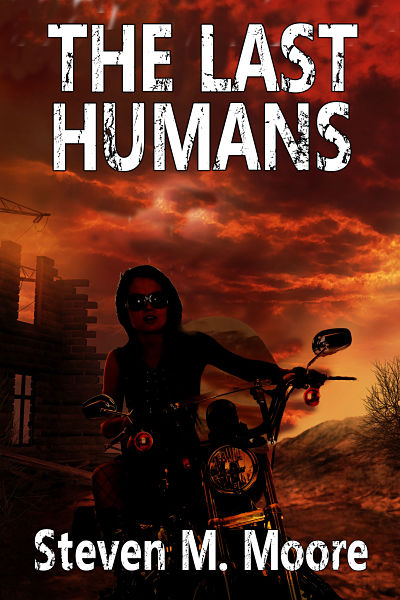
Drought has more than a cameo role in my new post-apocalyptic thriller, The Last Humans (scheduled for publishing in 2019), but it more enables the prose rather than being a main character. My protagonist, Penny Castro, is preoccupied with water.

First, she’s an ex-USN search and rescue diver who ends up recovering corpses for the LA County Sheriff’s Department—ponds, rivers, and the ocean are where she works as a CSI. Second, after the apocalypse (a bio-engineered contagion delivered by missiles), she spends a lot of her time searching for and collecting water just to survive, or to help others survive. Third, she wants to grow things—understandable when she can’t find much to eat except dog and cat food—so she needs more of it. And fourth, she hates water because her brother almost drowned her as a kid, but she met her fear head-on to become a champion high school swimmer and Navy diver.

California, even before the apocalypse, worried about having enough water. Desalination platforms dot the coast and pump fresh water to thirsty Californians. Survivors of the apocalypse become even thirstier when the platforms stop pumping and mountain snow packs diminish. Drought seems like a villain.

Fresh, potable water is, of course, a big deal. Life on Earth couldn’t exist without it. Lack of fresh, potable water is already a problem in many areas of the world—emphasis on “clean, potable.” Lack of water will become even a bigger problem over time. As often happens when a problem is big and no one can think of a solution, people ignore the problem.

In my novel, Penny Castro can’t ignore it. Even with not many people left in the world, those last humans still need water to survive. That’s a theme in the novel. The jury’s out on whether we can solve this problem in real life. Stay tuned.

***

The Secret Lab (2nd Ed). Four students on the International Space Station discover the origins of a mutant cat and uncover a conspiracy in a sci-fi mystery that’s sure to entertain young adults and adults who are young at heart. In a new second edition completely rewritten and reedited by Steven M. Moore’s collaborator A. B. Carolan. Now available in a print version (Create Space) as well as all ebook formats (Amazon and Smashwords).

From a review of the first edtion: “I will disclose this: I picked up The Secret Lab because of Mr. Paws, the intelligent cat. Yes, I could not resist the temptation to read the adventure of a sentient, mathematics inclined cat, told by Steven M. Moore. It exceeded my expectations. Mr. Paws is the result of a genetics experiment aboard a facility orbiting Earth in 2147. The cat and his newly found friends, a group of four smart teenagers, find themselves in an intrigue with corporate agendas, young curiosity, dangerous and ethically problematic research, relationships and their difficulties when coming of age. The complexity is enthralling, but the author also makes it easy to follow, using a light, natural style to tell us their story.”–Alfaniel Aldavan, in a Smashwords’ 5-star review

In libris libertas!


This Saturday…

March 17th, 2018

A. B. Carolan and Steven M. Moore wish you:

Happy St. Patrick’s Day!

Celebrate responsibly.  Don’t drink and drive.  If you see one of the wee people, you’ve had too much!  Or, Ancestry will say you have some leprechaun DNA.