Steve’s shorts: Fascist Tango, Part Two…

April 3rd, 2019

Fascist Tango

Copyright 2019, Steven M. Moore

Chapter Four

At a Buenos Aires Hotel

Juan Carlos watched Jasmine enter the hotel. He then paid the driver and followed her inside.

“I’d like to leave a message for Jasmine Locke who is also staying here,” he told the desk clerk, who then handed him a message pad.

He wrote: “Make it nine-twenty. r/Juan Carlos.”

He watched the clerk stick it into a cubbyhole. He now knew where Jasmine’s room was—number 312.

He went up to his own room on the fifth floor and checked his James Bond-style alarm. He’d read some of those old novels. One of his few surviving hairs plucked and stuck in the door jam and a camera inset in the peephole, low and high tech—no danger. He entered with confidence until he spotted the note that someone had shoved under the door. It read: “Thanks for the tango. r/Jasmine.”

I’ll be damned, he thought. How’d she know I was here? He changed hotels every time he journeyed to the port city from his hideaway in Salta. He decided she or the group had just waited for one of those trips to make it easy for them. But that also meant they probably didn’t know where he lived in Salta, which was a good thing.

He took off the fancy shirt with ruffles he used when milonga-hopping and his undershirt and looked at the old scars. They itched for some reason. Especially around the prosthetic. Is that a premonition of things to come?

He wondered how much of Jasmine was real woman. When they were dancing, all of her seemed real. The group’s techies must have improved both hardware and software if she was only part human. And she’d lied. She could dance. What is her story? He figured something in her past had brought her into the group.

He didn’t have many hours to sleep, and he didn’t sleep well. At breakfast Jasmine Locke looked a lot better than he did when he slid into the booth opposite her, although, with light makeup and lipstick, she’d looked better the night before.

“Coffee’s good,” she said.

“Questionable. Brazil’s next door. I’m partial to Colombian, for obvious reasons. What did you order?”

“The tropical fresh fruit plate. Brazil’s next door.”

He studied the menu. “Southwest scramble with a side of bacon for me. I assume they mean US Southwest. Why not just call it Mexican?”

“There are significant variations—Tex-Mex, Californian, New Mexican, Tijuana, Monterrey.”

“So you’re an expert on gringolandia without living there? Are you going to be contradicting me all day?”

“Just providing information.”

“The information I require is about what I might be getting into.”

She thought a moment. “Did you know Karl Wilson?”

“Ha! We called him the dumb Marx brother—Karl, get it? Besides, he was often an old Groucho, not gaucho, if you know your trivia. Great drinking buddy, old Karl. Miss him, just hearing his name.”

“Old Karl is dead.”

Juan Carlos, who had just scooped up a pat of butter for his biscuit, stopped his knife in midair. “Job-related death?”

“Yes, but don’t ask me for details. You’ll soon know them.”

He put the knife and biscuit down. “Mierda! That’s a turn-off. I’m retired, Jasmine. I’m done with this dangerous assassin and spying crap. I survived, and I want to keep it that way.”

“No desire to revenge his death?”

“More scared about having to face a global fascist movement in order to do that. What about you?”

She shrugged. “I have motives beyond revenging his death, but that’s one of them.”

“I never figured you for a death-wish woman.”

She now frowned. “Shut up and eat your breakfast.”

***

The safe house was in the Argentine capital’s suburbs. Juan Carlos drove Jasmine’s rental car.

“This had better be interesting,” he said. “That big breakfast is making me groggy even with that foul but strong coffee.”

“Just drive. I’m—”

Juan Carlos only had time to swerve a bit before the Mercedes-Benz truck T-boned their car and pushed it onto the sidewalk against the wall of a building, pinning it. Blood streaming down his face, he sniffed a bit. No gasoline spill. He drew his gun and waited.

Read the rest of this entry »

Villains…

April 2nd, 2019

When readers and writers think of main characters, they’re often thinking about protagonists, the heroes of a tale. Villains are the antagonists, characters who make life difficult for the protagonists. But they can be main characters too.

Consider the Jackal in Forsyth’s thriller classic, The Day of the Jackal. He IS the main character, no doubt about it. He plays a more important role than anyone who’s after him. [Spoiler alert.] The protagonist, if there is one, might be the French Sûreté detective (I don’t remember his name) who helps stop the assassination of De Gaulle.

Often authors writing series have their villains appear in multiple books for multiple reasons, but I suspect the main reason is that villains can be more interesting than heroes. We analyze them under the lens of our writer’s microscope. We see their complexity in a first book of the series and imagine there’s more for readers (and us!) to know about them. When a villain pops in and out of our stories, s/he helps stitch them together as much as a recurring protagonist. Both their complexities grow, and the two become the yin and yang of the series.

Harry Potter vs. Voldemort is a case in point. Harry naturally grew more complex as he got older. But in each novel of the series, we discover more about Voldemort, the villain, and his complexity grows. Readers will probably think it’s strange that I consider Voldemort Rowling’s best character—his development is more interesting than Harry’s, maybe because we confront it piece by piece. He’s always the same Voldemort, but we learn more about him as the series progresses. After all, Harry’s being trained at Hogwarts. He has to grow, right? And Harry would be a nobody if Voldemort weren’t there to make trouble.

Sometimes my villains seem to take over too. Dimitri Negrini in Come Dance a Cumbia…with Stars in Your Hand!, dominates the entire novel, for example. This maniacal industrialist is a complex villain. If the “Chaos Chronicles Trilogy” is my Foundation trilogy, then Negrini plays the role of the Mule of Asimov’s Second Foundation.

There’s one villain who I kept around for a long time, the Russian Vladimir Kalinin. He’s a presence through two series and two bridge books in my “Future History Timeline.” (See the list of free PDF downloads on the “Free Stuff & Contests’ web page.) He also appears in the novella “The Phantom Harvester.” (See the same list.) Not even Detective Castilblanco has that staying power as a character.

And Volodya (nickname for Vladimir) is quite the clever fellow in all his evil complexity and even shows he has a good side too (roses for the dying Lydia Karpov in The Midas Bomb and love for the adopted orphan in No Amber Waves of Grain).

I became attached to old Vladimir even though he’s a scurrilous devil. That happens. And it often leads to readers remembering the antagonists more than the protagonists.

There are many famous villains—Moriarity, the Mule, Voldemort, the Jackal, and so forth. Together we can probably generate a long list of them. When someone asks about my favorite fictional characters, I have to include them. And I just might forget who they battle against.

What about you? Do you have any favorite villains? Do you want to add to my list?

***

Comments are always welcome.

Chaos Chronicles Trilogy Collection. From a dystopian Earth dominated by multinationals and their mercenaries, to star colonies and first contact, and to the future and beyond where a maniacal industrialist seeks to conquer all near-Earth planets, this trilogy contains in one ebook Survivors of the Chaos, Sing a Zamba Galactica, and Come Dance a Cumbia…with Stars in Your Hands! This bargain bundle of three books is available on Amazon and Smashwords and all the latter’s affiliated retailers (iBooks, B&N, Kobo, Walmart, etc).

Around the world and to the stars! In libris libertas!

News Flash!

April 1st, 2019

NASA scientists have just confirmed that the brilliant fireball seen in the southern US corresponded to the crash landing of an alien spaceship containing four distinct species of ETs. The skeletal remains indicate different bone structures, one with four legs and two arms. Preliminary investigations also indicate four different variations on DNA components and/or handedness of key amino acids. Stay tuned for further information.

Turning points…

March 28th, 2019

SpaceX’s success with the capsule with Ripley inside (the dummy filled with sensors, not Sigourney Weaver, star of the Alien trilogy) might represent a turning point for the US space program. Since the cancellation of the shuttle program, NASA has depended on the Russians to get astronauts into orbit. After the SpaceX success, that dependence might soon end.

In the bigger picture, another turning point has already occurred. When private companies began launching successful space missions, a paradigm shift occurred: NASA became the science group with astronauts and payloads as passengers, and private enterprise became the transportation agencies.

I’ve always assumed this change was inevitable. Let’s assume it is. Will it be good or bad? Tech companies grow bigger, more arrogant, and more international as time goes by. Capitalism without controls is always bad, but only Europe seems to be reining in the abuses of tech companies. The opportunities for space exploitation, i.e. exploration of space for financial gain like big petroleum companies exploring for oil, offer potentially great rewards and seem boundless, so the same might happen to the space tech companies.  They could get rich by spinning off lucrative enterprises that have wonderful products made extremely expensive because of their origins.

Is this pessimism unjustified? Hopefully yes. But pessimists have the advantage that, if things turn out better than expected, they can rejoice. Yet Murphy’s Law, or its extreme version, Sturgeon’s Law (look it up), justifies being pessimistic.

I explored corporate domination of outer space in the future with my novel Survivors of the Chaos (now part of The Chaos Chronicles Trilogy Collection, a bargain ebook bundle of three novels). This is not uncommon in sci-fi or dystopian literature or movies (Avatar and Elysium are recent examples of the latter). My novel starts in a dystopian future where multinationals have their own mercenary armies controlling the chaos on Earth an their surrogates in space sponsoring all space projects and exploiting their findings. The book ends with three starships fleeing the chaotic Earth to colonize three planets in other star systems.

Such visions of the future are warnings created by pessimists, and these warnings are possible extrapolations of current conditions, including science and technology, of course. These stories are as old as sci-fi itself, but I find them more interesting than utopian drivel. Humans don’t have a good track record for creating utopias; they have a terrible one for creating dystopias and apocalyptic events. And, as science and technology progresses, the latter can become even worse.

***

Comments are always welcome.

Dystopia:

The Chaos Chronicles Trilogy Collection. The three novels take the reader from a futuristic worldwide dystopia to the stars and far into the future. The second novel answers Fermi’s question, “Where are they?” The third shows how Humans and their ET friends battle a mad Human industrialist. The whole trilogy can be considered an homage to Dr. Asimov’s Foundation trilogy with ITUIP (International Trade Union of Independent Planets) playing the role of the Foundation, and the mad industrialist playing the role of the Mule. Lots of enjoyable sci-fi reading await you. Available on Amazon and Smashwords and all the latter’s affiliated retailers (iBooks, B&N, Kobo, etc).

Post-apocalyptic:

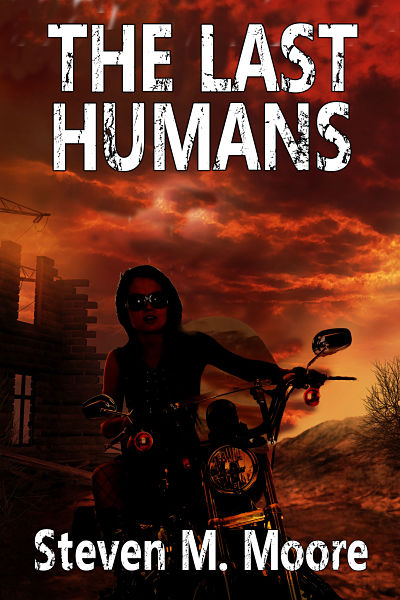
And don’t miss The Last Humans. Last man alive? What about last woman alive? Penny Castro, LA County Sheriff’s Deputy and forensic diver, finds she isn’t alone, though—there are a few others who survive the contagion and want to kill her. And the remnants of a US government could be the greatest danger for her and the family she’s adopted. This post-apocalyptic thriller (yes, it’s also sci-fi) will be released by Black Opal Books in both ebook and print versions on March 30 and available at the publisher’s website, online retailers like Amazon and Smashwords and the latter’s affiliated retailers (iBooks, B&N, Kobo, etc), and bookstores (if they don’t have it, ask for it!). You can pre-order on both Amazon and Smashwords.

Around the world and to the stars! In libris libertas!

Steve’s shorts: Fascist Tango, Part One…

March 27th, 2019

[Note from Steve: This serialized novella is dedicated to the victims of political, ethnic, and religious violence everywhere, and especially to those who have been victims of far-right white supremacist and neo-Nazi movements. We’ve seen this many times recently—in fact, just this last week in Christchurch in New Zealand and not long ago in Pittsburgh in the US.

Here most of the action takes place in the Southern Cone of South America in the near future where right-wing violence and autocratic regimes maintain a death grip on the world—that is fiction.

In the real world of the past, this was the norm in many South American countries like Argentina, where the military junta waged its “Dirty War,” and in Chile, where Pinochet’s regime tried to halt all progressive movements by slaughtering their leaders—both fascist governments came to power with the help of the CIA. While Venezuela’s current problems weren’t caused by the far right, one cannot deny that the Chavez and Maduro regimes might as well have been—the labels we use for autocratic governments are irrelevant. And, of course, Hitler’s “Final Solution” was responsible for the death of millions—an American CEO just recently used the meme “Arbeit Macht Frei”!

To all these victims, I dedicate this story, a terrifying look at what the world might become if this move to the extremes continues. This story pays homage to the grand tradition of all those great dystopian novels that I read as a kid—The Time Machine, Brave New World, Darkness at Noon, 1984, and others. It’s also a nod to William Gibson, creator of sci-fi’s cyberpunk subgenre.

A warning to parents: While there are no explicit sexual or violent scenes—at least no more than we might see in a PG-13 movie at a theater—the topics considered here are not appropriate for small children, even if they are precocious. Please use your parental judgment wisely by reading the novella first.]

Fascist Tango

Copyright 2019, Steven M. Moore

Summary

It is 2037. Jasmine Locke, a cybernetic-human who is a top agent for a centrist vigilante group, is sent to South America. Her assignment: go undercover to trace the tentacles of a new fascist worldwide organization. In Buenos Aires, she meets Juan Carlos Benavides, a retired member of her group whom she recruits to help her. Her mind-melding with the group’s AI network to manage large quantities of data, which is not uncommon at the time, leads to unforeseen consequences.

Chapter One

At a Budapest Warehouse

I’d already scanned the inside of the warehouse with my IR and radar sensors, but I still peeked around our group’s sentry into the dim interior of the warehouse. Force of habit.

The construction was late twentieth or early twenty-first century, so the place wasn’t in good shape, especially after fires in the 2031 riots had left it standing with charred walls. Still functioning, though. Seven years later, the autocratic government was still in firm control.

Our forensics people had just entered after parking their unmarked van behind the warehouse. I could still see what was left of Karl chained to an old steel chair—his blood and body parts were spread around his mangled corpse. I’d seen the chair with my radar, but not Karl with my IR—his body was already cold. Almost lost my lunch with the visual.

I’d seen tortured and dismembered bodies before. Autocrats loved to do that to anyone who went up against them. Hadn’t known the victims in the previous cases. Karl had been one of our best agents, one we hated to lose, especially in this way. We were only a few now, spread thin around the world trying to do what we could to end fascism’s stranglehold on humanity.

I stretched a bit. Was overdue for a tune-up. I’d gone through hell fighting off rejection when I received my prosthetics and new body parts after the semi had crashed into me. Guess I should call the necessary tune-ups only purgatory. The stiffness wasn’t any worse than what I used to have in an Edinburgh winter.

I turned away from the scene and walked a few steps toward the river to avoid the stench of the Danube made especially nauseating by my heightened sense of smell. What the Hungarian right-wing totalitarian government had done to the Danube even before the riots had produced an eternal stench too, but I tolerated all that better than the stench of torture and death. Even the fog made yellow from the old streetlamps as it rolled in from the river seemed refreshing but hesitant to compete against death’s stench.

After my stomach settled a bit with the fresher air, I stuck my head through the door again and transmitted to our chief CSI via her normal earworm-mike combo, “Look for anything that will give us a clue about which fascist group was responsible for this.”

“Probably locals, Jasmine,” said the sentry. “Hard to imagine who else would know about this abandoned warehouse.”

“Locals with international connections,” I said with the CSI still in the link. “Someone told them what Karl’s goals here in Budapest were.” I touched my forehead with my index finger—nearly metal against metal because my head was well protected now. One benefit? My wig never itched! “And we’ve lost all the information Karl gathered.”

He’d been working undercover. We all did from time to time. We had to be highly motivated to put our life on the line like that. Many times in my case. My motivation was simple: fascists had killed my father. I lost him when I was six. Everybody knew I had my personal agenda, but the people in charge of our group couldn’t turn the revenge-seekers away all the time—good agents were hard to come by.

***

Marvin Cox soon joined me at the warehouse. Sans earworm and mic, he liked to pretend he was a big shot. He was an able administrator, but he’d never been in the field. Lost some respect from that, but I wouldn’t want his job.

“Came as soon as I could. Any info on Karl’s killer?”

I used my software to kill all my RF links. “Multiple killers. DNA from at least three different people.” Frowned. “I would have thought that you’d be a bit more maudlin. Karl was a great guy and one of our best agents.”

“Men aren’t as emotional as women.”

Prick, I thought. Whispered it too. Was glad that was off-air. Was also glad Marvin was on our side, though. He could be an asshole, but provided a bit of balance against the smart fascist assholes we were fighting round the globe.

“I won’t even respond to that stupid statement,” I said.

The SOB winked at me. “You just did. Suck it up. This is good experience for you. Someday you might have your turn in the torture chair. We’re not in nursery school playtime, you know.” He was an American, but none of us could live there anymore, so he had acquired a bit of a local accent—English sprinkled with paprika.

“And you know Karl was a human being, not just your slave.”

“Shit, Jasmine, we’re all in this together.”

I didn’t respond to that meaningless but true observation. Of course we were—the endangered few who thought the world’s scourge of fascism should end.

We both talked to the chief CSI agent live when she exited the warehouse.

Our group wasn’t very big. Major cities in all the right-wing countries or ones leaning that way often had small local clandestine offices. Budapest’s had four permanent employees—two CSIs, the agent who served as sentry, and Marvin, the local boss. Other agents would float from city to city, trying to do what needed to be done and sometimes getting killed while doing it. For example, I wasn’t tied to any particular office. Most of us weren’t. Yet Marvin felt he could boss me around. Karl hadn’t tolerated that. I’d miss Karl.

The CSI showed us a business card. Rodrigo Jimenez, Imports & Exports. A hologram of Rodrigo seemed to hang in midair; he was smiling at us. I didn’t like the smile. The address was in Asuncion.

“If he’s not here in Budapest, Mr. Jimenez was a contact for someone in the group here that killed Karl,” said Marvin.

“Or maybe he was someone who was directing the torture from afar,” I said.

Marvin nodded. “I’m sending you to Argentina, Jasmine. I’ll get the OK from Paris HQ.”

“FYI: Asuncion is in Paraguay.”

“FYI: Juan Carlos Benavides is in Argentina. You’ll need his help.”

“Who the hell is Juan Carlos Benavides?”

Chapter Two

In a Buenos Aires Milonga

I entered the dark milonga and spotted Juan Carlos Benavides—not among the audience, mostly couples seated at their tables sipping their drinks, and not on the small dance floor where patrons danced their sexy tangos—but in front of the band. The milongas still existed because the porteños couldn’t live without their music and dances, in spite of the junta’s curfews and other policies that tried to stop people from having fun.

Benavides was belting out the lyrics to “Por Una Cabeza” with good-natured lust. At times he would join the musicians using the bandoneon draped around his neck.

I’d heard the song ages ago in the classic movie Scent of a Woman—tangos are songs that often inspire dancing—and liked it so much that I’d found a purchase link to the old soundtrack and downloaded it, under a false identity, of course. While Juan Carlos was enthusiastic, he was a better bandoneon player than singer.

After scanning the audience, band, and Benavides across the EM spectrum, I found an empty table, ordered a glass of Malbec from Mendoza, and settled in to enjoy the rest of the song. Lengthened by segments featuring the orchestra, everyone could dance who wanted to do so. When both singer and band came to a galumphing stop, everyone applauded, and I raised my glass to salute Juan Carlos. He saw the gesture and approached me when the band took a break.

Turista gringa,” he said, labeling me but not too loudly.

There were informers and spies in the audience. Thought I’d picked most of them out. Maybe they just wanted to enjoy Buenos Aires nightlife too, but I doubted it. Were they following me?

Read the rest of this entry »
Interviewing author Scott Dyson…

March 26th, 2019

Steve: It’s my pleasure today to interview author and longtime friend Scott Dyson. We met via Joe Konrath’s blog long ago, and we’ve had lively email discussions ever since. He writes mostly horror a la Stephen King, but he has written stories in other genres too. His longer works include The Inn and Reciprocal Evil. He also has short fiction collections like The Cave, Die 6, The Striker Files, and The Never Ending Night.

Without further ado, let’s go to it. Scott, please tell us a bit about yourself.

Scott: By day I work as a general dentist, and I’m a husband and father to two boys. In my spare time, I write and self-publish tales of horror, mystery and science fiction/fantasy. I’ve been writing since grade school, but it wasn’t until the mid 1990s when I was helping to host a book and writing forum on Delphi Internet Services, called “The Book And Candle Pub,” that I became more serious about creating works of fiction.

Besides writing, my passions in life are my family, making music, reading, watching movies, and following Chicago sports, especially the Cubs and the Bulls. (Yes, I admit to being a long-suffering Chicago Cubs fan!) I play keyboards and enough guitar and drums to get by, and currently play in a local bar band. I’m a big fan of Disney films and theme parks as well!

Scott on Writing:

Steve: Why, how, and when did you start writing?

Scott: I can’t really remember a time when I didn’t write.  I wrote my first full length stories in 6th or 7th grade, but I was always writing something.  Throughout my college and professional school years, I didn’t have time to write that much, but I still harbored the desire.  As soon as I was out of school I started writing again.

Steve: Did you publish the first book you wrote?

Scott: If you count the things I wrote back in grade school (that I finished), the answer is no.  If you don’t count them, then my first finished book is a mystery hinging on a dental clue.  I think there is something good in there, but it’s as yet unpublished.

Steve: What is your biggest problem with the writing process. How do you tackle it?

Scott: I don’t know where I’m going when I start, and I often get lost along the way.  I have dozens of files of stories in various stages of completion, but I don’t know if I’ll ever figure out where to go with them.  So I suppose my biggest problem is plotting. [Note from Steve: I for one know there’s a really good YA adventure novel in your files. How ‘bout it? When are you going to publish it? No pressure.]

Steve: Do you feel writing is something you need to do or want to do?

Scott: More want than need.  I enjoy it, the same way I enjoy playing music.  I don’t often feel a burning NEED to write (and it shows in my productivity), but when I have time to do something I truly enjoy, as often as not I will sit down at a computer and write.

Steve: Have your personal experiences (or situations) influenced you creatively? If so, how?

Scott: My dental career helped me write that as yet unpublished first short novel.  I’ve always been a bit of a dreamer, and I was always strong in science and math, so my first love is probably science fiction.  That said, I have trouble writing it.  I can’t really understand why.  Horror and supernatural thrillers seem to come more naturally.

Steve: How much of your creative ability do you think is innate and how much is learned?

Scott: I think that most of my own creative ability is learned.  I watched a lot of Disney as a child, and I literally HAD to watch movies like The Wizard of Oz and The Ten Commandments every year.  Their airing on broadcast TV was almost an event for me.  I always read a lot.  It feels like a natural progression to go from reading fictional tales to making them up myself.

Steve: What is the last book you read? What are you reading now?

Scott: I am currently reading A Perfect Tenant by Steve Richer and Nicholas Gifford.  I just queue up my reads like they’re songs in my iPod.  The last book I finished was The Twenty Three by Linwood Barclay.

Steve: Whose writing inspires you the most and why?

Scott: I think I’d have to say Stephen King.  I’ve read writers who might be better than him, but his storytelling always grabs me and pulls me in.  It was his books as much as anyone’s that exposed me to the power of a short story, and it was his storytelling that showed me how a fictional place could become real in the reader’s mind.  I was also inspired by Asimov and Heinlein, but I can’t seem to do what they do with their stories.

Steve: Do you have a favorite genre?

Scott: Not really.  I have some I don’t like.  I read broadly in science fiction, mysteries, thrillers, and horror fiction.  I will step outside of those often into other genres if the premise of the story grabs me.  I love a well-drawn character in an immersive story.

Steve: Should writers read in their genre?  Should they be avid readers?

Scott: I think so.  It’s sort of like music.  How can we be good musicians if we never listen to anything?  Reading broadly and avidly gives us a sense of how a story works.  You can read phrases and appreciate them, and they will find their way into your writing, not verbatim, but in the tone of your prose.  You get a sense for what works, what doesn’t, how it flows, and you appreciate the authors’ uses of specific words in specific situations.  It comes through in your writing unconsciously, I think.  You can always tell a writer who watches a lot of movies but doesn’t read by their exposition in their writing.  It’s not the same. Read the rest of this entry »

Movie Review #73…

March 22nd, 2019

[Note from Steve: As many readers know, I post a list of the week’s blog articles on both Facebook and Twitter. This is an addendum because, like millions of others, I saw the movie in question this weekend. Although it was the second weekend, the theater was still packed. Was the movie worth all the hype? Read on.]

Captain Marvel. Anna Erden and Ryan Flack, dirs. Loud, spectacular, and long, but I would have fallen asleep if it weren’t for the deafening soundtrack. Many moviegoers have here more of what they want I guess—loud, spectacular, long action without much substance, i.e. pure escapism—but there’s some good acting from Brie Larson (Carol AKA Captain Marvel) and Samuel L. Jackson (Fury). Larson perhaps overacts and gets carried away in her role as an amnesiac Paula-in-peril, but Jackson is in top form.

Here’s my ranking of the recent origin stories: (1) Wonder Woman, (2) Black Panther, and (3) Captain Marvel. Hmm. I sense a trend: they’re getting progressively worse–or should I say less awesome. Or, maybe I’ve had enough of the Marvel Universe? (I loved the comics when I was kid, but it seems like every year there’s more, like ants in springtime.) Can’t Hollywood come up with anything else? The answer is: yes, of course! See some of my other movie reviews for alternatives—better, meaningful stories, and without all the spectacle and overbearing soundtrack.

With the new comfortable, even heated, seating in many theaters (at last!) and earplugs, I guess I can always take a nap. But then I couldn’t write a review, could I? Movie reviews are like book reviews—the reviewers should really see and read what they’re reviewing!

***

Comments are always welcome.

Last man alive? What about last woman alive? Penny Castro, LA County Sheriff’s Deputy and forensic diver, finds she isn’t alone, though—there are a few others who survive the contagion and want to kill her. And the remnants of a US government could be the greatest danger for her and the family she’s adopted. The post-apocalyptic thriller The Last Humans will be released by Black Opal Books in both ebook and print versions on March 30 and available at the publisher’s website, online retailers like Amazon and Smashwords and the latter’s affiliated retailers (iBooks, B&N, Kobo, etc), and bookstores (if they don’t have it, ask for it!). You can pre-order on both Amazon and Smashwords.

Around the world and to the stars! In libris libertas!

Blurbs and book buying…

March 21st, 2019

As many readers and writers know, “blurb” is a technical writing term for those little more-than-tweet-length paragraphs used to entice people to read a book. I prefer “read” to “buy,” because people might borrow the book from a library or online service like Overdrive.

A blurb has to do many things. First, it has to summarize the book, or at least part of it. Second, it has to be a teaser, a bit like a movie preview to grab the reader’s attention. And third, it has to be short—not necessarily as short as an endorsement or “elevator pitch” (called that because one is only allowed the time it takes to go down in an elevator to make the pitch).

That third requirement is quite a constraint when considering the first two. I’ve been doing them for 10+ years, and they don’t seem to get any easier. All authors have to market their books now, so I imagine there are “pros” out there specialized in writing blurbs, ready to take authors’ money. And there are also people who tell an author how to do it free of charge.

I wish there were some metric that allows authors to measure how good their blurbs are. I know of none. How will they satisfy those aforementioned requisites? Like many things in the book business, an appreciation for blurb quality is often subjective.

Read the rest of this entry »

News and Notices from the Writing Trenches #167…

March 20th, 2019

Winter doldrums? My solution is to read, read, read. Of course, I read books in the spring and summer too, but there’s a lot of other things to do then, even if they’re just day-trips. Getting involved in a book makes me forget about all the cold and bad weather. What about you? While March is still roaring like a lion, spring is just around the corner. I’m already thinking about chef time at my BBQ.

Where are all the books? You can find your favorite authors’ ebooks online at Amazon and Smashwords and all the latter’s affiliated retailers (iBooks, B&N, Kobo, etc.). Many libraries also offer ebooks (I give them a special discount on Smashwords), and you can also borrow them elsewhere (Overdrive, for example). Small presses often sell their own books on their websites (and offer sales!). Kobo/Walmart offers an alternative to Amazon—Walmart signed a deal with Kobo (subsidiary of Rakuten), so you can find Kobo ebooks at Walmart stores and their online retail site.

Print books are available on Amazon, B&N, and at your favorite local bookstore. The smaller ones don’t have enough room to stock all recent books, but they’ll order them for you. Of course, print books are more prevalent in libraries (I’ve denoted copies of my print books to libraries on the East and West Coast).

Interviews. You probably saw my interview last week of historical fantasy writer Bruce Woods (if you didn’t, take a peek—he writes interesting stories). These interviews are a common feature in my blog because they let readers know about authors. (My book reviews do the same for their books.)

Any author can request an interview. Use steve@stevenmmoore.com to query me. I’ll send you a list of questions that you can selectively answer (you can add your own too).

Readers like to know the authors who write the books—their perspectives, their history, and why they write…so this interview service is for readers too! And who knows? You might find some interesting and entertaining books to read.

Book sales. I now only offer ebook sales to my email newsletter subscribers. Here are the books on sale this month: the entire “Mary Jo Melendez Mysteries” series, Muddlin’ Through, Silicon Slummin’…and Just Gettin’ By, and the just published Goin’ the Extra Mile. You can receive the email newsletter by dropping me an email using steve@stevenmmoore.com.

I only offer special prices for my print books at special events (like last November’s Holly Berry Show).

All my books are reasonably priced.

New revision of “Writing Fiction” available. Mostly for writers, but also for readers who want to understand the hurdles writers have to jump over to bring readers all those wonderful books. The latter represents a lot of work, often for little pay. But for writers of fiction, it’s not about selling books—it’s about entertaining readers with stories that make readers laugh, cry, and think about the meaning in their lives and their world. And, of course, many of us are just addicted to writing!

Anyone can download this course by following the instructions on my “Free Stuff & Contests” web page at this website. You could also just shoot me an email to steve@stevenmmoore.com and ask for the course. It’s a free PDF.

There are other free PDFs available, free fiction and info for book clubs. That same web page has the complete list. Or send me that email and I will provide the list to you.

Why do I offer free fiction? There are three basic reasons.

The first: When I start writing a story, I never know whether it will turn into a short story, novella, or novel, but guess what? It’s just as difficult or more difficult than getting a short fiction story accepted for publication by a ‘zine (online or otherwise) as it is for a novel accepted by a small press. I prefer to spend my energy on my novels.

The second: ‘Zines pay next to nothing in royalties. They’re an endangered species, at least the print versions, and probably deserve to be so, because they often exploit authors more than the Big Five. That’s just my opinion, of course, and many authors only write short fiction for ‘zines. More power to them.

The third: Many authors give away free novels. I don’t do that except to reviewers in exchange for an honest review. I give away free short fiction so readers can try out my writing without obligation or cost.

Check out the free fiction available in the list of free downloads on my “Free Stuff & Contests” web page and in the blog categories “Steve’s Shorts” and “ABC Shorts.” I’ll start a new serialized novella next week in “Steve’s Shorts” in homage to the victims of the Christ Church massacre in New Zealand. Titled “Fascist Tango,” it is mostly set in South America’s Southern Cone, that setting inspired by my knowledge of all the horrible events in Latin American history that have occurred where I cry for a lot more than just Argentina.

Release of The Last Humans. Black Opal Books is set to release this post-apocalyptic thriller on March 30. Right now you can pre-order the ebook versions on Amazon and Smashwords. Visit either retail site to see the spiffy cover—main character Penny Castro looks like she’s ready for trouble…and it will find her!

One of those free PDFs, “Reading Notes for The Last Humans,” also contains the cover image along with a blurb, an excerpt, some articles I’ve written related to the book, and ten questions for book clubs.

More coming attractions in 2019. First up I suspect will be A. B. Carolan’s Mind Games, published by Carrick Publishing. Here’s a blurb:

The hero of this sci-fi mystery for young adults and adults who are young-at-heart is a fifteen year-old-girl who can’t remember her past before age five. She’s lived with her foster father Ferdie since then in the Dark Domes where all the misfits on the planet Sanctuary live. Both her father and she are adepts, persons with psi powers, but Ferdie has made her pledge to keep them hidden. When he is murdered, she vows to revenge his death. To do so, she must sharpen and employ these powers because his murderers also employ them. A. B. Carolan gives readers another thrill ride with many twists and turns as he continues the “ABC Sci-Fi Mystery Series.”

Read the rest of this entry »

Scientific scales…

March 19th, 2019

Like Asimov, Heinlein, and other sci-fi writers, I’m an ex-scientist who loves to tell stories—all Asimov’s stories were sci-fi, for example; mine are mysteries, thrillers, and sci-fi. (To be fair, Dr. Asimov wrote some excellent sci-fi mysteries! He was also a fan of the mystery genre.) But Asimov might be better known to some readers for his non-fiction popular science books. I once thought of writing them too—it’s writing, after all, and I love to do it—but I was too hooked on fiction to write those kind of books.

Every now and then I occasionally write a blog post in the popular science category, though. I’ve been remiss in doing that, so let’s do one! I can never compete with Dr. Asimov in either sci-fi or popular science, but I’ll do my best.

Let’s talk about scientific scales. Much science in the twentieth century explored scales from the smallest to the largest, from the tiniest bits of matter to galaxies and clusters of galaxies at the far reaches of the cosmos. Astrophysics and cosmology connect the two extremes, and these connections are like good twists in a good mystery.

One might think the smallest scale is determined by quarks—those usually invisible particles that make up protons, neutrons, and a menagerie of strange particles, all organized by the special unitary group SU(8) as proposed by Murray Gell’Man. Instead, I’d propose it’s the Planck length, defined as follows: take the square root of Planck’s constant h multiplied by Newton’s gravitational constant G and divide by the cube of the velocity of light and twice pi (it’s a constant derived from fundamental constants). From the very definition you see that it connects quantum mechanics and gravity. In fact, it is believed to be the length where quantum gravity effects become important. Planck’s length is a very, very small fraction of the size of a proton, and it could very well define the granularity of space-time in our Universe.

The largest scale is the size of the Universe, of course. That’s finite, but it’s expanding, a bit too fast according to conventional theoretical astrophysics, which is a puzzle. Adding to that mystery is the existence of dark energy and dark matter that astrophysicists invented to explain other oddities (these are just names for things the scientists don’t really understand). The presence of dark energy and matter should make the Universe’s expansion slow down more!

We start realizing there’s a lot we don’t know about our Universe. In fact, we don’t even know whether it’s unique. Certain theories add metaverses, and there’s an infinite number of them. Some of those theories were created especially to provide science with dark energy and matter, or help in the quantization of gravity, a vexing problem for astrophysicists.

Infinite numbers of metaverses? An easy way to get at them is to realize that the Universe must have its own quantum state, so, according to the Many Worlds Theory of Quantum Mechanics, at each point on the Universe’s world-line winding around in some higher-dimensional continuum (usually ten dimensions), that quantum state splits up into an infinite number of states, ad infinitum. These many world-lines are called quantum histories. They’ve been used as objects as astrophysicists try to quantize gravity, starting with James Hartle and Stephen Hawking (Hartle was one of my professors at UC Santa Barbara).

All those metaverses, parallel states of our own Universe, lead us to question the concept of infinity itself. Some used to think the Universe was infinite and existed in a steady state, everything arranged neatly so that the more the Universe changed, the more it stayed the same. Let’s accept for the sake of argument that’s not true—i.e. the Universe is finite, although it’s certainly not in a steady state with its expansion. What happens at the other end of the scientific scale? Can we go smaller than the Planck length?

We describe the physical world with mathematics, mostly with real numbers or combinations of them (three space dimensions plus one time, for example). The set of real numbers is a larger infinity than the infinity of integers or even fractions constructed from them. But does the cosmos have to match the larger infinity of the real numbers? In other words, is space-time quantized and countable like fractions? Maybe with the Planck length as the size of a bit of Universe? We could think of these chunks as pixels in space-time. We could no longer say “space-time continuum” because it wouldn’t enjoy the continuity of a real-number based Universe. Every position in space-time would represent a four-dimensional cube—albeit a very small one, to be sure, but the Universe would then be finite at both ends of the size spectrum (technically at the lower end, it would be a countable infinity like integers and fractions).

I enjoy thinking about these questions. I wish someone would answer them!

***

Comments are always welcome!

“Reading Notes for The Last Humans.” This free PDF can be downloaded by visiting the “Free Stuff & Contests” web page at this website. It’s designed to provide useful information to all readers about my new post-apocalyptic novel, and it contains a list of questions that will stimulate discussions in book reading clubs. The ebook is available now for pre-orders on Amazon and Smashwords, and it will be released in print and ebook versions by Black Opal Books on March 30.

While you’re on that web page, be sure to check out the other free PDFs that are available—these are all just a thanks to you for being a reader.

Around the world and to the stars! In libris libertas!