Steve’s shorts: Fascist Tango, Part Four…

April 19th, 2019

Fascist Tango

Copyright 2019, Steven M. Moore

Chapter Ten

Rodrigo’s Club

            I sat with them, smiling first at the manager and then at Rodrigo. The gnomish owner’s intentions weren’t clear. After some pleasantries and questions about why I’d emigrated from Colombia, the conversation took another tack.

“I must congratulate you. You fit right in to our dance group.” The beaming Rodrigo flashed his perfect teeth. Implants?

“I’m happy you think so. I needed a job. I think the customers’ applause was for the ensemble, though. All the girls are good dancers.”

“We intercepted some texts. They liked the new addition. That’s you, and it means they’ll  be back. This is a business, you know. If we give the people what they want, they’ll come back.” He reached under the table and rested his hand on my upper leg. “That works for me too. You’ll go far here if we become good friends, if you know what I mean.”

I smiled but inwardly shuddered. “Lulu told me. I can show you a good time. Listen! A tango. Do you dance, Señor Jimenez?”

“Yes, but I’m usually the one asking. I’ll lead, though.”

Rodrigo danced a sexy tango. His hands danced too—all over my body. It was disgusting, but it was my job. I’d later analyze why I could survive the experience by thinking of Juan Carlos.

But Rodrigo was called away, so I was left alone with the manager.

“The boss is a good dancer,” I observed.

“Many Latinos are good dancers, as you well know. My German heritage gets in my way, I fear. My wife complains about it.”

“Maybe she should learn the polka?”

“Prussian blood, not Bavarian.” He smiled but then turned serious. “Be careful with Rodrigo. He likes rough sex. Even the kind where you have to put a plastic bag over your head.”

“I’m not into S&M,” I said.

“He’s more S than M.”

***

In the wee hours of the morning, Rodrigo still hadn’t returned. Only the bartender was left cleaning up along with his assistant, who was stacking chairs on table tops. I decided to take a tour of the club’s offices. They were in the back where the loos were, so I figured it wouldn’t seem odd that I would visit them before heading home.

With the prosthetics, I had a lot of strength, but I didn’t want to just wrench the door knob out of the door–too obvious. But I could pick the lock, using my augmented hearing to sense the tumblers turning. In five seconds, I was inside.

Desk and file cabinets were unlocked. I went through their contents in a flash. Mostly boring business stuff associated with the club. I used my built-in RF link to upload some copies to the group’s secure cloud maintained by its AI network, but I doubted they would be useful.

In a closer examination of the office, I found a wall safe hidden behind the painting of a nude. It had an electronic combination lock, fingerprint ID, and a retina scanner. It would take some doing to break into it. I was calculating how long when my super-hearing picked up Rodrigo’s voice at the club’s entrance.

I slipped out of the office and entered the women’s WC. When I heard the door to his office close again, I returned to the main club area.

Hasta mañana,” I said to the bartender and his aide as I left.

That safe would be on my short list for finding more about El Vengador and his Libertad con Responsibilidad group of friends.

Chapter Eleven

At the Pension

            Juan Carlos and I were having some aguardiente in his pension room, that potent Colombian drink made from fermented sugar cane and flavored with anise, when I put my finger to my lips to silence him. That early in the morning there were few noises to be heard. Of course, even if there were noises, my noise-cancellation software would help me separate signal from noise.

I held up my right hand, counting to four for the four men who had just come up the stairs and were in the hallway. He nodded, went to his briefcase, and took out four guns. They all had silencers. He tossed me two, and we took positions at opposite sides of the door. He then killed the lights. Made no difference to me: my IR sensors kicked in.

There was a loud knock. A voice said, “Policia!”

In a fascist state, even the police are dangerous, but Rodrigo shook his head in the negative, confirming my opinion.

I laughed out loud, startling Juan Carlos. “Vayanse. Estamos ocupados y no vestidos.” I was telling them to go because we were occupied and not dressed. If they were Latinos, they’d fill in the details.

Some people just don’t respect lovers’ privacy. They broke down the door. The laser beams looked for targets in the gloom but found none.

“Drop your weapons!” Juan Carlos said.

Luckily he jumped aside. The firefight that ensued went bad for the four intruders. We stared at their bodies.

“Besides the fact that we now have four weapons to add to our arsenal, this is another cluster-fuck,” I said. “What are we going to do with the bodies?”

“At least I was right. They’re not real cops.” The four lay in pools of blood and brain matter. “Let’s pile them into my bed. We’ll clean up in your room and get a few hours of sleep. Early tomorrow, we’ll get rid of the bodies and sheets.” He jerked a thumb toward the window. “There’s a convenient dumpster below for the bodies. I’ll bribe a maid to clean up the rest.”

He was so calm about it. As I lay beside him listening to his soft snores, I wondered why. Maybe he’s been doing this too long?

***

The maid was calm too. Juan Carlos told her they were gang members. A large bill sealed the deal. We went down to breakfast. He was humming a tango. I thought it was “Malena,” but without the lyrics, I couldn’t be sure.

“You seem happy enough,” I said as we took our seats at the table.

The pension’s old owner immediately arrived with coffee, so he only nodded.

Read the rest of this entry »

Name recognition…

April 18th, 2019

In the book business, some marketing gurus think this is more important than any particular book in an author’s oeuvre. Some people call it an “author’s brand,” as if the author were a CEO of a corporation looking out for the brand name of their products. When authors advertise, I call it PR and marketing. The marketing is for the individual products, and the PR to increase name recognition of the brand and defend it, although advertising gurus will probably take exception to those distinctions. You can’t have name recognition without good products, and no product lacking name recognition will sell as well as one with it, and subsequently add to that name recognition. It’s a two-way street—the advertising traffic has to flow both ways. So say the gurus.

If true, self-published and small-press traditionally published authors will have a tough time in today’s publishing environment, especially if they’re just starting. There’s a lot of competition, and Big Five traditionally published authors are competing with everyone else too, for the most part, unless they’re coasting and pushing books from authors already having name recognition. P. D. James’s name recognition is secure among mystery readers; Steven M. Moore’s is not.

Those authors who already have name recognition have the advantage that marketing efforts can be focused on their next book. Consider James Patterson, CEO of Patterson Books, Inc., which runs the largest assembly line of books in the world. His new book The Cornwalls Are Gone recently appeared in a full-page ad on the back page of the “Arts” section on the NY Times March 28, the back page of the front section on April 4, with another ad on the back page of the “New York Times Book Review” on March 31.

Read the rest of this entry »

Review of Jill Paterson’s Rose Scented Murder…

April 17th, 2019

(Jill Paterson, Rose Scented Murder, J. Henderson, 2019)

I read novels from all over the world, and almost any book involving a DCI or DS attracts my attention. And Ms. Paterson, an Australian author, has a whole series of them!

In this novel, DCI Alistair Fitzjohn and DS Martin Betts set out to solve another crime, this time the murder of a famous Australian actor. The crime occurs just after the last play in a famous old theater that will be torn down. The memoir of the victim plays a big role. (As an aside that’s a wee bit curious,  at the time I purchased this book, I was already well into a piece of short fiction involving my detectives Chen and Castilblanco with a famous actor as victim. I’m far enough along that it might turn into a novella, not a novel, though. My detectives work in NYC; there are many more theaters there.)

A bit more taut and better written than number seven in the series, this did a nice job of satisfying my minimum quarterly dose of a British-style mystery (the “local color” here is Australian, of course). I put most books containing a DCI in this category (Louise Penny’s and Ian Rankin’s provide other examples that don’t occur in Britain), and Fitzjohn is one of the most interesting DCIs. There are nice twists throughout the book, and there’s a wee bit of surprising news regarding Inspector Fitzjohn.

I have been following this series. It’s a good example of how books in a series can stand alone relative to others in the series (the reader can jump in anywhere), avoiding cliffhangers and soap-operatic episodes that drive readers away (including me). At the same time, readers who follow the series can watch the characters change as the novels proceed along a timeline that follows their careers. Ms. Paterson has done well in both regards.

***

Comments are always welcome!

Rembrandt’s Angel. Esther Brookstone, of London’s Scotland Yard, is also a DCI, but she’s not modeled after any of the ones mentioned above. She’s more like a younger version of Dame Agatha’s Miss Marple. How far would you go to find a painting stolen by Nazis in World War Two? Esther, of the Art and Antiques Division, becomes obsessed with the idea, and paramour and Interpol agent Bastiann van Coevorden (he even looks like Hercule Poirot, rather David Suchet, the actor who portrayed him so often) attempts to focus the investigation and keep her out of trouble. Together they discover the painting plays a role in an insidious conspiracy that threatens Great Britain and the world. Available on Amazon in ebook and print format, on Smashwords and its affiliated retailers (iBooks, B&N, Kobo, Walton, etc) in ebook format, and in print at your favorite bookstore (if they don’t have it, ask for it). A sequel, Son of Thunder, will be published by Penmore Press—coming soon!

Around the world and to the stars! In libris libertas!

“Because some stories just have to be told”…

April 16th, 2019

I liked this slogan from small-press publisher Black Opal Books the moment I saw it. The Barbara Tuchman quote on small-press publisher Penmore Press’s website also inspires me: “Books are the carriers of civilization….” Yes, I’ve published with both Black Opal and Penmore, but I’m just leading into the theme of this post. They represent different ways to express that theme, something that motivated me to begin writing my stories and putting them “out there” about fifteen years ago.

Maybe that theme is a meta-theme—one that rises above all adages and platitudes about storytelling and explains why fiction entertains and informs us and why we need it as human beings. We have been telling stories since prehistoric times. Storytelling makes us human. Yes, books are the carriers of civilization, but storytelling was an essential stimulus for its development.

When I was in junior high (middle school for people on the East Coast and Mid-America), I was already looking for a career, something I could imagine doing for many years and not get tired of it. One possibility was anthropology or archaeology. I checked out all the books on those subjects our public library had and read most of them. Besides concluding that the subjects were too complex because human beings are complicated and then opting for math and the so-called hard sciences instead, I also learned how the storytelling tradition grew over time and civilized us (and even created cultural revolutions in some cases!).

It all started with oral tradition, of course. I revisited that in Sing a Zamba Galactica, the second book in the “Chaos Chronicles Trilogy” (all three books are now sold together in an economically priced bundle). The ETs who human beings encountered on the planet New Haven in the 82 Eridani star system are very strange, and they have an even stranger language, Buzzspeak (the human name for it, of course—they also have an underwater language that contains sonar images). These ETs are superb storytellers. They essentially communicate via stories. The human colonists on New Haven need the help of an AI to judiciously translate and edit those stories into Standard, humans’ language in the future (a descendant of English, Mandarin, and other languages).

I didn’t dwell much on the sociology of those ETs the humans end up calling Rangers (why the name? that’s part of the story!). Although the ETs’ appearance is strange, their culture is beaver-like. And they have a difficult time being alone outside their clans, but they manage. (In particular, the trilogy shows this numerous times, and A. B. Carolan continues to show this in The Secret of the Urns and Mind Games, the latter due out soon.) But they always communicate among themselves by telling stories; that’s how Buzzspeak works…and it’s how they think.

It’s how I think too. Although I’m an ex-scientist, my love for and use of language wins out over experiments, data and its analyses, and equations. And, as the Black Opal Books motto states, I must tell my stories just like those Rangers do.

Read the rest of this entry »

Steve’s shorts: Fascist Tango, Part Three…

April 12th, 2019

Fascist Tango

Copyright 2019, Steven M. Moore

Chapter Seven

Buenos Aires Safe House

            I wanted to learn more about Rodrigo Jimenez. The safe house had a state-of-art connection to the net, complete with interactive helmet to speed up searches through massive databases with an AI’s help. I took out my personalized dongle and plugged it into the side of my head and then connected its leads to the helmet’s input/output jacks. While the dongle could use an RF link, the bandwidth was larger with the helmet. I became one with the net and began my search.

The high bandwidth sped up the search, allowing me to mind-meld with the AI, but I still spent over three hours. I then gave up. I had a wealth of information about the history of fascism in Paraguay and the Southern Cone in general, but little on Rodrigo. He seemed to be a sympathizer of a movement called Libertad con Responsibilidad. Some name! Fascists neither want liberty nor responsibility for others. Everyone must bow to those in power. Still, the name gave me a start.

The name he called himself was even more twisted—El Vengador, the Avenger. I wondered how many lives our group had lost to find that out! His shtick was purification—he wanted to purify Earth. Only then could there be true liberty through responsibility under God’s watchful eye.

I never could figure out why some people bought into this crap, but they did. At least the Argentine junta was more down to earth—tyrants in the old-school sense.

For some reason, Karl had thought Rodrigo was key. I wondered why. Jimenez looked a little like Peter Lorre. I saw the actor once as a gambling man in some old Hitchcock TV show. The only photo we had of Rodrigo was taken in his nightclub in Montevideo with three bimbos draped around him.

We had no details about his financial situation. He moved in the rich circles of power in the Southern Cone but mostly in the background. I was developing an image of him as a ruthless manipulator of right-wing sympathizers, though. What is this man’s life below the tip of the iceberg?

***

“We’ll take a corporate jet from Jorge Newbery Airpark to fly to Asuncion,” said Juan Carlos as I climbed into the backseat of the Mercedes. The irony was never lost on me that we often used these cars once preferred by Nazi VIPs. And that scurrilous North Korean dictator. “Ted knows the way, so let’s talk about the mission.”

“We’re assuming they don’t know me. That’s a big assumption.”

“You’ve changed your name and eyes and hair color. I don’t know anything else we can do.”

“I can change my eye and hair color at will. It’s just software.”

He glanced at me. “Yes, we might need that again. What else do I need to know about you, other than you’re a great shooter?”

“I’m more machine than flesh, so you should just be prepared for surprises.”

“That’s not a good answer. We’re working on this together. But I didn’t feel anything artificial when we were dancing that tango.”

“The designers had talent.”

He paused to think that over. “What about down there?”

The devil actually pointed. I smiled. “Why are you asking?”

“Just asking. I’m a Latino.”

“And I’m known as a cold Scottish lass. Let’s get back to the mission. How do we know that Rodrigo’s club will have a job waiting?”

“Cranston ordered a little kidnapping. There will be two openings in the dance group.”

“Dance group? I’m not qualified for that. We’ll have to call Cranston.”

“I suggested it. The group does only Moulin Rouge numbers. I’ll show you a video after we arrive. You have good legs.”

“And how does that get me hooked up with Rodrigo?”

“He likes to drape girls all over him. Most of them are his employees. Or so I’m told. I’ve never actually met the bastard even though he’s a competitor in a few things.”

I thought of the pic of Rodrigo with the girls. “Yes. That could work.”

Chapter Eight

Jorge Newbery Airport

            They were waiting for us when we rode the tiny bus out to the plane.

It was a good thing I went in first. I saw the two-man crew had guns and attacked. Their reactions were too slow. Peripheral vision told me they’d been drinking as I bounded over seats and tackled one who died quickly. I used his body as a shield, still feeling the impact of bullets, and then his gun, eliminating the other crewmember.

Mierda! That was amazing,” said Juan Carlos. He’d been peeking into the cabin from the jet way.

“I’m dripping. Help me plug the leak!”

“I don’t see—oh.”

I had my blouse up. A bit of green lubricant was dripping from where a bullet had passed through my left-side exoskeleton.

“There must be a first-aid kit in the galley. Find a band-aid. You can just wrap it around the tube. My sensors and auto-diagnostic software tell me it’s mostly intact.”

After Juan Carlos played TV doctor with my inner plumbing, we frisked the corpses.

“These aren’t our people,” he concluded.

“No kidding. But where are the real crewmembers?”

“Probably dead. Doesn’t matter. I’ll fly the damn plane. I’ll need a copilot.”

“I’ve only flown old prop planes and made water landings.”

“That’s good enough. Let’s wave the port goodbye.”

As we taxied down the runway, I was wondering how our enemies had found out about our flight. Did that mean our mission was doomed before it even started?

***

“You’re from Colombia, you say?” said the club’s manager.

“Manizales. A lot of Colombians are fair-skinned. Paisa ancestors emigrated from Spain to the country when the Spanish king kicked out all the Jews. My ancestors had already converted to Catholicism, but they still wanted to put that hijo de puta king behind them.”

“Too much information, Rosita.”

My name in Asuncion would be Rosa Barrera. He’d used the diminutive, which meant he might already be looking me over as a future conquest. Let him try!

“Let’s see you dance, querida.”

He used his cellphone and played “Galop Infernal” from Offenbach, the quintessential can-can music. I’d been a fast learner at the pension where Juan Carlos and I were staying. I sensed the beat and then started my routine.

When the music stopped, I stood in front of him, not even breathing hard. “How’s that? I can adapt to the group’s routine, of course. I just improvised.”

“You did fine. You’re hired. When Lulu comes in, tell her I hired you. Right now, let’s get Draco to give us some refreshment. Follow me.”

I’d jumped to conclusions about the manager. He was a nice, mature man of German descent in his fifties. Turned out he had a new young wife and three kids from a previous marriage. He didn’t make any passes.

He asked questions about Colombia. I spouted stuff I’d learned, and he seemed satisfied. Rosa Barrera had graduated from the Universidad de Antioquia in 2023 with a major in theater arts and a minor in music. Because Colombians were also citizens of Paraguay—in some long forgotten war, they’d been the only ones who supported the Paraguayan people—she’d migrated to Asuncion to look for work. She’d found none in Medellin.

Lulu was nice enough too, but she gave me a warning.

“The boss likes to use us in an ornamental fashion sometimes, if you know what I mean.”

“Do you mean the old man? He’s like a teddy bear.”

“No, Rodrigo, the owner. Are you on birth control?” I nodded. “Good. He sometimes wants to fool around too, the bastard. If you know what I mean.”

“I couldn’t just cut his balls off?”

She laughed. “You could try, but you might want to increase your life insurance before doing so.”

I didn’t have any life insurance. Too complicated. They kept personal data on those insured.

Chapter Nine

Asuncion

            “Who’s the new chiquita?” said Rodrigo.

The club manager was watching the high kicks. That Rosa’s a find!

“Rosa Barrera. Colombiana. From Manizales originally. She fits right in.”

“Too bad we can’t clone her. Do you think the two we lost became lesbian lovers and eloped?”

The manager shrugged. “Anything’s possible these days, sir.”

“I hate that shit. It’s against God’s will. Homos, Jews, left-wingers—they’re all alike. Scourge of the Earth, they are. Immoral bastards. We have to eliminate them.”

“Yes, sir.” The manager was used to Rodrigo’s rants.

“I want to get to know this Rosita,” said Rodrigo. “If you know what I mean.”

“After the routine, I’ll have her come to the table.”

Rodrigo seemed to sulk the more he waited. He’s such a pig, thought the manager. I’d never trust my daughters with him. And a hypocrite! He pretended to be a godly man but treated women in ungodly ways.

The manager needed his job, so he never said anything. But his ear had caught nuances in the new girl’s Spanish that worried him. Maybe it was just that Paisa accent from Medellin—he’d heard it often enough when Pablo’s cartel had dominated the city—but there seemed to be something else.

He nursed his cuba libre and matched Rodrigo’s mood as they waited in the shadows at the back of the club, out of sight from everyone else. He hated the spot, but Rodrigo insisted on it. He was a man who lived in the shadows.

***

Rodrigo had already heard that Juan Carlos’s plane had safely landed at the airport. His men had failed again. But a spy, a Jorge Newbery baggage handler, had informed him Juan Carlos had shoved out his men’s bodies and taken off before authorities knew what was happening. They later found the crewmembers in a men’s room.

You can count on the Junta being sloppy, he thought. That’s why we need someone strong to bring order and peace to the world.

            He had come too far to give up on his dream of a united Earth under his rule. Samuelson and leaders like him were too weak. He was strong. Once he had Juan Carlos out of the way, he would move on that man Karl’s little group of leftists and obliterate them completely. After that, it was only a matter of time.

He’d find someone to do the PR and marketing so people would love the peace he brought to the world. That was all easier now. Goebbels would have loved all the modern media opportunities to brainwash gullible people and cause them to hate others. Most people were stupid and filled with prejudices. It was his duty to mold them and bend them to his will to establish peace on Earth. He would be Plato’s philosopher king doing God’s work.

Long ago, Juan Carlos Benavides had become a business competitor. Rodrigo blamed him back then for Rodrigo’s loss of several lucrative business deals. He hated the man for that, but he also hated him for his good reputation.

I have no reputation because I live in the shadows. Some day that will change!

***

Comments are always welcome.

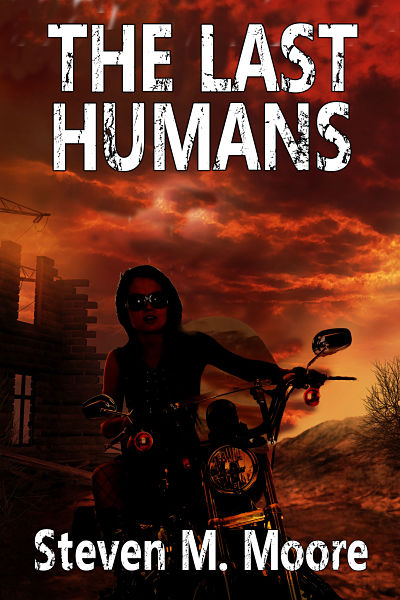
Last man alive? What about last woman alive? Penny Castro, LA County Sheriff’s Deputy and forensic diver, finds she isn’t alone after the apocalypse, though—there are a few others who survived the contagion and now want to kill her. And the remnants of a US government could be the greatest danger for her and the family she’s adopted. The post-apocalyptic thriller The Last Humans has just been released by Black Opal Books in both ebook and print versions and is available at the publisher’s website, online retailers like Amazon and Smashwords and the latter’s affiliated retailers (iBooks, B&N, Kobo, etc), and bookstores (if they don’t have it, ask for it!).

“Moore’s books keep getting better with each new effort. The Last Humans follows this trend by combining a familiar theme with a unique story and producing a great book.
The Last Humans does not dwell on the details of the cause of an apocalyptic event, but instead builds some wonderfully deep characters. A strong female lead deals with the aftermath of a biological catastrophe.
I really enjoyed this story and found it difficult to put down. Admittedly, the heroine was extremely lucky, but that did not distract from the tale.
I highly recommend this book for those who enjoy post-apocalyptic and /or action novels.”—Debra Miller, in her Amazon review.

Around the world and to the stars! In libris libertas!
Interviewing author Nancy Hughes…

April 11th, 2019

Steve: It is my great pleasure today to interview mystery writer Nancy A. Hughes. Her debut novel was The Dying Hour. Her other novels are found in her “Trust Trilogy” that includes A Matter of Trust, Redeeming Trust, and Vanished . Without further ado, Nancy, why don’t you tell us a bit more about yourself.

Nancy: After graduating from Penn State in journalism and advertising, I was a business writer for small to mid-sized companies and nonprofits. Then I turned to writing mysteries and crime stories. I’m a novelist who murders people. Tastefully. On paper. My mystery/suspense stories feature protagonists who, through no fault of their own, are ensnared in crimes that they must solve to save themselves and their loved ones.

Nancy on Reading and Writing:

Steve: Why, how, and when did you start writing?

Nancy: By fifteen, I knew I wanted to be a writer, and was fascinated by television advertising. I spent one dreadful semester as an English major, then transferred into Health & Human Development, which let me assemble an inter-college program—journalism, advertising, PR, broadcasting, business writing—this program became PSU’s College of Communications.

Steve: Did you publish the first book you wrote?

Nancy: The Dying Hour was my debut novel, but my “first book” became part of my “Trust Trilogy.” I refused to relegate A Matter of Trust, my 400+ page saga, to practice or just for fun. While The Dying Hour was being edited by my publisher, I rewrote, refined, expanded, and corrected the behemoth into A Matter of Trust and Redeeming Trust. Vanished completed the trilogy.

Steve: What is your biggest problem with the writing process? How do you tackle it?

Nancy: As a journalist turned novelist, I had to police myself not to get the who-what-when-where-why out up front, but just let readers meet the characters little by little as in real life. With a media background, I lived with deadlines. Missing them meant losing the job, the client, and my reputation, and my business. Deadlines still makes me uneasy; I rarely procrastinate.

Steve: Do you feel writing is something you need to do or want to do?

Nancy: Both! I cannot leave it alone. I have a vivid imagination and wake up with plots in my head, wanting to tear into them immediately.

Steve: Have your personal experiences or situations influenced you creatively? If so, how?

Nancy: I prepared to work in advertising, a big-city career. My husband’s agricultural banking career meant rural living, however. I created a PR business specializing in media relations, learning from a variety of people and occupations. This exposure gave me the background for plots, characters, scenes, and how things work.

Steve: How much of your creative ability do you think is innate and how much is learned?

Nancy: It’s 50-50. Being a born verbal extrovert is a plus, enabling me to approach fascinating people and absorb their ideas. My mother, a brilliant scholar and teacher, encouraged my creativity and chose a community with excellent schools. She thought I could do anything, which made me work hard, lest she find out I was average!

Steve: What is the last book you read? What are you reading now?

Nancy: I read Will Schwalbe’s Books for Living and his The End of your Life Book Club, both with amazing commentary on wonderful classics. I’m reading Christine Trent’s A Virtuous Death: A Lady of Ashes Mystery. Her protagonist is a female undertaker in an occupation unheard of for a Victorian-era woman.

Read the rest of this entry »

Book review of M. J. Markovki’s Whatever It Takes…

April 10th, 2019

(M. J. Markovski, Whatever It Takes, White Bird Publications, 2019, ISBN 978-1633633773)

Hunter Grainger acts strangely when he returns to Parker, Texas. So does Regan Argent. The two almost committed in high school; the attraction still remains. And they don’t realize how their pasts during the years away from Parker are connected.

How should I classify this novel? Much of it is steamy romance as Regan and Hunter draw closer. But all the romantic heat gives way slowly to a tidy mystery, suspense, and thriller story.

The romantic part is a bit soap-operatic, reminding me of the few peeks I’ve taken at Nicholas Sparks’s oeuvre. The rest is more disorganized and rushes a bit toward the end where the finale of Hamlet nearly occurs, with Regan in the role of Ophelia (in this case, it’s her mother who’s nuts) and Hunter in the role of Hamlet (his father is almost but not quite the villain). To make another analogy, Regan’s time in NYC reminded me of John Grisham’s character in The Firm who found out the legal establishment he worked for wasn’t quite so legal.

I’ll confess that this novel didn’t hook me at first. It improved. I gauge that by my reading speed. By the end, I was in a mad dash and when the race ended, I wanted more. I often say writing a novel is like running a marathon, so I now wish the author had paced herself a bit more. The book nearly divides into two parts: part one, the steamy romance; and part two, mystery, suspense, and thrills.

Read the rest of this entry »

Why ex-military?

April 9th, 2019

Many of my characters are strong, smart women modeled loosely after those I’ve had the privilege of meeting during my lifetime. The same is true about my ex-military characters. I’ve known quite a few real one too. (Sometimes they’re the same). There’s something about people in the military that appeals to me. I’m neither violent nor aggressive as a person, so the je-ne-sais-quoi I like about their personalities is hard to pin down. The order they embrace in their lives both in and out of the service; their skills at decision making, including snap judgments; and their strength and fortitude—all are admirable.

Some people who know me wonder why I have this admiration for people who are serving and have served our country. They know me as basically a pragmatic progressive (that’s in the vernacular now, perhaps a better replacement for “left-leaning centrist”). Maybe some of these people just equate our nation’s military to conservative, even far-right, political views. Dunno. But I do know it’s not true. Many of my older relatives fought in the Second World War. And many of our finest youth enlisted after 9/11. Their political proclivities didn’t seem to matter. And one thing is for sure: my admiration has nothing to do with politics. It has more to do with efficiency, moral fiber, and dedication, just to name a few things.

My son’s godfather was a member of the Colombian Air Force, or FAC, to use the acronym (military-speak is full of acronyms, one of the negatives—this one means Fuerza Aerea Colombiana). An upstanding gentleman, he represented most of what I admire. Exactly what you would ideally want as a godfather for your son—respectable, dignified, honorable, efficient, and a moral person as well.  He landed a wounded Mirage on its belly and walked away. He also piloted the Colombian president around in that country’s equivalent of Air Force One. He railed against terrorism long before 9/11. How ironic that his son was killed in that horrible attack! (My very first book, Full Medical, is dedicated to that son who was also like a son to me.)

My son’s godfather never rose to extreme heights  in the military echelons of Colombia for a variety of reasons (except in a plane), but one reason was that higher positions were too political. We have that same problem in the US. I admired those military types I knew who were below the political ranks of generals and admirals. (OK, I knew one VIP military man who once was provost of West Point—or whatever they call them there. I admired him too.) All of my characters, at least the protagonists, were in those lower echelons before returning to civilian life.

Read the rest of this entry »

Movie Reviews #74…

April 5th, 2019

Dumbo. Tim Burton, dir. Not Burton’s strangest by any means, and a mixed bag. Unlike the original cartoon feature, the animals no longer talk, and the humans, with the exception of Danny DeVito as the circus owner Medici, don’t emote as actors. The plot is more twisted too and doesn’t work well in this context.

Young kids probably won’t care. Most of them haven’t seen the original either. “Look, Mommy, the elephant can fly!” If that’s not enough suspension of belief in this fantasy world (should I say Dreamworld?) that you’ll have to make in this remake, consider one baby elephant’s trunkful of water putting out a ranging fir. Etc. Etc.

Tim Burton did no one any favors here. The film has some redeeming moments, and I think the cast were all trying to make it work, but they couldn’t pull it off. Disney has to stop trying to make animated films come to life. Aladdin was in the previews. Will Smith doesn’t do it as the genie after Robin Williams in the original cartoon feature and that guy on Broadway, James Monroe Iglehart, who is great. (Similar to Julie Andrews not getting the film role as Eliza Doolittle?)

I’m not sure how this film will do. It’s also bit dark in places for small kids, but not as bad as Voldemort in the last Harry Potter movies. Many kids in our theater got bored and started running around too. I’m not sure their parents weren’t bored either. I was too, for the most part, and I could have done with the animal rights” spiel at the end. Mind you, I’m a big believer in animal rights and protecting them, especially endangered species, but this was NOT a concern in 1919.

***

Comments are always welcome.

Last man alive? What about last woman alive? Penny Castro, LA County Sheriff’s Deputy and forensic diver, finds she isn’t alone after the apocalypse, though—there are a few others who survived the contagion and now want to kill her. And the remnants of a US government could be the greatest danger for her and the family she’s adopted. The post-apocalyptic thriller The Last Humans has just been released by Black Opal Books (where you can also purchase the book) in both ebook and print versions and available at the publisher’s website, online retailers like Amazon and Smashwords and the latter’s affiliated retailers (iBooks, B&N, Kobo, etc), and bookstores (if they don’t have it, ask for it!).

Here’s a review excerpt:

The Last Humans is a thrilling ride into a dystopian world. Written in first person narrative, the heart and soul of the heroine emerges. Every thought, emotion, and action is seen from her perspective. She is courageous but not necessarily brave. She faces her fears and often vomits in the aftermath. Her femininity at times gets the better of her, but her humanity always prevails. The cast of characters and the tragic events surrounding her cause her character to grow beyond expectation. This concept is mandatory for survival in an apocalyptic world, keeping to the adage ‘that which doesn’t kill you makes you stronger.’” —Cheryl E. Rodriguez, Readers’ Favorite reviewer

Read the full review on the Readers’ Favorite website.

Around the world and to the stars! In libris libertas!

Local libraries featuring local authors…

April 4th, 2019

Many residents in Montclair, NJ where I live are associated with the publishing industry—editors, journalists, screenwriters, and book authors. We’re just thirteen miles from the Lincoln Tunnel into Manhattan, so that makes sense. People stay close but move out of NYC to have some room for their growing families, and these people associated with the publishing industry are no exceptions.

There are pros and cons for Montclair authors. The big positive is that these people surround me and enrich my life as a writer. The big negative is that local bookstores have never paid any attention to me. That’s just non-productive whining, of course, and I understand where that attitude comes from: we’re too close to the Big Five, those big publishing conglomerates that, together with their big name authors, still dominate the book publishing business. Bookstores are overwhelmed with Big Five books, so mongrels like me (traditionally and self-published authors) are puny signals lost in the noise created by the Big Five.

One place where the Big Five can’t dominate are those local library shelves that feature local authors. Libraries feature their local authors, even in Montclair. There are many reasons for them to do this. The first is that the library patrons like to see books by local authors. We’re all part of the same community, after all. The second is that local authors often donate books to our local libraries. I’d be surprised if the Big Five or any of their authors do that.

I was reading our great little local newspaper awhile ago, The Montclair Local (it’s killing the older one, The Montclair Times, especially after some big newspaper conglomerate bought it). I was surprised to see Soldiers of God, my 2008 sci-fi thriller, in a pic of a rack in the Montclair Public Library containing books by local writers (that’s a print version from Infinity; there’s a 2014 ebook second edition, and I provided no link to the first because there are major changes between them). Most scientists, even those no longer practicing their professions, are observant, and, as an ex-scientist, I’m no exception. Of course the book has a striking cover (both editions, but the Infinity edition has a Juan Valdes-like campesino in the mountains of Colombia riding a burro toward a mushroom cloud—read the book). My eyes went right to it.

Like many of my “old books” (many consider 2008 “old” in today’s publishing environment, especially online retailers), it’s as current now as when I published it, maybe even more so. And it’s a “bridge book” connecting two series, the “Clones and Mutants Trilogy” and the “Chaos Chronicles Trilogy” (now all three books in the latter trilogy are bundled together as one ebook–see below).

I was happy to see the library’s copy still looked OK, but I was also sad to see it in that good condition at the same time. I’ve donated many print versions to libraries, including the Montclair Public Library—most are worse for wear, beaten up and dog-eared (they’re trade paperbacks, after all), so I’ve often replaced many of them with new copies. Hopefully more library readers try Soldiers of God. To be immodest, I’d say it contains some of my best prose. Maybe readers are scared of the mushroom cloud? Buy the ebook then.

But back to libraries. I’ve also donated books on the West Coast, thanks to an old high school chum. (I’d do the Midwest if I had old high school chums who lived there.) I also offer special prices for my ebooks to public libraries on Smashwords, which translates to their affiliated library services getting a break on prices (although all my books are inexpensive to begin with).

You see, my main goal as an author is to write stories that will entertain readers however they read my books. I’m also a great believer in public libraries. My reading life was enriched by them at a tender age.

And doesn’t everyone feel more comfortable browsing through recently published books in a quiet library than in a crowded bookstore? I have nothing against bookstores and know they’re having a tough time in this modern publishing environment, but I hope libraries will go on forever.

***

Comments are always welcome.

Chaos Chronicles Trilogy Collection. From a dystopian Earth dominated by multinationals and their mercenaries, to star colonies and first contact, and to the future and beyond where a maniacal industrialist seeks to conquer all near-Earth planets, this trilogy contains in one ebook Survivors of the Chaos, Sing a Zamba Galactica, and Come Dance a Cumbia…with Stars in Your Hands! This bargain bundle of three books is available on Amazon and Smashwords and all the latter’s affiliated retailers (iBooks, B&N, Kobo, Walmart, etc).

Around the world and to the stars! In libris libertas!