Time and FTL travel…

May 30th, 2019

Time travel is barely mentioned in Sing a Zamba Galactica (second novel in The Chaos Chronicles Trilogy Collection); faster-than-light (FTL) travel plays a key role in unifying the planets of near-Earth space into ITUIP (Interstellar Trade Union of Independent Planets). If that doesn’t sound strange enough, consider that both time and FTL travel are linked in that trilogy by similar physics.

The star systems of the first three Human colonies were reached by old interplanetary rigs that took around a hundred years to travel there at sublight speeds. Only after first contact with ETs on the planet New Haven in the 82 Eridani system did two physicists, one Human, the other ET, come up with the foundations for an FTL drive.

While time travel was mentioned in an oblique way in Sing a Zamba Galactica, and later in the Moliere-like farce “The Apprentice” (short story in the speculative fiction collection Pasodobles in a Quantum Stringscape, Volume Two, available as a free download—see my “Free Stuff & Contests” web page), I tend to avoid the topic. It’s rarely well-handled, even ignoring the many paradoxes that often occur in a plot (both of the previously mentioned stories avoid them).

If authors want to transport readers back to the past, steampunk might be the better option. It’s a subgenre of sci-fi or fantasy (the line, as is often the case, is blurry) that in general asks the question, “What would the world be like if recent important inventions were actually made in the past?” In other words, steampunk is alternate history, and that’s a clue for treating time and FTL travel correctly (i.e. without paradoxes or contradicting Einstein).

I learned about the “Many Worlds Theory of Quantum Mechanics” when studying the origins of how Professor Feynman came to quantize classical fields, the electromagnetic field in particular. Some people, even physicists, associate his quantization technique to what are now called Feynman diagrams, simplistic shorthand for studying a series of terms that contribute to the answer. That is too simplistic.

Read the rest of this entry »

Steve’s shorts: The Lighthouse…

May 29th, 2019

[Note from Steve: Sometimes vacations can bring surprises. Are you going on one this summer?]

Angela looked across the water where the waves crashed against rugged cliffs. A lonely lighthouse stood atop the cliffs guarding the entrance to the small harbor.

“Can I hike to that lighthouse?” she said to the wait person.

The older woman looked to where she was pointing. “Old Angus runs that lighthouse. He’s not one to welcome visitors. Keeps to himself, he does.”

“I’ll respect his privacy. I’m just thinking the view from up there would be spectacular.”

“I suppose. You’ll need a slicker. The spray’s pretty bad over that way. High waves pounding the cliffs most of the time. Anything else I can get for you?”

“No thank you. Everything was just delightful. Just the check.”

The SUV she had rented for her vacation in New England didn’t have any problem going up the steep approach road to the lighthouse. She left it parked in a cutout about a hundred yards from the building. Still a steep walk up to the lighthouse, but she didn’t plan to go there. True to her word, she’d respect the lighthouse keeper’s privacy.

She saw the old man and waved, though. No wave back.

She climbed a bit on rocks to get better views of the roiling waves crashing onto the ones below. Nearer the edge of the cliffs, there was more spray. Good thing the old lady in the diner warned me. She zipped up the rain coat. Her sneakers were getting wet, though. They had grooved soles, but she was still careful.

But one rock had both moss and spray remains. In an instant she was falling. She screamed all the way down.

***

The smelling salts woke her. The old man took them away and studied her.

“Leg’s broken, missy. Lower left. Have some tea now to get warm. I’ll carry you to your car when you’ve recovered.” He left the room.

The bed she was lying on had squeaky springs and a thin mattress and nothing else. An unused guest room? I must be in the lighthouse.

She could hear the pounding surf., so the room must be on the first floor facing the ocean side. There was no window to confirm that. How did I get here? I should be dead!

She couldn’t remember anything between hitting the water and awaking in the lighthouse’s room.

Angus returned. “Made some scones just this morning.” He put a plate on the nightstand next to the tea. “Sorry I can’t offer you a meal. I’ve only got some old leftovers.”

“Thanks Angus.” She took a bite and then sipped some tea. “How did I get here?”

He shrugged. “You fell; I saved you. Those rocks are treacherous.” He glanced at the door. “I’ll be back in a moment. I was cleaning the lens when I saw you fall. Good thing I did. You’d be food for the fish otherwise.” He smiled at her. “I’ll go finish that task now. When I return, maybe you’ll be ready for me to carry you to your car.”

He slipped away again.

***

Angela’s leg didn’t hurt. It was in a homemade splint. Maybe just a sprained ankle? But the splint reached almost to the knee.

She finished the scone and tea and swung over to sit on the edge of the bed. She flexed the leg, expecting a shooting pain. She’d broken her right leg once playing ice hockey. Not the same feeling.

She could even stand, although a bit wobbly. Not broken. Why did he lie to me?

She heard footsteps and sat on the edge of the bed again.

Read the rest of this entry »

Author gigs…

May 28th, 2019

To get them, you have to be a “popular author”; one way to become a popular author is to get them. That’s a vicious circle many authors face—maybe not those outside the NYC area, but in my case….

What do I mean by “gigs”? Not the usual rock-group or jazz-group meaning, but traditional ones for authors—book signings, lectures, discussions, and so forth. I’ve done a few, but not as many as I’d like to do. Why?

One basic reason: We live close to NYC, so the Big Five authors dominate the gigs in the area. They live around here too. And more than fiction writers—Hillary Clinton had a book signing at a local bookstore for her last book (she lives in NY state). Both the Montclair Literary Festival and the Montclair Film Festival have also been taken over by celebs (Colbert’s wife runs the latter). Bookstores have waiting lists for book signings. Therefore I take a stealthy approach and try to do gigs Big Five authors would think were beneath them. It’s tough, though. In other words, I’m still stuck in that vicious circle.

None of this is the fault of readers, mind you. The celebs will draw people who don’t even read much—video game players and viewers of streaming video, for example. But avid readers are usually happy to have a conversation with an author, anywhere, anytime. I meet them on park benches relaxing during a walk, in doctors’ waiting rooms, at theatrical and music functions, and so forth—that’s why I always carry business cards with me.

Recently I gave a card to a fellow. The next time I saw him, he said, “Hey, you’re the real deal. I’m going to read some of your books.” Maybe, maybe not. But there was a definite interest.

And that’s the crux of the matter. By living where I live, I’m close to many activities and meet many people. I just have a hard time finding gigs.

“What about conferences, or book tours?” you might ask. Again, some Big Five authors monopolize them. Cost is a factor—attendance fees and per diems, respectively, and the cost of hotels. Anyone can go to the International Thriller Writers conference in July. No hotel for me; it’s in NYC. I could go in by bus or train. But ITW charges an arm and a leg to attend. Until I have a blockbuster book, having the money to do that isn’t in the cards (or maybe it is—blackjack at an Atlantic City casino?). And I can’t see that meeting a bunch of other thriller authors would be much fun or benefit when I prefer to meet readers.

Maybe I’d be better off moving to Maine near Stephen King and becoming more of a recluse (avoiding the author’s fate in Misery, of course). Or maybe I just should keep writing my stories and forget about gigs.

The ones I’ve done have been fun, though. I had no long lines stretching out the door like the celebrity authors, but I bet I had more time to meet and greet readers one on one, two ordinary people with one just happening to be an author.

***

Comments are always welcome.

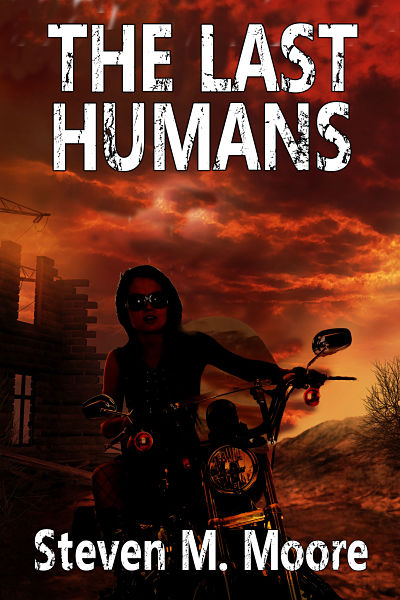
The Last Humans. Penny Castro is on a forensic dive off the SoCal coast for the LA County Sheriff’s Department. When she surfaces, she finds her fellow deputies and a witness dead. Follow her adventures as she struggles to survive in a post-apocalyptic world. Available in ebook format on Amazon and Smashwords and all the latter’s affiliated retailers (iBooks, B&N, Kobo, etc) and in print on Amazon and in your favorite local bookstore (if they don’t have it, ask them for it). The book is also available at the publisher, Black Opal Books.

Around the world and to the stars! In libris libertas!

Memorial Day…

May 27th, 2019

Let’s all remember the true meaning of Memorial Day: honoring all those who made the ultimate sacrifice to preserve democracy.

The most important equation…

May 23rd, 2019

As a scientist, I dealt with many equations. As a full-time writer, not so much. Many people know Newton’s F = ma. That equation, and its rotational form, τ = Iα, appear in Survivors of the Chaos (the first novel contained in The Chaos Chronicles Trilogy Collection). That’s about it for equations in my fiction.

Some people might think that Einstein’s equation linking the curvature tensor of space and time to the matter-energy tensor in General Relativity is the most important one in science, or Maxwell’s equation for the electromagnetic field (tensor form so it’s just one equation). The latter certainly has more application in our everyday lives than the former, if that’s important.

The most important equation, though, is exp (i π) + 1 = 0.

exp (i π) is usually written differently—e to the i times π—but I use the less common form to avoid superscripts. The functional notation exp ( . ) is shorthand for the irrational number e raised to some power. Here i is the imaginary unit that is the square root of -1; all complex numbers can be written in the form a + bi where a and b are real numbers. exp (i π) can be written that way too: cos(π) + i sin(π). The symbol π is the ratio of the circumference of the circle to its diameter, and some readers might remember that cos(π) = -1 and sin(π) = 0.

So there you have it: that most important equation just says that -1 + 1 = 0. “Big deal!” you might say. Well, it says that in a most beautiful and profound way, connecting the five most important numbers in mathematics. First 1, the first natural number, the numbers used in counting; second, 0, an important human invention signifying nothing, but also used as a placeholder, as in 1000; e and π, the two most important irrational numbers in the set of real numbers; and finally i, needed to create the complex numbers so important to scientists and engineers.

Why do these numbers link up this way? Maybe that’s not the right question. The better question: Isn’t the discovery that they do link up this way in one equation more important than any physical law ever discovered? There’s something immutable and unchangeable about this equation beyond any other in science.

Think about it. True science is empirical. Experimental data lead to “laws” like F = ma that explain many natural phenomena, but Newton’s law must be modified to explain special relativistic effects occurring at high velocities. There’s nothing empirical about exp (i π) + 1 = 0 at all. It would exist for some ETs living at the bottom of a methane ocean under huge pressures, or on a planet in the 82 Eridani star system (they’re there, and you can read about them in Sing a Zamba Galactica, novel #2 in the collection mentioned above). The symbols they might use in the equation could be different—maybe just sonograms—but that doesn’t matter.

That equation exists without any phenomena at all, and it can be considered a cornerstone of universal mathematics. It’s a mathematical tautology of the utmost importance.

Think about it this way: the equation connects natural numbers, integers, real numbers including two fundamental irrational numbers (ratios of integers are rational numbers), and complex numbers. The only thing that this equation doesn’t include are quaternions, the biggest set of numbers that includes them all that scientists sometimes use to describe three-dimensional rotations.

Now, isn’t that one beautiful equation?

***

Comments are always welcome.

Mind Games. You know A. B. Carolan as the writer of The Secret Lab and The Secret of the Urns. Those novels are sci-fi mysteries for young adults (and adults who are young at heart). In Mind Games, A. B. tells a new story that’s set a bit farther into the future than his first two books. Della Dos Toros is a young girl with psi powers living in the Dark Domes of the planet Sanctuary. Her adopted father doesn’t let her use those powers, but she must do so to find his killer. This story about ESP and androids adds another action-packed novel to the ABC Sci-Fi Mystery series. Available in both print and ebook versions.

Around the world and to the stars! In libris libertas!


Product and place names in your prose…

May 22nd, 2019

I use them: liquors, hotels, and so forth. They’re all part of the plot, unlike the Starbucks cup in a recent Game of Thrones episode. The reason? They go a long way in satisfying Tom Clancy’s maxim that fiction must seem real.

Mystery and thriller writers often avoid this because they don’t want to be accused of endorsing or criticizing something real (both can lead to negative reactions from readers; the latter can lead to lawsuits). Avoiding them and using only fictional names goes a bit too far, though. The reasons given aren’t valid if the author is neutral or positive, although a positive remark might upset a reader who hates the product or place. Tough!

I say that because characters who express opinions about real products and places are human beings who have a right to express them (even I might disagree with them!). And the products and places are there in the real world, so why can’t characters refer to them like everyone else?

In The Last Humans, I never mentioned the country responsible for the apocalypse. I focused more on main character Penny Castro’s post-apocalyptic struggles. In the sequel, the reader will find out what that country was, but it has been changed by the apocalypse too. That’s part of the story.

You see, real products and places evolve too, just like characters. There are some places that are static for many years, or even throughout the characters’ lives—Yosemite Valley, in the case of Penny Castro’s adventures. But even those evolve, especially considering the characters who frequent them.

Most fiction has a mix of real and fictional. Rembrandt’s Angel contained places I’ve been too, for example, and places I made up. It even featured a real, missing painting! We satisfy Clancy’s maxim if it all seems real. Much of the sequel to that novel, which follows Sandro Botticelli, the Renaissance painter, and St. John the Divine, moves between real places but fills in the history of what the characters did there, which is fiction. It also creates new old places in the sense that I took liberties and created them within the real historical settings.

Products are a bit trickier than places. There’s no problem when I write about havenberry wine (from the planet New Haven in the 82 Eridani system)—see the new book Mind Games—that’s sci-fi, and a reader has no idea whether he would like it or not. And the ETs who make it won’t time-travel back to sue me if they don’t like what I say about it!

Contemporary products can present problems, though. I adopt the same policy as I do with real characters. If I am neutral or say something good about a product, the company that makes it won’t sue me. Why would they? And readers will just have to live with what the character who expresses her or his opinion about that real product states in the prose. In fact, the latter ties in nicely with minimalist writing because, if the product is real and well known to readers, they become participants in the story, whether they like the product or not. Minimalist writing is all about involving the reader.

With the caveats mentioned above, I can see no negatives for using real product and place names in your prose. So use them in your fiction to make it come alive. If you worry about legal repercussions, consult a lawyer!

***

Comments are always welcome.

Mind Games. You know A. B. Carolan as the writer of The Secret Lab and The Secret of the Urns. Those novels are sci-fi mysteries for young adults (and adults who are young at heart). In Mind Games, A. B. tells a new story that’s set a bit farther into the future than his first two books. Della Dos Toros is a young girl with psi powers living in the Dark Domes of the planet Sanctuary. Her adopted father doesn’t let her use those powers, but she must do so to find his killer. This story about ESP and androids adds another action-packed novel to the ABC Sci-Fi Mystery series. Available in both print and ebook versions.

Around the world and to the stars! In libris libertas!

“Evergreen Books”…

May 21st, 2019

Every book in my lists of “Best Mysteries and Thrillers” and “Best Sci-Fi Books” (see my blog posts in the “Writing” category) is an “evergreen book.” What does that mean? It means they never grow old, whether they’re considered a “literary classic” or not. Of course, many literary classics are also evergreen (and some classics are just terrible reading for most readers today).

But evergreen books in the sense that they’re still wonderful books to read, even if they were published a while ago, form a much larger class than best books in a genre or literary classics. Many early books in an author’s oeuvre are evergreen. Unfortunately bookstores and online book merchants prefer to market recent books over evergreen books, thus depriving readers of good books to read and authors of those books readership and royalties. The smaller the bookstore, the more likely this is done. That’s a stocking or warehousing problem essentially. The online merchants like Amazon and Smashwords have no excuse; they have all the space in the world. The reader can find evergreen books there, but they have to know the title and author. (Titles aren’t copyrightable, so you observe the same or similar titles used over many decades.)

Thirty out of thirty-five books listed on my “Steve’s Bookshelf” web page under “Fiction” and “Stealth Reads” are evergreen. The non-fiction books there tend to be more topical and recent, important now, but maybe not future evergreen books. All these books are ones that have really impressed me, for whatever reason, which points out that which books are considered evergreen might differ from reader to reader. Still, when an author declares a book is evergreen, it must bear a little weight, and readers should consider them. (Note: Not all books in my lists of “best books” are on my bookshelf page. There’s just not enough room, and I wanted to get those “Stealth Reads” on that web page.)

While two recent books of mine, Mind Games and The Last Humans, were published this year (2019), I published my first book Full Medical in 2006. It’s an evergreen book because it’s as current today as when it was published, maybe even more so, because it deals with cloning as a nefarious solution to the lack of organs to transplant. I’ve published a few books per year since then. Everyone of them is evergreen except for those 2019 books, which are just “new.”

The “review circus” keeps many evergreen books from popping up on online sites. Unless a book has 25+ reviews, Amazon ignores it, and, of course, Amazon, in their infinite wisdom, doesn’t count reviews posted anywhere else! Amazon mitigates this somewhat by sometimes popping up books that are selling well, even if they don’t sell well. Smashwords pop-ups are only determined by the latter. Any intelligent person can see what a vicious circle this is: pop-ups and other promos will draw customers to books, but they pop up only if many other customers were already drawn to them by some other means.

On my Amazon author page, titles are listed in order of sales, not reviews, although publication date is also weighted somehow (only the bots know the formula). Smashwords simply lists them in reverse chronological order of publication. The first is that vicious circle again; the second makes evergreen books less visible.

Book marketing in bookstores and online conspires against evergreen books. Savvy readers know that and go looking for them, on the author’s online author pages, in used bookstores, and in public libraries. Be a savvy reader. You’ll be surprised at what you can find among those evergreen books.

***

Comments are always welcome.

Mind Games. You know A. B. Carolan as the writer of The Secret Lab and The Secret of the Urns. Those novels are sci-fi mysteries for young adults (and adults who are young at heart). In Mind Games, A. B. tells a new story that’s set a bit farther into the future than his first two books. Della Dos Toros is a young girl with psi powers living in the Dark Domes of the planet Sanctuary. Her adopted father doesn’t let her use those powers, but she must do so to find his killer. This story about ESP and androids adds another action-packed novel to the ABC Sci-Fi Mystery series. Available in both print and ebook versions.

Around the world and to the stars! In libris libertas!


Authors reading…

May 16th, 2019

I was recently amused by an op-ed in the NY Times (5/5/19) written by a novelist. I neither know this writer nor his books. That’s not important. What surprised me was the admission that he wasn’t an avid reader. He seemed to prefer watching Netflix to reading, only returning to the latter for any length of time when the TV network went down.

I probably shouldn’t criticize, but how can you be a writer without being an avid reader? OK, maybe not an avid reader, but someone who at least sits down with a book and reads for long stretches of time instead of watching mind-numbing TV?

“Whoa!” you say. “People can spend their leisure time any way they see fit!” I agree. A person can do anything they want with their spare time, some things unmentionable in this PG-13 blog—hopefully not illegal (the definition of that seems to change all the time). But, in my naiveté, I always assumed authors tell stories because they love story telling. The want to give to the world new stories because they’re hooked on reading others’ stories.

To put a fine point on it: how can authors write good mysteries, for example, if they haven’t read good mysteries to learn how those stories are told? Same for thrillers and so forth. Most of my interviewees have expressed that opinion in one way or another, so I’m not alone in stating that you can’t write well if you haven’t read enough to see how it’s done.

To be fair, maybe that author of the op-ed read a lot before he started to write novels, so he has some idea about how books in his genre used to be written. But the italicized words indicate the same general theme: he has no way of knowing how today’s books are being written. Readers tastes evolve. While some readers only follow certain authors, avid readers often try new ones and new books. I’m often reading a new author and say to myself, “That’s a cool way to do that,” or “That’s a new technique I should try.”

In a previous post, I related how I saw James Patterson mix first and third person in the same book. I’m not plagiarizing Patterson when I do this; I just learned a writing trick from him to use in my own writing by reading his books. If I only wrote my books and ignored others’, this could never happen.

It’s surprising that the op-ed writer is distracted by NetFlix. Distractions abound nowadays, so readership is declining everywhere. It’s surprising that a writer is distracted, though. I watch TV to relax too, but not that much. My preferred shows are news programs and PBS shows like “Nature” and “Nova,” but I’ll watch a decent drama too (and criticize the screenwriters—if they’re too bad, I turn it off). But I’ll reach for my Kindle in a jiffy if what’s on TV is mind-numbing junk.

Am I a member of an endangered species? I don’t think so. Lots of people are avid readers still. I just thought that group contained all authors. You learn something every day.

***

Comments are always welcome.

Mind Games. You know A. B. Carolan as the writer of The Secret Lab and The Secret of the Urns. Those novels are sci-fi mysteries for young adults (and adults who are young at heart). In Mind Games, A. B. tells a new story that’s set a bit farther into the future than his first two books. Della Dos Toros is a young girl with psi powers living in the Dark Domes of the planet Sanctuary. Her adopted father doesn’t let her use those powers, but she must do so to find his killer. This story about ESP and androids adds another action-packed novel to the ABC Sci-Fi Mystery series. Just published and available in both print and ebook versions from Amazon and ebook version from Smashwords and all the latter’s affiliated retailers (iBooks, B&N, Kobo, etc).

Around the world and to the stars! In libris libertas!

Son of Thunder…

May 15th, 2019

There were two options to consider when I thought about writing a sequel to Rembrandt’s Angel: (1) Write about Scotland Yard Inspector Esther Brookstone’s life as a spy in MI6 during the Cold War (i.e. a prequel), or (2) write about some adventures Esther had after those described in Rembrandt’s Angel. As it turns out, I did both!

Let me explain. The main story revolves around Esther and Interpol agent Bastiann van Coevorden, her paramour, the main characters in Rembrandt’s Angel. Also featured are the Renaissance artist, Sandro Botticelli, and St. John the Divine, Christ’s favorite disciple. (And there’s no time travel!) Woven into the plot are flashbacks to Esther’s MI6 career and the side story of Bastiann’s efforts to thwart illegal weapons merchants. Various other themes and substories are present as well, including those about Esther’s Scottish castle, BBC documentary, and art gallery.

The prose about the historical figures so important to the main plot required a lot of research, more so than in any of my other books (they all required some). For example, it is known that John lived a long life. I gathered facts and legends and decided which ones to include in the story. I then had to become creative and fill in enough details to make a historical-fiction tale about the turmoil in the early Church during John’s life. He partners up with Mary Magdalene in a few adventures (no Da Vinci Code romance here, though).

I always wanted to write something about St. John. His gospel is so much more interesting than the other three (there are many more gospels, but the Church only chose four for the canonical Bible). And then there’s the Book of Revelation. Did he really write that? His gospel is about a loving God; the Book of Revelation returns to the vengeful God of the Old Testament. (Just my perception, of course.)

Sandro, like many Renaissance artists, made a living painting works about both religion and mythology. Medici, his patron, financed his and others’ frescos in the Sistine Chapel before Michelangelo even touched that ceiling (maybe that’s why he did the ceiling—it was the only space left?). He goes on a trek with his parish priest in the story. Both trip and priest are fictional (we don’t know how much Sandro actually traveled), but the places visited are real.

Esther and Bastiann seemed to be the right pair to add to this mix. Does it matter that there are three parallel but related stories here? I promise you that their stories are interwoven, but that’s all I’ll say. To learn how that occurs, you’ll have to read the book when it comes out. You’ll also learn the origins of the title.

Besides the usual beta-reading and pre-editing I do for every book, I also sent a copy of the manuscript to a Jesuit priest. I’ve had good relationships with Jesuits in the past. I asked this priest to look it over to see if the history part of this historical fiction tome agreed with known facts. I did a lot of research, but you never know (Dan Brown was led astray with The Da Vinci Code). The priest never answered, so I guess he didn’t find anything wrong (chuckle).

While this book was a lot of work for the required research, it was also a lot of fun to write. I hope it will be fun for everyone to read.

***

Comments are always welcome.

Rembrandt’s Angel. Scotland Yard Inspector Esther Brookstone, the Art and Antiques Division, becomes obsessed with recovering a Rembrandt painting stolen by the Nazis in World War II. Her paramour and Interpol agent Basitann van Coevorden tries to focus that obsession and keep her safe. Their pursuit of the painting leads to a far larger conspiracy. Available at Amazon and Smashwords and all the latter’s affiliated retailers (iBooks, B&N, Kobo, etc.), as well as in our favorite local bookstore (if they don’t have it, ask for it). The sequel, Son of Thunder, is coming soon from Penmore Press. (Check out their catalog for many more good books to read.)

Around the world and to the stars! In libris libertas!

Characters…

May 14th, 2019

Last week I discussed point of view (POV) vs. person. Both involved characters and how we treat them in our stories.

Readers often identify with characters. In my fiction, I kill a few off. Invariably, someone comments or writes, “Oh no, not X! He’s such a great character.” Readers can become attached to characters, but writers have to treat them a bit more objectively—what happens to them must fit the plot and move it forward, and fit the themes winding in and around the plot.

Some authors don’t pay much attention to characters’ names, whether they’re going to kill them off or not. I worry about names a lot. I often use an X as a placeholder until I learn what X is like. Names reflect many things. As an amateur interested in languages and how their histories reflect cultural trends, I believe each character should have an appropriate name. My Detective Castilblanco is a Puerto Rican-American; my arch-villain Vladimir Kalinin is Russian. Although they are both men of the world, their cultural backgrounds play important roles in their subsequent lives portrayed in my fiction.

Writers don’t have to go overboard with their characterizations, but we don’t want our readers to be perplexed and say “Huh?” Dick, Jane, and Spot just don’t cut it either. Who a character is has to make sense. Characters have to seem real. What they say or do has to make sense too.

The flip side of that coin is that a character shouldn’t be a carbon copy or caricature of any real person, especially the author. Writers have to become a bit schizophrenic so every character is a different person one might encounter in real life. I find all that easier to do in first person all the way through the book (that has other benefits too), but many stories aren’t one-person stories. In fact, some novels, through complexity or length of time considered (e.g. several generations), have many characters.

I don’t write outlines for my books, but I maintain a list of characters. At some point when that list becomes too long, I will include the final list at the beginning of the novel. In any case, my personal list has the name of the character and a short description. That also helps me see if I have described a character well enough in words to match my mental image of the character, both physically and mentally.

Imagination is key when telling a story. It’s key for the plot, although that can evolve. But it’s super-important for characters. We need to imagine the inner persona as well as the outer. Both are important.

As often happens in any creative activity, good characterization in writing comes with practice. It is based on observation too. Observation and practice work in hand to make our characters come alive in the reader’s mind.

***

Comments are always welcome.

Mind Games. You know A. B. Carolan as the writer of The Secret Lab and The Secret of the Urns. Those novels are sci-fi mysteries for young adults (and adults who are young at heart). In Mind Games, A. B. tells a new story that’s set a bit farther into the future than his first two books. Della Dos Toros is a young girl with psi powers living in the Dark Domes of the planet Sanctuary. Her adopted father doesn’t let her use those powers, but she must do so to find his killer. This story about ESP and androids adds another action-packed novel to the ABC Sci-Fi Mystery series. Just published and available in ebook and print format from Amazon and ebook format from Smashwords and all its affiliated retailers (iBooks, B&N, Kobo, etc).

Around the world and to the stars! In libris libertas!