First contact…

June 20th, 2019

It comes in two forms: we meet them out there, or those out there come here to Earth. In any case, the theme is ubiquitous in old sci-fi. I’m not sure how much it’s used today. Recent discussions in the media of UFO sightings (remember, UFO only means “unidentified flying object,” not an ET’s vehicle, in spite of NY Times crosswords’ clues) might increase tales about first contact. Who knows? So it might be worthwhile to study how believable such tales can be.

Both versions have the problem that “out there” means the vast reaches of intergalactic space…and beyond. I’ve already discussed this in a previous post. Either version means someone, either an ET or human being, has to travel so far that it’s hard to get our minds around what the distance is. But let’s assume that it can be done, that two groups, ETs and humans, could somehow get together for the first time and have a chat. Why would they or we want to do so?

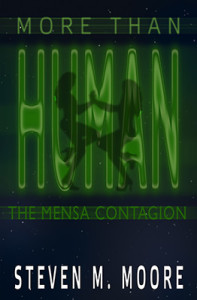
For humans, we could say that it might just be curiosity or the challenge. That’s why people who know nothing about climbing want to climb Mt. Everest—even why those who do so attempt the climb. That’s why people decide to visit all the continents after they retire. And that’s the scenario for the colonization of Mars in More than Human: The Mensa Contagion. But would that be enough to go to the stars?

Today isn’t 1969 or just before. I never bought into the competition with the Soviet Union to motivate the space race. Most people I knew didn’t. What motivated us was answering the question “Can we get to the moon?” We didn’t care about US pride or international politics. We were motivated by the challenge. Today one sees many people who even think going back to the moon is a waste of money. And the Pentagon certainly wouldn’t support that—all they probably want to do is put up more spy satellites, or sneak in a few satellites with nukes on them. And private industry just wants comsats and so forth where they can make lots of money. We’ve gone from sublime curiosity and meeting abstract challenges to greedy profit-making.

Sure we have a few visionaries like Elon Musk, Richard Branson, and their ilk, but not even the general public supports space research anymore, unless NASA can do it on a shoestring budget. And the politicos take this attitude and run with it. Budget cuts are crippling the space agency, as they are most scientific research.
Read the rest of this entry »

ABC shorts: The Map…

June 19th, 2019

The Map

A.B. Carolan, Copyright 2019

“Maybe it’s a treasure map,” Kevin said after unrolling the document they’d found in the old house onto the attic floor and putting some old tools at each corner to hold it down.

“Kind of weirdo,” his friend Dave said. “Just a bunch of black dots with some numbers beside them. Maybe the rest of it faded away? The paper’s brittle.”

The roll of paper had been in the top, thin drawer of an old chest. The other larger drawers were filled with rocks.

Kevin looked around. “Kinda spooky up here. I’ve seen enough. The old house is just full of junk no one wants.”

Dave squatted and studied their find. “Maybe Mr. Sandoval can analyze the paper. It’s old. Could be fun to see how old.”

Jorge Sandoval was the boys’ chem teacher. He also taught bio—they’d had him for that—and physics, which they’d heard was a really tough course. Kevin wanted to take that; Dave wasn’t sure.

Their high school wasn’t big enough to have more than one science teacher.

“Okay,” said Kevin. “Up to you. He’ll ask where we got it if it’s real old, you know.”

Dave shrugged. “Then we’ll tell him.”

***

Jorge was in his garage thinking about the next week’s demo for physics class. The topic was polarization of light. He’d just had an idea. Instead of an optical demo—the class’s back row wouldn’t be able to see anything—he’d use microwaves. Everywhere in the classroom, the kids could hear the effects of polarization instead of having to see them. He thought he had the equipment to do that in his garage.

He saw through the high basement windows Dave and Kevin, the future graduates from the class of 1984, park their bikes. They burst into his house and came galumphing downstairs. He saw the roll of paper in Dave’s hand.

Read the rest of this entry »

Author photos…

June 18th, 2019

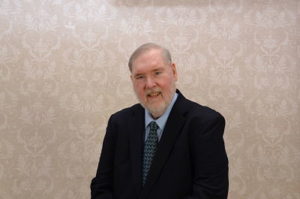
I probably don’t do enough of them because I haven’t found one I really like yet. Although my headshots appear in many places on the internet and in my books, they all look staged. Just below is my most recent one, which seems very staged (first pro shot). One of my first, with sunglasses, makes me look a bit like Tom Clancy. With my glasses off, my kids used to say I looked like Kris Kristofferson.

I think authors have a tough time with photos because a lot of us are nerdy introverts and not eager to project a public image in the photographs or otherwise. I still think a real headshot is better than some iconic doll or flowers, though. People sometimes want to know more about the authors they’re reading, the face behind the words as it were.

I just finished upgrading and updating my website, more to get some new book covers in, but that recent headshot is there too. (The job was done by Monkey C Media, my website gurus—thanks to them, the old website hangs in there.) That photo might put fear into a young adult reader interested in A.B. Carolan’s books, but hopefully they will learn I don’t write horror stories (and neither does A.B., and he doesn’t have a headshot—his icon in some places is a leprechaun, which suits him just fine).

An author’s promotional efforts bifurcate into two marketing areas: (1) personal branding, and (2) promoting her or his books. Fiction authors often forget #1 and focus on #2. #1 is an obvious goal for “experts” in something who write about it—the personal brand is what markets their non-fiction book(s)—so they worry about it. Even some fiction writers are better known for their personal brands—their fiction becomes an afterthought after they start making more money giving advice to other authors like “Just do what I say in my marketing books, and you’ll become a NY Times bestselling author.”

Unfortunately most fiction authors have to deal with both #1 and #2. I’m new to Twitter, but from the very beginning I didn’t want to spam the Twitterverse with ads for my books. I try to let readers and the #writingcommunity know who I am with pithy comments, retweets, and so forth; hopefully some of them help authors too. I also poke a wee bit of fun at the publishing business with my #daffynitions and try to motivate everyone with quotes from famous authors that I particularly like. I also “like” similar things other authors post but rarely their book ads (I read most of them, though, if that makes them feel any better).

Read the rest of this entry »

News and Notices from the Writing Trenches #170…

June 14th, 2019

[Note from Steve: I cannot believe this is only issue #170 of my “News and Notices…” after 10+ years of this blog. But here it is.]

Spring and summer reading. Summer seems almost here, and then it’s not. So let’s just agree to say spring and summer reading is here—books to read on vacation, day-trips to the beach, or in those lazy evening of daylight savings time when you’re tired of TV reruns, lack of good movies, or everyone hogging your internet bandwidth. Or just books to read on those bad-weather days.

Given that ode to the changing seasons, let me make a couple of…

Reading recommendations. Here are two books I found entertaining (I wrote reviews for both of them):

Kilts and Catnip. Zoe Tasia, author (Black Opal Books, 2019). This romantic fantasy features an American in Scotland who discovers there’s something to those Celtic myths.

Aegir’s Curse. Leah Devlin, author (Penmore Press, 2015). This mystery/thriller features a Viking ship discovered near Woods Hole, MA. What could go wrong?

Black Opal Books and Penmore Press are small presses. You can find their catalogs online at https://blackopalbooks.com/ and https://www.penmorepress.com/. Please support small presses. They have treasure chests you’ll find full of gems—entertaining books to read!

TBRoR books. Now that I have three books out the door in 2019 (four counting a manuscript—see below), I can get some R&R and return to my TBRoR-list of books. (It’s always growing—so many good books and good authors, and so little time to read. I shuffle the list around sometimes, depending on my moods). Here’s three I want to read ASAP:

The Bottom Dwellers. Leah Devlin, author (Penmore Press, 2015).

The Clock. Leonardus Rougoor, author (Black Opal Books, 2017).

Sins of the Sister. Zari Reede, author (Black Opal Books, 2018).

Although I’ve started all three (I often have two or three going for variety), finishing those three aforementioned books of mine interrupted my serious reading for a while. It will be good to get back to them. They’ve all passed my title, cover, blurb, and “peek inside” tests, and books from 1.5 of the authors’ previous works (that’s an author’s inside joke) I’ve already read. All look interesting. (You’ll note that they’re from the same two small presses.)

Magic vs. science. Science fiction grandmaster Arthur C. Clarke’s quote is a good way to start this segment: “Any sufficiently advanced technology is indistinguishable from magic.” This is more than a glib remark from an old sci-fi writer. It is an important statement about technology.

Read the rest of this entry »

Stars and planets…

June 13th, 2019

It’s hard for anyone to get their head around how far away the stars are. The nearest, Proxima Centauri, is 4.243 light-years distant—a light-year is the distance traveled by light in a year, going at 186,000 miles per second!

Three Sol-like real stars (i.e. like our sun) are where the Human colonies of New Haven, Novo Mondo, and Sanctuary are located in The Chaos Chronicles Trilogy Collection (a three-novel bundle from Carrick Publishing). In A.B. Carolan’s Mind Games, the main character visits two of those colonies, plus a much-changed Earth. The stars, 82 Eridani, Tau Ceti, and Delta Pavonis, respectively, are about twenty light-years from Earth. They’re G-type stars like our own. I started writing about these colonies around 2000, so I didn’t know if there were real Earth-type planets in those faraway solar systems. I still don’t.

Today scientists have discovered many real extrasolar planets. Some are in the zone where liquid water can exist, so a sci-fi writer today might choose one of those as a setting for a story. The stars I chose are still good ones, but if scientists find they have no planets or none are in that sweet spot relative to their parent star, I’m toast.

In addition, we now know some stars have a huge Jupiter-like planet in that sweet spot. That’s not a bad setting either because a planet like that can have a large moon that’s like Earth, full of life. Such is the case of Hard Fist, a satellite of Big Fellow, and where the action of A.B. Carolan’s The Secret of the Urns takes place.

When I began writing the books in the trilogy bundle above, no one knew if any stars besides ours had planets. At least now we know planets are ubiquitous. Three of my four fictional ones I’ve mentioned had life before Humans arrived. That might be less likely than being in that sweet spot—if water exists, it doesn’t mean life does. Both our moon and Mars have some water, for example, but no observable life.

Statistically it’s likely that life exists out there. It might not exist very close to Earth, though, as it does in my fiction. I’m thinking of an active biosphere, of course. Even Mars might have some life. And it’s unclear how long Earth will continue to have a biosphere unless we recognize the dangers of climate change. CCDs (that’s “climate change deniers”) are trying to get everyone to believe their lies.

Let’s consider some possibilities A.B. Carolan, in his short story “Harvest Time” two weeks ago in honor of Brian Aldiss, considers one possibility that’s also at the end of the first novel in the collection named above—a long-range starship. Its propulsion system, yet to be determined, would apply a constant acceleration and then a constant deceleration to arrive at the target star. Humans aboard might be in cryosleep or stored as frozen embryos, or even in banks of frozen sperm and ova, and the colonists could be woken at the end of the trip and nurtured by robots. Things could go wrong on the journey, as in A.B.’s short story.

Any attempts at organizing a galactic empire, or even a trade union like ITUIP (“Interstellar Trade Union of Independent Planets”), a la European Union, would require faster communication between planets than that provided via long-range starships. Faster-than-light travel (FTL) was invented by sci-fi writers for that purpose. Many old stories talked about hyperspace; Star Trek had its “warp drive”; and my stories have ships traveling through the metaverses provided by some esoteric theories from particle physics, superstring theories to be precise, as considered in yesterday’s short story “Shipwreck.” It all boils down to skirting Einstein’s theory of relativity by leaving our universe where the speed of light mentioned above limits all velocities.

Humans haven’t been around too long, geologically speaking, and have wondered what’s out there for even less time. The way things are going, we won’t be going out there anytime soon, no matter how organized we become to do it. Some wonder if what’s out there will come to us. Either way, the distances covered will truly be a star trek. And all that’s still in the realm of sci-f for now.

***

Comments are always welcome.

More than Human: The Mensa Contagion. Amazon reviewer S. D. Beallis called it “broad in scope and cautiously optimistic.” Amazon reviewer Debra Miller said she “was reminded at times of Kim Stanley Robinson’s Mars trilogy.” Both comments indicate the epic nature of this one novel where an ET virus creates Homo sapiens 2.0, and then the new humans colonize Mars. Available on Amazon and Smashwords.

Around the world and to the stars! In libris libertas!

Steve’s shorts: Shipwreck…

June 12th, 2019

[Note from Steve: Join me in a little space opera.]

Shipwreck

Copyright 2019, Steven M. Moore

You only think about gravity when you don’t have it—the real thing or the artificial kind.

“What’s going on, Wilbur?”

The ship’s AI didn’t respond. That’s when you know you’re in trouble.

I floated up from the lounge to the control room aided by the few handholds I could find. My launch toward the captain’s chair was okay, although my head ended up where my butt should be.

I managed to flip around and strap in. Checked some readouts Wilbur had access to but were independent of him.

Everything seemed normal except for the offline AI and no artificial grav. The ship was still following the AI’s computed path through the multiverse, now without the AI to get it back to our own universe.

Ergo, I thought the first priority was to fix Wilbur. Without the AI, who knew what would happen in the final moments at the end of that path, sans calculations needed to pop the ship back into normal space-time.

Transitions were always problematic, which is why a quantum computer based AI had to do them. Popping in, popping out—everything else was almost doable by a Human. Not me, because I don’t know a damn thing about how a stardrive works. But an engineer in the factory that built the ship might be able to do it, but not the transitions.

I needed Wilbur to perform the transition!

***

The ship was a yacht that once belonged to an ET industrialist. His title was loosely translated as Duke of the Fourth Realm, a translation that did me no good because I had no idea what the Fourth Realm was. I’d “borrowed” the yacht to escape from some four-eyed crazies on Adele’s Planet who thought I’d stolen their queen. I didn’t. I just gave her a lift to another planet. See if I do anyone a favor again!

Don’t get the wrong idea. The Queen’s best features are found in the expressive four eyes. They sit atop four stalks sprouting from a pulpy base ringed with tentacles. Maybe a thousand little feet sit below the main body.

Okay, the mind that controls those beautiful eyes and all those feet is a beautiful one. But she’d been bored with her queendom (maybe the First Realm?). I’d never been idolized by thousands—correction: millions—but I can imagine being bored by it all. She’d wanted to study physics with some other ETs on another planet. Okay by me. She was a nice lady. She deserved to be happy.

***

Once I’d left ordinary space-time, I knew the Duke’s fleet had lost me. But if I couldn’t bring Wilbur back online, I’d either become a topological disaster at the end of my journey through the multiverse, or I’d spend a hundred standard years trying to learn enough about stardrives to get back to the normal universe. Neither alternative appealed to me.

Of course, repairing an AI might be even more complicated. The stardrive depended on quantum physics; so did the AI. It might be easier to learn to turn off the stardrive. That’s a hypothetical “learn,” of course—learning in principle. I had no idea what would happen. From the early days of perfecting stardrives, what happened was unpredictable…and generally bad, even if others managed to find the remains.

Wilbur usually appeared as a hologram that stood behind me in the captain’s chair. The projector was on the panel before me. I stretched and gave it a kick. Bad mistake. Conservation of momentum sent me flying out of the chair when its back broke. Amazing that old Newtonian mechanics can still smack you when you’re flying through the multiverse.

I was also in an uncontrolled spin. Must have twisted somehow. Managed to fold up into a ball, which increased the spin—conservation of angular momentum—and I bounced off the back wall. On the return, I grabbed onto an arm of the chair, passing right through Wilbur’s hologram.

“I found the problem,” Wilbur announced.

The gravity came back on. I fell to the floor.

I sighed but thanked the space gods I had no broken bones, just a lot of bruises.

“Just make sure you can get us back to our universe, Wilbur.

“No problem. All in good time. Would you like an analgesic?”

“If you mean something alcoholic, I’m game.”

***

Comments are always welcome.

More than Human: The Mensa Contagion. Amazon reviewer S. D. Beallis called it “broad in scope and cautiously optimistic.” Amazon reviewer Debra Miller said she “was reminded at times of Kim Stanley Robinson’s Mars trilogy.” Both comments indicate the epic nature of this one novel where an ET virus creates Homo sapiens 2.0, and then the new humans colonize Mars. Available on Amazon and Smashwords.

Around the world and to the stars! In libris libertas!

Popular fiction…

June 11th, 2019

Some literary wags consider this equivalent to “genre fiction” and look down their noses at it, while they prattle on and on about boring “literary classics” that high school English teachers use to torture their students. I prefer “popular fiction” as a descriptor because many avid readers actually flock to it in order to entertain themselves and learn things about the world as well—past, present, and future.

I don’t particularly like the word “genre” either. Today genres are only key words used to classify books, and these books exist to entertain. And, to rebut the wags, many of them treat themes of universal relevance for our times, unlike many “literary classics” where the reader is lost unless s/he knows the themes relevant at the time the literary classic was written.

Of course, pop fiction books fill a wide spectrum of quality. I’m an author, but I have a problem determining quality. I buy a book and am disappointed when it turns out to be a dud. Popularity correlates poorly with quality sometimes.

Amazon considers books just like any other product they sell, and we buy books with very little information about them. (How many book buyers use the “peek inside” feature? I do.) In their defense, though, they ignore whether a book is a “literary classic” and just let the publishers or authors do the labeling. They treat Jane Austen just like Isaac Asimov.

Pop fiction is big. It’s what most read for the most part, erudite academics and classicists being the exceptions. It never stops surprising me. There’s the good, the bad, and the ugly, and occasionally there’s the excellent. All of those descriptors are subjective, which is part of the fun: readers can talk about pop fiction books and how they react to them.

Maybe I’m old-fashioned. I’d rather sit in my recliner with my bit of Jameson and read a good story than watch some ridiculous TV show with scripts written by young scriptwriters who can’t write anything good because they know nothing about life. As a speed reader, I get through a book quickly. The good stories make me want more; the bad ones leave me thinking, “Why did I bother?” (That assumes I finished it, which I always do when reviewing.) And during the reading, I’m transported to other situations, even strange worlds, travel that only requires that recliner and Jameson whiskey (the latter might be a cup of Earl Grey tea if it’s a British-style mystery).

As you can tell from the “Steve’s Bookshelf” web page at this website, or from my book reviews, I also read non-fiction. I use information contained in those books too. For example, Isaacson’s Leonardo da Vinci was a resource for my new novel Son of Thunder, not for Leonardo, but for the Florentine setting he lived in, which Sandro Botticelli shared.

But I read a lot more popular fiction. I always have—sci-fi, mystery, and thriller stories mostly, the books I couldn’t get enough of as a kid…and still can’t. Now I’m also writing pop fiction books, telling my own stories.

***

Comments are always welcome.

More than Human: The Mensa Contagion. Amazon reviewer S. D. Beallis called it “broad in scope and cautiously optimistic.” Amazon reviewer Debra Miller said she “was reminded at times of Kim Stanley Robinson’s Mars trilogy.” Both comments indicate the epic nature of this one novel where an ET virus creates Homo sapiens 2.0, and then the new humans colonize Mars. Available on Amazon and Smashwords.

Around the world and to the stars! In libris libertas!

Magic vs. science…

June 6th, 2019

[Note: This can be considered a continuation of last Thursday’s post.]

Arthur C. Clarke’s quote is a good way to start this article: “Any sufficiently advanced technology is indistinguishable from magic.” This is more than a glib remark from an old sci-fi writer. It is an important statement about technology.

Imagine a caveman from Earth’s prehistory holding a smart phone. He can’t call anyone and no one can call him, but he can hit a video replay icon, see the video unfolding, and drop the phone as if it were black magic. (He might react the same way with a mirror, of course.)

If we can’t explain something, we call it magic…or something fancier to make our ignorance more palatable. That’s how the phrases “dark energy” and “dark matter” came into existence—physicists are very inventive about hiding their ignorance. I don’t think they’d consider themselves in the same class as Ugh the caveman, but I don’t see much difference sometimes—Clarke probably wouldn’t either. (Of course, I could be wrong. For years I thought the Higgs field was just a mathematical device to generate spontaneous symmetry breaking in the electroweak theory of Salam and Weinberg.)

Dark energy and dark matter express our ignorance about how to explain certain observed phenomena, though. It’s a bit different when we consider phenomena that seems to be more blatant about contradicting known physical laws. There’s magic in the extrapolation of the former needed to create good sci-fi stories. That magic differs from that used in fantasy stories. The boundaries are fuzzy, though, between these two situations.

Paranormal activity—the use of psi powers—has been featured in fantasy and sci-fi stories for a while. Unlike dark energy and dark matter, which was invented to “explain” some observed phenomena, paranormal activity has never been observed. That amounts to a double whammy against it.

Like time travel, I haven’t included psi powers very much in my sci-fi, in spite of a long-standing tradition of sci-fi authors of using it as a plot device. I generally consider psi powers to be more in the realm of fantasy. Yet in the three books of The Chaos Chronicles Trilogy Collection, I include psi powers as a plot device, and in Sing a Zamba Galactica, the second book, I consider time travel. Let me fall back on Mr. Clarke’s quote, though, to put both back in the hard sci-fi realm in order to assuage my guilt.

A.B. Carolan’s new book Mind Games goes farther. We have robots, but the androids go beyond commercial robots available today—these don’t exist either. So what does A.B. do? He writes about trying  to give androids psi powers. And he plops this down in the hard sci-fi universe I created.

Considering the aforementioned collection, I suppose he’s justified. The story is another sci-fi mystery for young adults where the main character Della wants to find out who murdered her adopted father. He had always told her to hide her powers, but she needs to use them all to solve the mystery.

Is this sci-fi or fantasy? Maybe those labels don’t matter. The main question might be: Is it a good story? You can read it and tell me via your reviews or emails.

I generally prefer a scientist’s approach in my sci-fi writing, taking known science and extrapolating it far beyond where a practicing scientist might go (any extrapolation is always dangerous), without contradicting current knowledge. Maybe the psi powers in A.B.’s book and my own are more an application of Clarke’s point of view than J.K. Rowling’s, more akin to physicists dark energy and dark matter and an expression of our wonder and ignorance about what might be true. Not fake science, just wild extrapolation far beyond what’s now known so that the science just seems like magic. Is Ugh the caveman smiling?

***

Comments are always welcome.

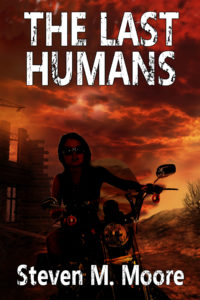
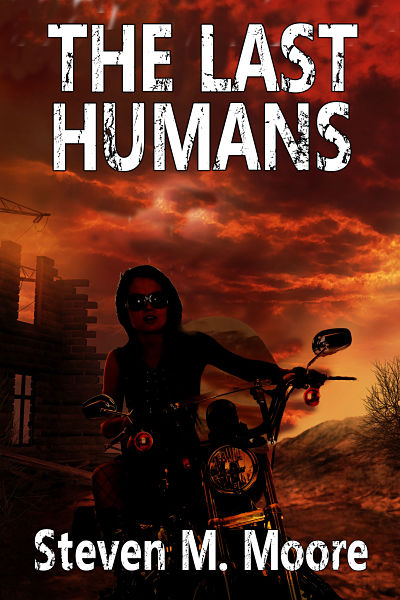
The Last Humans. Penny Castro is on a forensic dive off the SoCal coast for the LA County Sheriff’s Department. When she surfaces, she finds her fellow deputies and a witness dead from a virulent contagion. Follow her adventures as she struggles to survive in a post-apocalyptic world. Available in ebook format on Amazon and Smashwords and all the latter’s affiliated retailers (iBooks, B&N, Kobo, etc) and in print on Amazon and in your favorite local bookstore (if they don’t have it, ask them for it). This novel was published by Black Opal Books. Visit their website to see a treasure trove of great reads. Support small presses and their authors.

Around the world and to the stars! In libris libertas!

ABC Shorts: Harvest Time…

June 5th, 2019

[Note from Steve: A. B. Carolan isn’t sitting around patting himself on the back for his new novel Mind Games. He continues to write short fiction. Here’s one story he wrote in honor of Brian Aldiss.]

Zeno climbed higher. The fruit at the top ripened first. The tribe always went through the grove, back and forth, each time getting nearer the ground. And then they would start all over again.

He climbed almost to where the sky closed over and he could climb no more. It never occurred to him to ask why the sky closed over, but that day when he sat on a limb, ate his fruit, and stared upwards, he asked the obvious question: Why does the sky stop my upward progress?

He climbed a bit higher to where he could reach out and push against the sky. It’s solid! Is there something on the other side of the sky?

“Zeno! Come back down!”

His mother didn’t like it when he climbed so high.

I’ll have to tell her about the sky!

***

Zeno’s mother had always been warning him. Other creatures climbed high too. One of the wide-eyes was stalking him. He turned just in time, saw the salivating predator, and moved away, only to slip on a patch of moss.

It was a long fall accompanied by his mother’s scream. He bounced from limb to limb as he floated toward the forest floor. No one in the tribe had ever died from a fall, but limbs could be broken and minds addled by hitting the hard wood of the fruit tree limbs.

He was unconscious when he hit the ground.

***

Zeno awoke. A member of another tribe hovered over him and smiled. He was covered in a bright white skin.

“You had a nasty fall, Zeno.”

He spoke the language of the people, but it didn’t sound quite right. Some chirps and whistles rose in pitch when they were supposed to go down, for example.

Zeno looked around and felt claustrophobic. He was in a place best described as a nest, but it was a bit larger, and the whiteness of its walls was as white as the stranger’s covering.

“Where…where am I?”

“Where you’ve always been, just a bit more forward in the….”

Zeno didn’t understand the words that had followed. “I want to go home.”

“You need a few more visits to the….”

Again the words meant nothing to him. He mouthed the unfamiliar words: long-haul starship and ship’s portadoc. They seemed like gibberish. He wriggled a bit, testing his body. Everything hurt.

“Am I broken?”

“Kira found you. She was testing soil….”

He knew the word soil. The tribe used soil and ground almost interchangeably. He didn’t know what pee-aych meant, though.

“So I have to stay here?”

“Only for a while.”

***

Later that day he met Kira. He hadn’t known Kira was a female’s name. She was much taller than his mother, and he liked her immediately.

“I have a friend, Roberto, who asked me to find out why you’re called Zeno,” she said.

“There’s always a Zeno in the tribe. It’s tradition…and a rule. If there’s no Zeno, the tribe can fall on hard times.”

She nodded. “Do you have a mother?”

“Everyone has a mother.”

“What’s her name?”

Read the rest of this entry »

The writing process…

June 4th, 2019

My first experience with a computer was with a CDC 3600 (the now defunct Control Data Corporation), a powerful machine in its time but not much good for word processing—typing a story onto punch cards? No way! I was working odd hours during the semester and full-time in the summer at an R&D outfit located not far from the UCSB campus. Until that time and even a bit beyond, I took notes and wrote short stories and bits and snippets on almost any media, from unfinished lab notebooks to paper napkins.

How we write, i.e. the physical process, makes no difference for the final product, the story we tell. Some writers might still write their stories out longhand with pen and paper. I always liked pen better than pencil because I hate eraser crumbs, and I can see what I scratch out and maybe use it later. If you still write in that fashion, more power to you. I still do it occasionally.

Authors write their stories in a multitude of ways. As a reader, I don’t much care about how they do it. That doesn’t affect my enjoyment of their stories. As an author, I have my preferences, and they often change.

I’m also a fan of efficiency. I have authored a few books. I couldn’t have written them without some efficiency in my writing process. The typewriter always helped a bit. Two of my writing skills are speed reading and touch typing. The first allows me to quickly scan what I’ve written, much as a reader would when deciding to buy a book; the second allows me to write it in a speedy fashion. Some authors still use their old typewriters. (I remember a Tom Hanks documentary about them—the typewriters, not the authors who used them.)

Word processing software on a personal computer is the most efficient. It was a bit primitive on my first computer, the Radio Shack Color Computer, but software advances in pace with hardware. I never used Word Perfect—it seemed unwieldy—and MS Word always tries to be too many things (I rarely use all of its features). But word processing packages always provide tools that make my writing efficient, content editing as I go.

And word processing software facilitates the editing process. MS Word’s “Track Changes” is a bit flaky at times (one has to tame that left review pane before it crashes MS Word), but it’s an essential tool for editing in the end game. Before I even get there (or an editor does), I use the search feature to find and eliminate all my bad quirks. I do this even before sending an MS to beta-readers or first editors.

I’ve never found authoring packages like Scrivener attractive. I’m a pantser, writing by the “seat of my pants” and rarely using an outline. Those authoring pages almost always require some kind of an outline, and that puts a straitjacket on my storytelling abilities. Other writers might have found otherwise.

The title of this article is key. Writing is a process. The more authors can make it a process, preferably an efficient one, the more they can focus on what’s important, telling a good story. Process does not destroy creativity; it makes it more efficient. The process isn’t the story, but it’s what gets the story out to our readers.

That said, I wrote this article on a note pad with a pen. I often do that as I watch network news or CNN. When the news slows down or goes to commercials (a hurrah for PBS News Hour!), I create blog posts. All just part of writing!

***

Comments are always welcome.

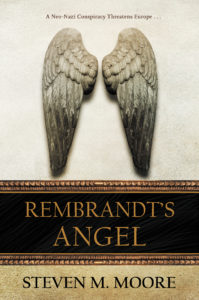
Rembrandt’s Angel. How far would you go to recover a Rembrandt stolen by the Nazis in World War II? Inspector Esther Brookstone, of the Art and Antiques Division of Scotland Yard, will provide one answer to that question. Paramour and Interpol Agent Bastiann van Coevorden tries to keep her safe in her quest to recover the painting, but the duo uncover something much more sinister—a vast conspiracy that threatens Europe. Available in ebook format on Amazon and Smashwords and all the latter’s affiliated retailers (iBooks, B&N, Kobo, etc) and in print on Amazon and in your favorite local bookstore (if they don’t have it, ask them for it). This novel was published by Penmore Press. (A sequel titled Son of Thunder is about to be published.) Visit their website to see a treasure trove of great reads. Support small presses and their authors.

Around the world and to the stars! In libris libertas!