Book review of Zari Reede’s Sins of the Sister…

July 10th, 2019

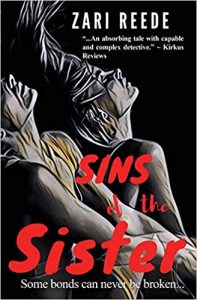
Sins of the Sister. Zari Reede, author (Black Opal Books, 2018) Lana has been looking for her twin sister, Dania, who was abducted three years earlier. In the opening scene, Lana meets the sex traffickers who she’s been pursuing, thinking they’re somehow involved with Dania’s disappearance. But there’s another candidate too, a mad gamer who carries his role-playing too far. Lana knows her sister’s alive because she can sense how her captor tortures her and abuses her sexually. If he’s the role-player, he’s bent on “cleansing” the girls he captures for Mother before killing them.

My first impression was that this story is really creepy, but on the Goldilocks scale, it’s probably just right. It could be a model for anyone wanting to write a horrific crime story. The plot moves along as the reader follows Lana’s pursuit of clues and her missteps. Parallel stories are found about Dania’s two potential captors; Lana’s friendship with Favor, her martial arts instructor; and her romantic feelings in her love-hate relationship with Norris, the cop who seems to have given up on finding Dania. The characters seem like real people—creepy villains, misguided teens, and good people with flaws, all examples of the wide spectrum of human behavior.

On one hand, this is a mystery/crime story with Lana playing the role of the PI (she inherits an agency). The connection Lana has with her twin adds a bit of paranormal flavor. The point of view (POV) flips back and forth between Lana and the gamer at first. That might be a bit disconcerting to some readers, especially when they’re inside the monster’s insane mind, but as a reader I always enjoy the use of this technique. Readers will know who he is before Lana does, which suggests this book is also a thriller. The parts involving the sex trafficker, whose POV isn’t shared, is more a standard mystery with interesting little twists and one major one.

I won’t dwell on the cast of characters. There are so many, which makes this novel complex and interesting. The writing is superb. Let me include one quote I hope to always remember: “…in the river of life, relationships pooled up in eddies, sometimes churning forever, while others swept around the bend, lost except in the memory of those who once cherished them.” That’s a meta-theme for this novel: relationships. I’ll write no more about it. You should just read it…and enjoy the story.

***

Comments are always welcome.

“Detectives Chen & Castilblanco Series,” the NYC novels. In The Midas Bomb, terrorism and Wall Street excesses go hand-in-hand, with an evil genius lurking in the wings. In Teeter-Totter Between Lust and Murder, Castilblanco is out to prove that Chen is innocent of murder. In The Collector, the detectives find that sex trafficking and stolen art provide an unusual mix. And in Family Affairs, Castilblanco helps some family members who are in trouble. All these ebooks are available on Amazon and Smashwords and the latter’s affiliated retailers (Apple iBooks, B&N, Kobo, etc.). Current, pithy, and exciting, this is great summer reading!

Around the world and to the stars! In libris libertas!

Titles…

July 9th, 2019

I’ve seen some original and interesting titles lately just browsing through Amazon or bookstores. Many authors have learned that titles and covers are eye-catchers.

As examples, let me consider some from my fellow writers (you can email me and critique mine): Sins of the Sister, Waiting in the Shadows, Rose Scented Murder, Reciprocal Evil, Dead Shrinks Don’t Talk, Last Gasp…the list is long. These are all eye-catchers.

Consider Sins of the Sister. Don’t you just want to know what sins the sister committed? (I’m reviewing that book tomorrow, by the way.) Or Reciprocal Evil—who’s reciprocating with whom? (I already reviewed that book.)

Dead Shrinks Don’t Talk grabbed me too. It’s a tautology, of course, but it’s funny—a lot of shrinks talk a lot, drilling down on their patients with questions to discover the origins of their neuroses. Maybe a patient doesn’t like that too much? (Again, see my review of the book.)

Last Gasp didn’t tell me too much, but it did tell me someone was going to die. Who? How? Why? Those kind of questions generated by a title can attract readers to the book too. (See my review.)

Pundits say titles should be short. That’s malarkey because length isn’t a criterion. Whether short or long, titles should grab the reader’s attention. It’s hard to be original in a few words, but originality always helps—a variant on someone else’s title doesn’t cut it for me. Titles in a book series that are A, B, C,… + Is for Something? That’s been overdone. Gone Anything and Girl on the…—they’ve been overdone.

Maybe I’m weird or jaded, but I want title, cover, blurb, and “peek inside” to get my attention when I’m browsing for a book (the “peek inside” might be a physical one in a bookstore and the blurb on the back of the book). On Amazon, I don’t care about the book’s reviews either. (I only care about my own because they provide excerpts useful for promo purposes. A hearty thanks to all reviewers, though, no matter whose books you review. You’re helping both readers and writers.)

I can get by a bad title if I like the cover, blurb, or “peek inside.” I need at least two of the four. Big Five covers are often terrible, especially when they’re abstract art that should be on floor tiles and not the front of a book. It seems they’re often saying, “We’re the Big Five, so we don’t have to have great covers.” Their titles often aren’t that original either, so the blurbs and “peek inside” better grab me. (I don’t care who the author is.)

While I’ve read some books that have turned out okay once I’m into them (mostly when I’m doing my official reviewing with Bookpleasures), for R&R reading I have to be without another book to read to keep going sometimes with a book that just doesn’t work for me. The tests I mentioned above help avoid that.

The title, though, is the first thing I or any other reader sees, especially if we’re in the bookstore or library just examining book spines. Maybe that’s one thing Amazon has over a bookstore or library: the browser sees the title and cover, and, with one click, s/he can see the title, cover, and blurb, and with another “peek inside.” Efficient with one book, but less efficient because of the number of books on Amazon—finding a book to read is easier in a bookstore or library. Or electronically via a small press’s catalog where the reader’s eyes don’t glaze over with information overload.

***

Comments are always welcome.

“Detectives Chen & Castilblanco Series,” the NYC novels. In The Midas Bomb, terrorism and Wall Street excesses go hand-in-hand, with an evil genius lurking in the wings. In Teeter-Totter Between Lust and Murder, Castilblanco is out to prove that Chen is innocent of murder. In The Collector, the detectives find that sex trafficking and stolen art provide an unusual mix. And in Family Affairs, Castilblanco helps some family members who are in trouble. All these ebooks are available on Amazon and Smashwords and the latter’s affiliated retailers (Apple iBooks, B&N, Kobo, etc.). Current, pithy, and exciting, this is great summer reading!

Around the world and to the stars! In libris libertas!

Dr. Gell-Mann and Mr. Rubik…

July 5th, 2019

When A.B. Carolan was writing Mind Games, he was torn between various names for a principal character. Should he call the android cop Olivaw, Rebus, or Rubik? Rebus won, in honor of Ian Rankin’s inspector.

But both Olivaw and Rebus are cops, so Olivaw fit the bill in that sense. Daneel Olivaw was Asimov’s android detective who worked with Elijah Bailey in the sci-fi mysteries Caves of Steel and The Naked Sun. Given that Mind Games is part of the “ABC Sci-Fi Mystery Series” of books written by A.B., that was another plus for using Olivaw. But I’d honored Daneel in Rogue Planet, so I told A.B. that would be two honorifics, which seemed excessive.

Rubik was an alternative because of the famous cube that became such a fad. It’s really a monument to logic and reason and could be an iconic representation for AI. The android in Mind Games is a walking AI and part of an AI network serving to augment a planetary police force.

I was reminded of Rubik’s cube recently for two reasons. One was my observation that Ms. Ginger Zee, GMA’s weather person, was wearing a dress that consisted of square patches with the same color scheme as the cube—garishly strong but happy colors that looked better on the cube than on her (sorry, Ginger). Just my opinion, of course. I’m no fashion expert.

Many see the cube as a game, but there’s math lurking in its twists and turns. There aren’t many simpler structures in advanced algebra than groups. You have one basic operation (like multiplication or addition—let’s write it as *) and one inverse operation in a group, and the group can either be finite, like the one describing Rubik’s cube, or infinite.

The Rubik’s cube’s group is constructed by labeling each of the 48 non-center facets with the integers 1 to 48. Each configuration of the cube can be represented as a permutation of the labels 1 to 48, depending on the position of each facet. Using this representation, the solved cube is the identity permutation which leaves the cube unchanged, while the twelve cube moves that rotate a layer of the cube 90 degrees are represented by their respective permutations. The Rubik’s cube group is non-commutative because a*b isn’t the same as b*a—doing two sequences of cube moves in a different order can result in a different configuration.

Read the rest of this entry »

Book review of Harol Marshall’s The Case of the Missing Mobster…

July 4th, 2019

Happy July Fourth to all U.S. readers of this blog! Celebrate, be safe, and be responsible.

[Note from Steve: For an interview with this author, see the previous post.]

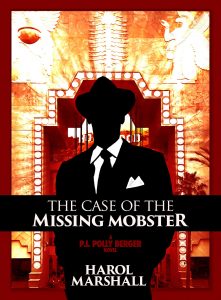
The Case of the Missing Mobster. Harol Marshall, author (Black Opal Books, 2019). When wannabe actress Sally Martin walks into PI Polly Berger’s office, Polly is glad to get the case of finding her client’s missing husband Ricky Martin—another wannabe actor, not the singer. But the case becomes complicated. Her client knows things the local Hollywood cops don’t know, and the local FBI agents, who start tailing Polly, won’t admit to knowing either. Part of Sally’s extra knowledge involves Lenny Spinoli, who Sally says was Ricky’s friend; his body just washed up on a beach.

There’s a good cast of characters here that includes Polly’s sidekick Bernardo “Bunny” Contreras and several “contacts” Polly works with, and other friends. The plot has enough twists and misdirects to please any fan of the mystery/crime genre, and with Polly in the first person, the reader will discover them right along with Polly. There’s serious business afoot too, but the overall tone is tongue-in-cheek, especially with Bunny, who moonlights as a standup comedian. That fits the Californian laid-back lifestyle. I should mention that Bunny’s girlfriend is Polly’s twin sister Franny, a fact used to confuse the FBI, for example. Franny and Rosa, who does tarot card readings in the office below Polly’s, add more color to the plot.

The author is a fan of Perry Mason, but the style here reminds me of both Robert Parker and Carl Hiaasen. LA is neither Boston nor Florida, of course, but having a bit of fun among the serious goings-on characterizes Ms. Marshall’s main character’s adventures as well as those of the other two authors’.

There were a few references to pop culture that tickled my fancy too, and a revisit to my old California haunts was frosting on the cake. Readers will enjoy this novel as much as I did, I’m sure.

***

Comments are always welcome.

The Last Humans. Ex-USN diver Penny Castro surfaces from a forensics dive for the LA County Sheriff’s Department to find her fellow deputies and a witness dead from a plague that sweeps around the world, killing billions. Follow her adventures in this post-apocalyptic SoCal landscape as she finds other survivors, some friendly and others violent. Their struggles aren’t for the faint of heart, but Penny and her companions show mettle and ingenuity as they deal with a world gone mad. Available in print and ebook format on Amazon and in ebook format on Smashwords and all the latter’s affiliated retailers (iBooks, B&N, Kobo, etc.).


Around the world and to the stars! In libris libertas.

Interviewing author Harol Marshall…

July 3rd, 2019

Steve: I have the pleasure today of interviewing author Harol Marshall who writes in the mystery and political thriller genres. Without further ado, why don’t you tell us a bit about yourself, Harol.

Harol: My father named me after his brother and dropped the ‘d’ from Harold, so I’m a female! I grew up in Upstate New York where my father was deputy chief of police in my town. No doubt as a consequence of all the stories I heard growing up, I write novels in those genres, as well as short stories, some of which you can read on my website: http://www.harolmarshall.com. My contact email is: harolmarsh at gmail dot com. I also have a Harol Marshall Facebook page and Amazon page.

Steve: Can you describe some of your books for the readers?

Harol: I’ve published four books in my PI Polly Berger series, the titles of which begin with, The Case of the, and include: Catwalk Saint, Vanishing Chef, Trophy Wife, and Missing Mobster.  The second edition of my first thriller, The Shadow Cabinet, came out last year, and The Singapore Assassin (second edition – the link is to the first) is due out this year from Black Opal Books, as well as the three books in my Mexico series: A Corpse for Cinco de Mayo, A Corpse for the Matadora, and A Corpse for Cortez. The protagonist is a police commander and head of the homicide division in the Tlaxcala State Police. I also have a stand-alone mystery, Adieu at the Zoo, and a short story anthology, Growing up with Pigs. I’m married and live in Greensboro, North Carolina, with my husband and three wily cats. My husband and I share four children and four grandchildren.

Harol on reading and writing:

Steve: Why, how, and when did you start writing?

Harol: I was an avid reader from an early age, but became interested in writing in high school, thanks to a  really great English teacher.  However, most of my writing over the years has been in the academic field until I retired, which is when I began writing fiction.

Steve: Did you publish the first book you wrote?

Harol: Yes, with a vanity press. That book has been rewritten and a new edition will be coming out later this year.

Steve: What is your biggest problem with the writing process?

Harol: I seldom experience writer’s block, but I do suffer occasionally from “plot block.” To tackle the problem, I work on two or three books at a time. When I’m blocked on one, I move on to another until I solve my plot issues.

Steve: Do you feel writing is something you need to do or want to do?

Harol: Writing is something I love to do.

Steve: Have your personal experiences or situations influenced you creatively?

Harol: Definitely, especially with regard to settings. My Mexico village mysteries are set in the State of Tlaxcala, where I conducted field research for my PhD dissertation in anthropology. My PI series is set in Hollywood, where my son once lived, and my zoo book is based on my experiences coordinating a research and education program between my university and the North Carolina Zoological Park.

Steve: How much of your creative ability do you think is innate and how much is learned?

Harol: I have no idea, so I’ll guess 50/50.

Steve: What is the last book you read? What are you reading now?

Harol: Right now I’m reading The Elements of Eloquence: Secrets of the Perfect Turn of Phrase, by Mark Forsyth, which I highly recommend to all writers. As for pleasure reading, I recently finished The Holographic Universe by Michael Talbot. I’m a fan of popular physics books, perhaps because I’m married to a retired particle physicist, and I’m a political junkie, so I am constantly reading articles on politics as well.

Steve: Who are your favorite authors? Whose writing inspires you the most and why?

Harol: Michael Connelly and Daniel Silva. Connelly inspires me, because his police detective and lawyer series are set in LA, like my PI series. Also, I like his straightforward writing style.

Steve: What was the last book to make you laugh? Cry?

Harol: For laughs, the one written by my son, Dale Hoffman (a former standup comic), which makes me laugh even thinking about it: Werewolf Watching in Michigan’s Upper Peninsula: A Field Guide. For crying, I can’t say, since I tend to avoid sad stories.

Steve: Should writers read in their genre? Should they be avid readers?

Harol: Yes, though I find myself reading less fiction than I did before I started writing fiction. And yes.

Steve: How do you find (discover) your plots?

Harol: On occasion, people (usually family members) give me the beginnings of a plot idea, but usually, my plots come from reading about actual crimes and criminals.

Steve: Are your characters based on real people?

Harol: I never base characters on people I know, and only occasionally on someone I’ve read or heard about. My characters are my own invention, which makes writing them easier, because they aren’t locked into characteristics apart from how I want them to look, think, feel, and act.

Steve: How do you name your characters?

Harol: Sometimes I google names, other times I’ve taken a name from someone I know, usually a family member (solely for the purpose of amusing myself).

Steve: Which comes first for you, plot or characters?

Harol: I start with a plot, and characters follow.

Steve: Any comments about writing dialog?

Harol: I love writing dialog, and I’m better at dialog than description. I find I can move a story along easier using dialog, and since readers interpret dialog as ‘action,’ I’m saved from having to invent unnecessary action scenes. Often, when writing dialog, I read the words aloud to ensure they sound right. The secret to writing dialog, I believe, is to be a good listener, and pay attention not only to what people say, but how they say it. I’ve always been good at recalling conversations, sometimes verbatim, so writing dialog seems to come naturally to me.

Steve: How do you handle POV?

Harol: I write my PI Polly Berger books in first person point of view, which can be challenging when writing a mystery because the reader can only know what Polly knows or learns. On the other hand, the books are driven by how she thinks, analyzes, works, and behaves. The people with whom she interacts, and the how and why of her life choices, are critical to the story, so first person POV works best.  By contrast, I write my thrillers, and the Mexican village mysteries, in third person because the stories revolve around a number of different settings and characters, some of whom are almost as important as the protagonist.

Steve: Do you do fact-finding for (aka research) your books?  If so, how? What sources do you use? Read the rest of this entry »

The economical Ian Rankin…

July 2nd, 2019

I’ve expressed before how much I like British-style mysteries, defining them as any crime story featuring a DCI or DI in a commonwealth setting—P.D. James, Louise Penny, and Ian Rankin oeuvres are famous examples. (The android agent in Mind Games is named Rebus for a reason—A.B. Carolan shares my predilection. See Tuesday’s post. The name of the main character is Della. Does everyone remember Perry Mason’s trusty aide?)

Unless one of their ebooks goes on sale, I don’t read any of those famous authors anymore—their ebooks are just too expensive. The Big Five wants to keep readers reading print versions, so they price ebooks high, almost at the same price as print, which is absurd. I won’t pay more than $6 for an ebook (my limit used to be $5, but inflation exists for the book business too).

Small press and self-published authors have ebooks that are more reasonably priced (like mine). I have managed to find economical substitutes for Mr. Rankin’s books. Actually there are probably many, but I’ll talk about two, books from Jill Paterson and Val Penny. Different peas in a pod (pun intended), these authors have created DCIs who are quite interesting. Jill is British but lives in Australia; Val is American but lives in Scotland. I’ve been following their mystery/crime series, Jill’s about Inspector Fitzjohn and Val’s about Inspector Hunter.

Fitzjohn is a quiet detective who grows orchids and is a bit like James’s inspector; Hunter is more forceful and a bit like Rankin’s inspector. Ms. Paterson’s Australian stories are civilized with characters of good breeding, even the villains; Ms. Penny’s stories are grittier and focused on the underbelly of Edinburgh life, with characters who could have appeared in a Rankin novel.

Their stories are quality entertainment. Moreover, they fit into my reading budget. I can buy three or four of their books for the price of one of James’s or Rankin’s. They’re reasonably priced; I get my money’s worth.

Read the rest of this entry »

Movie Review #75…

June 28th, 2019

Rocketman. Dexter Fletcher, dir. Many posts ago, I reviewed Bohemian Rhapsody. Rocketman is a very different biopic. The titles of each movie correspond to two famous songs, but that’s where the similarities end. Rocketman focuses on Elton John’s singer/pianist’s life just a bit beyond when he checked into a rehab center to save himself because he was abusing liquor and drugs…and ultimately to find himself.

The movie is a bit slow in parts, but it has its moments. I especially liked the part where Elton John (well portrayed by Taron Egerton, who actually sings) reports to the head mistress of the Royal Academy of Music. When he enters, she’s playing Mozart’s “Turkish Rondo” (Sonata Number 11 in A Major) and stops when she sees the future student enter the room. He brought no music with him, so she asks him to play anything. He sits down and plays to exactly the same spot where she stopped. He couldn’t play any further because he’d just memorized what she’d played!

The title song and many others are well sung and played, often couched within dream sequences or flashbacks with choreographed dancing, making this more like a musical than Bohemian Rhapsody. I’m still trying to decide if that works for me. Same for the group therapy session leading to the flashbacks—much of the movie stems from Elton’s self-analysis in those sessions.

Of course, Elton is one hell of a singer as well as a good piano man. His long association with lyricist Bernie Taupin (ably portrayed by Jamie Bell, with an excellent supporting actor’s performance) has motivated his song-writing. His wild initial success brought fame and fortune, not love, though. His long spiral down leading to that time in rehab is hard to watch. One complaint I have is that rough patch that could have killed him is the focus here, not the time after rehab where he did finally find love, and he has been sober for about thirty years.

His biggest failure in love was with the manager who seduced him, seeing a rising star he could get rich with. I’d like to focus on another failure, though. Like Freddy Mercury, Elton is gay; you can make your own conclusions about the reasons watching the movie (which had Elton’s approval, I’m told). But he tried a heterosexual marriage with another singer Renate Blauel, ably portrayed in the movie by Celine Schoenmaker—I’d like to see more of her. I hadn’t known about that aspect of Elton’s life.

The gay sex scenes aren’t the first ones in major movies as some reviewers claim (consider Brokeback Mountain, for example), but they’re just part of Elton’s story told in this movie, maybe justifying its R-rating. As such, Rocketman won’t have the success of Bohemian Rhapsody, which Hollywood sanitized to PG-13, thus trivializing Freddy Mercury’s similar struggles as a gay man.

[As an aside, I saw this in an AMC theater with those mechanically reclining chairs. When they first rolled out these chairs, I said to myself, “They’d better maintain them.” Well, I’m prescient. I was trapped at the end of the movie and had to struggle to get out of the chair! Just a warning for theater-goers.]

***

Comments are always welcome!

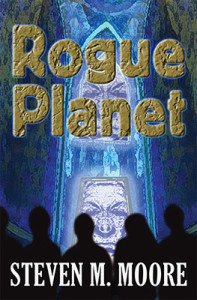
Rogue Planet. Sci-fi books are generally “evergreen” books, at least the ones involving the future of human beings in our galaxy—they never get old. This is one of mine. If you read A.B. Carolan’s Mind Games, you’ve learned how difficult it is for ITUIP (“Interstellar Trade Union of Independent Planets”) to control the colonization of new worlds and bring them into the trade union. Eden is such a world, forced back into virtual savagery after one tribe takes over and establishes a brutal theocracy. It’s up to the son of the deposed king to do something about that. Hard sci-fi with Game-of-Thrones fantasy elements, action, suspense, and intrigue await this novel’s reader. Available on Amazon in both ebook and print format, and in ebook format on Smashwords and all its affiliated retailers (iBooks, B&N, Kobo, etc.).

Around the world and to the stars! In libris libertas!

Obsessions…

June 27th, 2019

Esther Brookstone in Rembrandt’s Angel (Penmore Press, 2017) obsesses over recovering a painting; in the sequel Son of Thunder (to be published by Penmore Press), she obsesses over finding St. John the Divine’s tomb. Obsession is common enough in fiction, and it takes many forms.

In Teeter-Totter between Lust and Murder (Carrick Publishing, 2013), a senator is obsessed with making the country great again…his definition of greatness, of course. In Aristocrats and Assassins (Carrick Publishing, 2014), a terrorist is obsessed with vengeance against those who betrayed his homeland…and against Detective Castilblanco, whom he met when the detective was a USN SEAL. (Esther’s paramour Bastiann van Coevorden has a cameo in that book.) Obsession is a strong emotion human beings that develops for many reasons.

I know something about milder forms of obsession. I obsess over reading and writing now. The first is easy to satisfy: I pick out a good book and obsess over finishing it—I can’t wait to find out if the thriller’s main character prevails, or how the mystery’s detective resolves the case, or how the sci-fi story ends. Some people would call those books ones readers can’t put down—real page-turners (page-swipers? I’m usually on my Kindle). A story can grab me that way.

Even with my own stories, I can obsess. I wrote The Midas Bomb (the first edition) in a few weeks. I obsessed with finishing the story that my characters were practically writing for me. That often happens to me. (The major changes made in the second edition—Carrick Publishing, 2016—were to put Detective Castilblanco in first person to match other books in the series.)

Let’s call that “getting in the zone” in our writing because “obsession” often has a negative aura for some people. (Esther’s obsessions are positive; the terrorist’s and senator’s are negative.) When a plot seems to unfold without much intervention from the author, its characters really grab the author, and the author is eager to know how the story ends, that’s a good obsession.

But authors have to be careful. Finishing the novel-writing marathon is only part of writing fiction. In addition to making sure other elements work well—title, beginning, and end; characterization; logical structure; and so forth—there are various editing steps and proofreading after formatting, whether the author is self- or traditionally published. And, even though I’m a touch typist, my creative mind often gets ahead of my typing, causing me to leave out words and make typos. In other words, my obsession with writing a novel must carry me beyond that finish line in the novel-writing marathon.

I don’t obsess with every novel—some just represent blood, sweat, and tears as I try to make things work out. That’s part of the writing adventure. We can turn those stories into good ones too with some hard work. Are they better or worse than the ones we’ve become obsessed with? It might not matter to readers. As stated above, their obsessions with a book are a bit different. That’s okay.

Maybe the best novels are the ones both readers and writers have obsessed about. That implies a connection between author and readers that’s wonderful and makes publishing fiction a great human experience.

***

Comments are always welcome.

Rogue Planet. Sci-fi books are generally “evergreen” books, at least the ones involving the future of human beings in our galaxy—they never get old. This is one of mine. If you read A.B. Carolan’s Mind Games, you’ve learned how difficult it is for ITUIP (“Interstellar Trade Union of Independent Planets”) to control the colonization of new worlds and bring them into the trade union. Eden is such a world, forced back into virtual savagery after one tribe takes over and establishes a brutal theocracy. It’s up to the son of the deposed king to do something about that. Hard sci-fi with Game-of-Thrones fantasy elements, action, suspense, and intrigue await this novel’s reader. Available on Amazon in both ebook and print format, and in ebook format on Smashwords and all its affiliated retailers (iBooks, B&N, Kobo, etc.).

Around the world and to the stars! In libris libertas!

Steve’s shorts: WREK…

June 26th, 2019

[Note from Steve: Here’s another Chen & Castilblanco case as a short story. Enjoy.]

WREK

Copyright 2019, Steven M. Moore

Chen and her husband Eric had taken off on a vacation to Costa Rica. Pam and I had some time off too, but not enough money for that kind of vacation. Our little old house in Brooklyn we’d bought to make more of a home for our adopted children Ceci and Pedrito came with a stiff mortgage. It was getting so only one-percenters could live there. Prices were up all over the NYC area. Even with two salaries, we were just making out.

Pam’s old aunt in Port Jefferson, not far from SUNY’s main campus, came to our rescue. We became house-sitters while she was in New Orleans. A stay-cation, I guess—beaches and sun next to a nice old house.

Within a day, that house spoiled me. Four bedrooms, living and family rooms, and so forth were going to make our Brooklyn house seem even smaller when we returned. We had a great time until the third day. It was morning and I was walking around the backyard with my mug of coffee, pretending like I was a rich SOB. Our whole Brooklyn backyard could fit in the aunt’s flower garden. Wouldn’t want to be the one mowing her lawns, but I thought she probably had a gardener. Hadn’t seen him yet.

I saw two feet sticking out from under some kind of bush with sharp points on its leaves. I grew up in the city, so I was no expert on plant life. Didn’t matter.

Squatted without spilling the java and looked under the bush. The feet were attached to a body. Being a cop, I didn’t touch a damn thing. Stood, took out my smart phone, and called 9-1-1.

***

The local detective—I wasn’t quite sure where he was from—flashed his badge: Joseph P. Ricci. He’d entered the yard with the CSIs. I tried to stay out of everyone’s way. Eventually went back into the house to sit with Pam. The kids had ridden their bikes off somewhere.

“Should you call the station?” I asked Pam.

“Let’s see what the detective says,” she said. “For all we know, this man died of natural causes.”

“Yeah, no crime news there.” My wife had started her TV career as a crime reporter. “Maybe he’s the gardener and has been there since your aunt left. That’s a whole weekend plus a day. Or he could be the victim of a local MS 13 gang killing.”

“Which, sad to say, wouldn’t be news anymore either.”

“Is for me. They’ve been killing people for years. Mostly other kids who won’t join them, though.”

At that point, Detective Ricci came into the family room. I gave him credit for wiping his feet. We went through the usual  interrogation routine about who we were and what we were doing there. Joe asked to see my creds too. I asked him details about the body in our backyard.

“The victim’s name is James Watson.  He’s famous in the area—or infamous, depending on your political predilections. He ran a talk show on WREK radio. His throat’s slit. Hands are gone too.”

“Come again? What’s WREK? As I explained, we’re not from around here.” Pam looked at me.

“Yeah, I realize that. WREK’s one of those radio stations that blast out hate and bigotry under the cover of the First Amendment. They’re pretty common. They feature some syndicated crap too, but Joe was the local guy, spewing out all kinds of conspiracy theories along with his invectives.”

“So maybe someone didn’t like that?” I said.

“Friends, enemies, and frenemies. Advertisers loved him, right-wingers, racists, and neo-Nazis loved him, but a lot of people would just like to see him shut up. Maybe for good. That includes many true conservatives who are often embarrassed by what he says.”

“How interesting,” said Pam. “Maybe this will make a good story.”

***

I forgot about the whole incident…until I couldn’t. Two days later Detective Ricci returned. I walked him through to the patio where Pam and I were doing lunch.

“Can I offer you some iced tea?” Pam said. “Or a sandwich?”

He sat down across from me and catty-corner from Pam. “No thanks. Just had a Reuben and an iced coffee with it. I’m trying to contact Detective Dao-Ming Chen, your partner, Mr. Castilblanco.”

“Good luck with that, Joe.” I figured the Mr. Castilblanco was a bit formal. Wasn’t about to call him Mr. Ricci either. “She’s on vacation in Costa Rica.”

“Thought it might be something like that. Your precinct wouldn’t give out that information.”

“What do you need to chat about with her? Maybe I can help.”

“You know the drill. We have a list of people who had altercations with the victim.”

“Chen? She’d be the first to get on the First Amendment bandwagon, that’s for sure. She’s as conservative as hell. True conservative and not a nut like the victim. Good cop, though. What was the altercation about?”

“Road rage. Witnesses said that Mr. Watson tongue-lashed Ms. Chen, calling her a Chink whore and telling her to go back to her country.” Joe looked at Pam. “Sorry, ma’am, but that’s what he said according to his own admission—it was right on the police report—and some worse things too.”

I smiled. “Extremely amusing. Guess Watson didn’t know who Chen is. She could take him down, rip his balls off, and stuff them down his throat. Ex-military, like me. He was lucky. She grew up around here, by the way. American through and through. What happened after the verbal abuse?”

“Same witnesses said she just stared him down and he finally walked away.”

“Good for her,” said Pam. “That’s my Chen. Unless the SOB physically threatened her, she wouldn’t do much. Or even say much.”

“Question is: Did she hate Watson enough to kill him?”

“What?” Pam and I both said. “What makes you suspect that?” I said.

“Like I said, just the drill. Have a list, checking it twice, seeing who’s been naughty or nice.”

“I don’t suppose she’ll mind telling you what she thought of Watson when she returns, but you’d better find some other suspects.” I winked at Pam. “The crime’s MO just doesn’t match anything Chen would do.”

“But she might think about doing it?”

“Not Chen. She’s Wonder Woman and Captain Marvel all rolled up in one person. On a moral crusade to protect all good citizens from miscreants.”

“Okay. My duty with Chen is done. But my trip out here had another purpose. I could use some help, detective. It’s vacation time, as you know. Think you could help me out on the NYPD end?”

“In what way?”

“Just find out if Watson had any priors in any of the five boroughs. You have connections I don’t. He lived in Queens, for example, and he’s a hothead. He made someone mad enough to kill him.”

***

I worked on that the rest of the afternoon. Watson wasn’t just a hothead. He was a drunk. He’d been arrested for DUI several times along with speeding in his BMW, once on one of the bridges. That night I went online to listen to some podcasts he’d made of his radio show rants.

Not bad stuff, if you were into that kind of thing. Had a nice, pleasant baritone voice with a bit of rasp to it. Talked about how “Deep State” liberals controlled everything, how they were planning to take over the world, yadda-yadda. Even an international spiel about how Prince Harry’s wife Meghan was going to assassinate the Queen. Good for a few laughs. I’d heard some of that stuff before. It’s a free country, after all. Let’em rant. The other side did it too. If people didn’t like it, they could ignore it. It bothered me, though, that someone was paying James Watson a lot of money to blast the airwaves with his conspiracy theories.

Important question: Was any of that crap enough to make someone want to kill Watson? I didn’t think so. Told Ricci that the next morning.

Read the rest of this entry »
My email newsletter…

June 25th, 2019

Maybe I’m old-fashioned. Some pundits are now saying that email and email newsletters are dinosaurs due for extinction. I disagree with them. I subscribe to many email newsletters—mostly ones for regular news, science news, causes (environment and wildlife preservation are big ones), new books, and news about other authors and their books. I read them at my leisure, often at night on my Kindle. While email newsletters might be going out of style a bit, I still like them—let’s face it: tweets can’t be too newsy because they’re too short.

I didn’t have an email newsletter for a long time, but I started meeting many readers who (1) don’t read blogs or use other social media, and (2) want to follow what’s happening in reading, writing, and publishing from my viewpoint. #1 is key: they wouldn’t see my blog newsletter (it’s been a feature on this blog from the very beginning). #2 is important because many readers are older and read a lot, but they don’t want any encumbrances beyond email. So I decided to have both types of newsletters.

My email newsletter subscribers have two basic advantages. While there is always some overlap between the two versions, email subscribers get the information first, often a week ahead of time or more.

Email newsletter subscribers also and exclusively receive news about sales of my books. In every issue, I offer at least one of my ebooks for a discounted sale price on Smashwords. That presumes they read ebooks, of course. (There are various reasons why I can’t offer print books at discounted prices.)

Read the rest of this entry »