Writers’ blogs and op-ed…

September 14th, 2017

Recently (Sat, 8/26), the N.Y. Times published an op-ed about how to write an op-ed. My definition of op-ed is a bit more general than theirs. (I wrote a previous post about op-eds. I swear, sometimes I think someone at the Times is reading my blog. The other day they used my Dr. Jekyll and Mr. Hyde metaphor to describe Trump, which I’m sure I used a while ago—maybe on Facebook?).

I consider my posts commenting on current events op-eds; I also consider many of my posts on writing and the publishing business op-eds. Some of the Times’ op-ed about writing them applies to blog posts. Most of it doesn’t. For example, one of their columnist’s points was that the op-ed writer has to always bow to an editor’s wishes—the editor is always right. My blog is a personal blog, so there are no editors. Better said, I’m the editor, so I’m always right.

Another point was not to use long sentences. My sentences sometimes stretch on a bit. Unlike a journalist only reporting on facts, a blog writer has to pack a lot into a single sentence because a blog post has to be short yet much pithier than any op-ed column in a newspaper.

And that leads me to the main point (which the Times’ columnist, who obviously doesn’t believe in segues, says I should have already made): op-ed or blog writers differ from journalists. They wear different hats. While I try to verify the facts, my main purpose is to comment on them. (And that’s why the pundits at Fox News and MSNBC aren’t really journalists.)

While I recommend a journalism degree over an MFA if you think you need academic prep to be a novel writer, precisely because the former better prepares a person to be a minimalist writer, a collection of really short sentences in prose can be as boring as one with very long sentences. A mix between short and long maintains a more interesting pace.

There are many news websites that are really blogs and the posts are more newsy and written in a journalistic style. That’s fine, but it doesn’t work for writers’ blogs. So, dear author, let me give you my list of suggestions for writing your blog:

Don’t focus on writing per se. Most readers of your blog won’t care about POV, characterization, and so forth—the techniques of writing fiction. They care about writers and their stories—that means you and your stories too.

Don’t focus only on your stories. Your articles shouldn’t appear to be an ad orgy. Actually, this also holds true for discussion groups you contribute to. I’m reluctant to post a comment on Goodreads, for example, that mentions my books, although I know them well and they often provide good examples. There I use the subtopics allotted for marketing and promotion that almost every Goodreads discussion group has. Harping about your books can be tiring for readers who already experience a deluge of marketing every time they go online.

Read the rest of this entry »

Steve’s shorts: Intern…

September 13th, 2017

Intern

Copyright 2017, Steven M. Moore

[Some readers of this blog are probably familiar with my Dr. Carlos stories. Carlos Obregon is chief medical officer aboard the starship Brendan, part of the Interstellar Trade Union of Independent Planets’ (ITUIP’s) Space Exploration Bureau’s (SEB’s) fleet. His intern Dr. Julie Chen (not a future relation to my detective Dao-Ming Chen, as far as I know) plays an important role in some stories. The following story is about their first meeting.]

“Lester, I don’t need an intern.” Carlos Obregon crossed his arms and tried to look stubborn.

The captain of the starship Brendan knew that his First Medical Officer had a point. He waved off his objection, though.

“SEB says you do, and I agree with them that we need to train new medical officers all the time. They pair interns with experienced officers all the time. Weren’t you an intern once?”

“I did my internship in a New Haven hospital. I once made the mistake of diagnosing an SEB VIP’s ailment who then showed his gratitude by convincing me to sign on. In those days, fleet medical officers were stolen from the civilian population.”

“OK, let me put it another way: Don’t you think you have some obligation to train young people?”

Obregon indicated the young woman’s hologram appearing between them. “This intern already has experience. She could be a medical officer on a smaller ship right now and probably do a good job.”

The captain nodded. “I agree. She seems a bit over-qualified. It’s out of my hands, though. I can do nothing about it. Neither can you.”

Obregon thought a moment. “There are times when I could use some help, but those are probably times when an intern would just get in my way.”

The captain shrugged. “She’ll be boarding sometime this afternoon. You’ll have to talk to her. The faster you get her up to speed, the faster you’ll be rid of her.”

“Not until we have planetary leave again. That could take forever.”

“Or it could be in three standard months if we have a particularly stressing mission. And remember, you’ll be signing off on her being qualified for a regular post. That’s a major responsibility.”

“Can I wash her out if she’s not qualified?”

The captain frowned. “Don’t look for trouble, Carlos. Not being able to train a qualified intern won’t look good on your own record.”

“And here I mistakenly thought that the candidate’s performance would determine their future postings.”

***

“I’ve chosen a few classic texts for you to peruse,” said Obregon.

Julie Chen floated in a lotus position before his desk. Showoff, he thought. I could do that too, but I have a bit more decorum in zero-g. Brendan wouldn’t spin up the artificial gravity until just before going FTL.

They were already in the far reaches of the solar system where crewmembers had enjoyed a short leave on the fifth planet. The captain had ordered an FTL drive inspection that required the zero-g environment.

“I’m starting you with Wave Searcher’s Physiology of Known ET Genotypes and Blamak’s Sentient Lifeforms and their Circulatory Systems.

“I’ve already studied those texts. I remember you wrote a chapter in Wave Searcher’s book.”

“Fine. Look at the other texts then. Things are pretty quiet on the way out. The going gets rough when we have to explore an unknown planet and decide if it’s OK for colonization.”

Read the rest of this entry »

Monday words of wisdom…

September 11th, 2017

When the truth is little more than an arbitrary personal decision, there is no common ground to be reached and no incentive to look for it.—Ned Resnikoff

***

Fanaticism, fundamentalism, and terrorism have no place in a rational world; if they do find a place, we have to weed them out. Remember 9/11. We miss you, Carlitos!

Book sale: Some authors bundle a series or part of a series.  Here’s an alternative: from now through September 30, all three books in the “Clones and Mutants Trilogy” are on sale only AT SMASHWORDS, $1.99 for each ebook, reduced from $2.99—that’s one-third off.  The clones make their appearance in Full Medical as part of a complex government conspiracy, they combine forces with the mutant in Evil Agenda to thwart another plot, and they all save the world in No Amber Waves of Grain.  These aren’t comic book characters like X-Men—they’re real people who work to halt an apocalyptic future.  Use the link and go directly to Smashwords, enter the coupon codes during checkout, and get hours of fall reading for only $3.  (Amazon addicts, did you know Smashwords also sells .mobi files for your Kindle? They handle all popular ebook formats and distribute to many retailers and lenders—Apple, B&N, and Kobo include.) Pass the word about this sale to your relatives and friends. And, for librarians purchasing ebooks for their libraries, I’ve reduced the price of most of my ebooks on Smashwords fpr library purchases. Use the link to see my entire catalog.

In libris libertas!

Stay safe, everyone…

September 10th, 2017

Irma is a monster storm. Floridians, it’s better to lose your possessions than your life. Stay safe; seek shelter. Like for those victims in the Houston, Texas area, help will be waiting on the other side. The whole country is pulling for all storm and disaster victims, including those in Chiapas and those suffering the wrath of Katia. Mother Nature is throwing a tantrum right now, for whatever reason (she has many).

News and Notices from the Writing Trenches #149…

September 8th, 2017

Reading “older books”. In a Goodreads thread, I championed reading “older books.” (You can follow me on GR and even become a “friend.”) I think too many readers overlook too many less recent books that they’d find just as entertaining and intriguing. (Some of my special favorites are listed on the “Steve’s Bookshelf” webpage at this site. I periodically talk about them on my Facebook author page.)

Many older books also contain current themes too. One of my gripes about Amazon and Smashwords is that they overly emphasize newer books. My novel Full Medical (now on sale at Smashwords along with the other books in the trilogy) has themes that are probably more current today than when I wrote it, for example. The problem is that search options on retail websites usually come up with the most recent books first.

So, please readers, look for those older books. They aren’t “classics” per se (although they could be), but they might just be a better read than many new releases.

Types of editing. Readers often complain about editing. I do so myself, for both indies and traditionally published books, and everything in between (older Big Five paper versions re-released as ebooks are often badly edited). Many times readers are referring to copy editing or proof reading errors. What’s the difference?

First, there’s content editing, which I never trust to an editor. The logic and flow of my story are parts of my personal style—changing that to suit an editor’s whim makes it that person’s style or voice, not mine. Readers might be uncomfortable with my dialogue, where I put flashbacks, when I feel the need for back story, and so forth, but those are my own choices.

Copy editing finds spelling and grammatical errors like “it’s” in place of “its” or vice versa (MS Word always gets that wrong, by the way) or not closing quotes or parentheses. After formatting, proofreading makes sure the final product adheres to industry standards and the original intentions of the author in her or his manuscript, all this so the reader has a quality product to read.

Who is Steven M. Moore? Maybe you’ve read my bio on the “About the Author” webpage at this site, either the short or long form (kudos to you if you got through the latter). But, if you google “Steven M. Moore,” you’ll discover there are many of us out there, and even more Steve Moores. The biggest mistake I’ve made in my writing career is not choosing an uncommon pen name (somewhere in the “Writing” blog archive, there’s a post about that). So, if you see some Steve Moore wanted for a bank heist or creating a Ponzi scheme, it isn’t me. I’m not an ex-Patriots football player either, nor am I deceased. I do have a few cameos in my books, but I’m also not a bookstore owner.

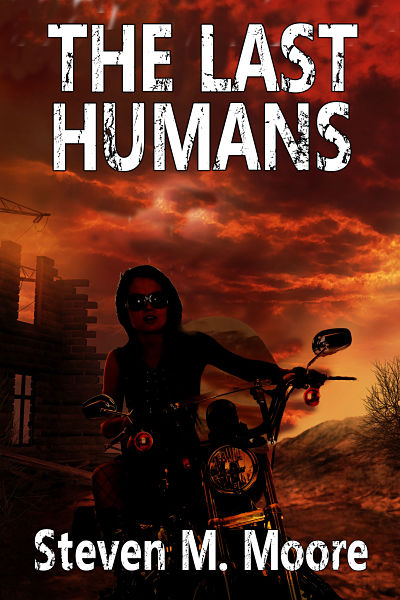
Why so few books this year? My readers might know that two is a bit less than my usual output. I’ve only published (so far) Gaia and the Goliaths (Carrick Publishing) and Rembrandt’s Angel (Penmore Press). I’m not really slowing down. I have The Last Humans, a post-apocalyptic thriller, with beta-readers, for example (see the following summary). I spent a wee bit more time (so did Penmore Press) getting Rembrandt’s Angel ready and then its PR and marketing campaign ready (probably spending what I saved in production costs on that), so at the half-year point I’m a bit behind my pace. Of course, there’s no race nor pace. And you can find plenty of excitement and action in my “older books” (see above).

Summary of The Last Humans. The apocalypse kills billions—numbers so large that most survivors’ minds snap shut. Foes of the U.S. have attacked with a bioengineered contagion that spreads around the world.  One of only a few survivors, Penny Castro, ex-USN diver and L.A. County Sheriff’s deputy, reacts differently. She fights back and creates a life for herself where death is the common denominator. On a forensic dive, she is interrupted. When she surfaces, she finds all her colleagues dead, so she has to battle starvation, thirst, and gangs of feral humans until she ends up in a USAF refugee camp. A post-apocalyptic thriller for our times, Penny’s adventures will entertain and shock you into asking, “Could this really happen?”

Why don’t I sell books on my website? There are so many book retailers on the internet that I don’t need to do that. You’ll find my ebooks just about anywhere that’s legit (and unfortunately in some places that aren’t). I’m limited to one link per book cover on the “Books & Short Stories” webpage, though, and they take you to Amazon, which also lists the print books as well as ebooks, if the former are available. Smashwords and its associated retailers like Amazon, Apple, B&N, and Kobo only deal with ebooks (B&N is the exception), but you’ll find me there too. And all my books save one (see below) are reasonably priced already, so I couldn’t offer you much savings for buying here, and my costs would go up (someone has to pay for this website’s programming—oh, yeah, that’s me!).

Reviewers v. beta-readers. Reviewers get free books in exchange for an honest review. Beta-readers get to read a manuscript (MS) before it becomes a book. I value both sets of people. They work hard if the job’s done right, but the latter group probably works harder—they have to read an MS Word document, looking for logical errors (the getaway car changes from red to blue in the middle of a chase), and they often catch a few remaining copy-editing errors too. Reviewers get to read a finished book and should say what they like or dislike about it and why. (Sometimes beta-readers do that too, but it isn’t a requirement.) I have to put my trust in both, but I screen beta-readers more. Most of my books need reviews, though; you can sign up to do one using my contact page. (Any reader can become a reviewer, of course, by simply reviewing the books s/he reads.)

Bundle or not to bundle? One of my more expensive ebooks is Survivors of the Chaos, published by Infinity Publishing, an old print-on-demand (POD) outfit (production costs for indie author’s print books are now less with Amazon’s Create Space, and even zero with small presses). I have a second edition ready. I’m planning to bundle the entire “Chaos Chronicles Trilogy,” meaning that readers can buy one ebook and get all three novels for a price less than the Infinity ebook first edition.

This is an experiment, so we’ll see how it works. The other two ebooks in the trilogy haven’t done well, and I’m suspecting that Infinity’s price for the first is a major cause. (All the books in the trilogy will be rewritten and reedited.)

Read the rest of this entry »
Do you get your money’s worth?

September 7th, 2017

Readers and writers alike see those expensive ads for a book. Video trailers, full-page ads in the NY Times, and huge ads in that paper’s book section every Sunday. You also have Kirkus Reviews, little more than ads themselves because they’re paid for by Big Five publishers.

You also have ad agencies and marketing experts who make a huge amount of money as the proverbial “middle men.” A Big Five publisher doesn’t usually design the ad or run the marketing campaign, after all. Someone is hired to do that.

Are these efforts worth the money? I suppose some readers respond to the hype. Marketing people working for Big Five publishers aim their big guns at those readers, of course. As a reader, I guess I’m old-fashioned. I don’t pay much attention to hype beyond being annoyed by it, especially when superstar author X endorses Y’s book. That’s similar to Henry Winkler or Mike Ditka selling insurance. Moreover, it’s dangerous for Y, because I might hate X’s writing.

To be honest, most of the big-bang marketing hype is for the Big Five’s stable of winning stallions and mares. You’ll rarely see a huge marketing campaign for a new author. If you’re an author spoiled by the Big Five, you don’t worry about PR and marketing very much either, so whatever they do is probably OK. If you’re not, the question becomes: Do you get your money’s worth?

Read the rest of this entry »

Steve’s shorts: Lifeboat…

September 6th, 2017

Lifeboat

Copyright 2017, Steven M. Moore

“Can we keep it?”

Jerry looked at the creature in his daughter’s hand. He had stopped sprinkling the new grass seed and considered her question. He held out his free hand, still gloved from raking the soil.

“Give it to me and let me rinse your hand off!” The creature looked like fancy lime Jello from a mold, except it wasn’t completely transparent. “Where did you get this?”

Susie pointed under the hedge. He saw something the size of a small, shiny, stainless steel garbage can. The rounded end was blackened as if it had gone through a fire. The flat end was emitting white smoke. There were strange characters on the side that looked a bit like Chinese writing. A bio attack launched from China?

Read the rest of this entry »

Monday words of wisdom…

September 4th, 2017

Facts do not cease to exist because they are ignored.—Aldous Huxley

***

Have a safe and enjoyable Labor Day, but let’s celebrate the workers who form the backbone of America.

Book sale: Some authors bundle a series or part of a series.  Here’s an alternative: from now through September 30, all three books in the “Clones and Mutants Trilogy” are on sale only AT SMASHWORDS, $1.99 for each ebook, reduced from $2.99—that’s one-third off.  The clones make their appearance in Full Medical as part of a complex government conspiracy, they combine forces with the mutant in Evil Agenda to thwart another plot, and they all save the world in No Amber Waves of Grain.  These aren’t comic book characters like X-Men—they’re real people who work to halt an apocalyptic future.  Use the link and go directly to Smashwords, enter the coupon codes during checkout, and get hours of fall reading for only $3.  (Amazon addicts, did you know Smashwords also sells .mobi files for your Kindle? They handle all popular ebook formats and distribute to many retailers.) Pass the word about this sale to your relatives and friends. And, for librarians purchasing ebooks for their libraries, I’ve reduced the price of most of my ebooks on Smashwords. Use the link to see my entire catalog. Great fall reading.

In libris libertas!

Notes on the eclipse…

September 1st, 2017

Isaac Asimov in his extended Foundation series (it brings together the Foundation Trilogy, the robot novels, and The End of Eternity) commented toward the end during the search for Earth that humans’ home is an E-type planet with a very large moon. Some gas giants have even larger moons, of course, but Earth’s satisfies the Goldilocks Principle twice over: its distance from the Sun and its diameter are just right so that it just blocks the Sun. That occurs about every eighteen months on Earth, but most eclipses aren’t seen by many people because the Earth’s surface is 70% covered by water.

Eclipses have left their observers agog from prehistoric times to present day. Originally explained via magic and superstition, we now use the magic of technology to observe them. These observations have aided and will continue to aid us in understanding our home star. The eclipse of May 1919 confirmed a prediction of Einstein’s theory of general relativity. While telescopes can now block the solar disk to study the sun’s corona and prominences, there’s something special about the moon doing it for us.

The eclipse occurred a week ago. Because the NYC area wasn’t in the path of totality, I decided to watch the totality multiple times with ABC’s reporters stationed along the totality path. Here are some notes (with annotations from yours truly) that I made during that experience:

The last cross-country total eclipse was 1776. I need to check that. If correct, that eclipse was the most patriotic one.

People were saying all viewers in the U.S. were at a “Woodstock for Nerds.” I was happier just seeing ordinary people, not Sheldons and Leonards, getting excited. Even the Great Denier of Science Fact seemed into it.

I’m not sure the two making their wedding vows during the eclipse got the wedding present they’d bargained for. It rained on them.

ABC’s left-clock announcing the “next totality” must have been created by a lover of oxymoronic phrases. There was no “next”; the moon’s shadow swept continuously across the country. They should have said “next report about totality” or something similar.

“Diamond ring”? Not a bad name, but that and the Bailey’s beads (named after astronomer Francis Bailey) are both due to the sun either peeking and/or diffracting through craters and valleys on the moon. Its limb isn’t smooth by any stretch of the imagination.

Read the rest of this entry »

Looking for a publisher?

August 31st, 2017

I don’t have much experience with this, but let me quote UK’s The Guardian: “These days, it is minimally staffed and funded firms who invest in new authors. The giants avoid such risk, only picking the writers once their names are made….” “The giants…” refers to the Big Five publishing conglomerates, of course. A contract with one of their subsidiary publishing houses might please most authors, so how are we to explain The Guardian’s comment?

Readers will find that new authors publish in various ways—with a major publisher; a smaller, independent one; or by going indie. The first two are considered traditional publishing. In spite of some readers’ beliefs and those of many professionals in the field, none of these has much to do with the quality of the book. You can have great books in all three; you can also have bombs in all three.

Full DIY (complete indie) isn’t very satisfying if you’re a new author looking for a bit more interaction with people who know the book business. A service like Draft2Digital can be helpful to the newbie and great for the seasoned author as well (my relationship with Carrick Publishing is similar, although probably more interactive in a pleasant way, and began before Draft2Digital was even born). Using reasonably priced PR and marketing services can always be useful even for most traditionally published authors (traditional contracts aren’t known to be much help there).

As is often the case, the bigger the traditional publisher, the more an author becomes a lost soul in a huge purgatory or hell of lost authors. This what The Guardian means. You won’t develop many personal relationships or receive much personal attention from a huge publishing house unless you’re one of their superstars. In either case, traditional or indie, you might be lucky enough to have a personal relationship with an agent, but that’s iffy too. And agents come and go from the agencies, so you might find yourself soon looking for another agent.

Read the rest of this entry »