Series fatigue…

June 4th, 2020

Readers of this blog know I binged on Faith Martin’s Jenny Starling series, seven Brit-mystery novels (lots of time to read during this pandemic, and reading a novel is much more interesting than any computer game). I reviewed that entire series recently (maybe a first among reviewers?). I started on her Hillary Greene series, which contains twelve books at last count, but I stopped after reading seven. What happened? I found out that binge-reading series can cause fatigue. I got tired of old Hillary and her hang-ups; the books seemed too similar; and the themes, if present, seemed too tame. Ms. Martin doesn’t hold the record for causing my series fatigue. I couldn’t even get beyond A in Sue Grafton’s alphabet series.

In general, readers can tire of series. Of course, the main problem with a series of novels is that it is a series. Authors must work hard to make each novel stand alone and allow the reader to jump into the series at any point. In each novel, there can be references to events in previous novels, but these should only be “little rewards” for the series’ dedicated followers. In other words, they could be deleted without affecting the reading of each novel. The Jenny Starling series does a good job of this; the Hillary Greene series, not so much, because the plots of one book often depend too much on what happened to the DI in earlier books, making each novel too much like an episode from a soap opera.

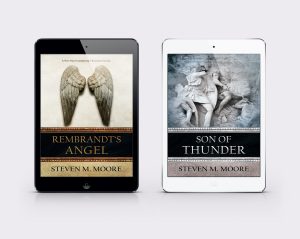
Considering that I have a long-standing tradition of following my own advice, I was surprised when a Goodreads reviewer stopped reading my novel Son of Thunder because he hadn’t realized it was a novel in a series. The surprise was partly due to the fact that I’d had independent verification that I follow my own advice well: A reviewer of a Chen and Castilblanco novel stated just the opposite, saying that I should teach a course on how to make a series book in a series stand alone.

That GR reviewer is entitled to his opinion, of course—reading appreciation is so subjective—but I wish he’d tried a bit harder. Or read the first book, Rembrandt’s Angel, if he felt the need. Maybe his loss? And, from my experience, he’s not the only reviewer who doesn’t want to jump in mid-series. (I’m suspicious of reviewers’ requests for books in the series previous to the one I’m asking them to review. While I value every review I get and send a blanket thanks to all the reviewers–as a reviewer myself, I know reviewing is time-consuming–I don’t think reviews help all that much. See last week’s post.)

I wish I knew all the causes for series fatigue in readers, including myself. That would give me a better list of things to avoid as a writer. Moreover, it would help me answer some questions: Why did I start to drag my heels with #6 in the Chen and Castilblanco series? I thought I’d ended my malaise with #7, but when I finished it, I decided I needed to take a break from that series.
Read the rest of this entry »

The Authors Guild…

June 3rd, 2020

This organization should change its name. In spite of all the nice platitudes on its website, it’s not a union for authors. It doesn’t represent the majority of authors at all. What it has become is a tool the Big Five publishing conglomerates and their authors use to rant against self-publishing and independent small presses, the former being those who feel threatened by the latter (they’ve got theirs, so they don’t want any competition). It’s a bit like those old range wars between farmers and cattle ranchers or sheep ranches and cattle ranches. I can’t come up with an appropriate name for this group. Maybe EPAC? Yeah, that’s it: Endangered Publishers and Authors Club. Well, EPAC doesn’t control this blog, and, as a mongrel (both self- and traditionally published), I’m certain I know what’s wrong with publishing today: We authors, the creators, are smacked around far too much, and EPAC does nothing whatsoever to protect us.

Sure, in their glib platitudes, the Guild professes to work to minimize that “smacking around.” Dunno. Maybe they do for those already established authors who want more power to push the Big Five and their agents around for better contracts, but their presence I’ve seen in entirely different. And I don’t know what their problem is. Big Five conglomerates and the old formulaic mares and stallions in their stables have successively trampled on small-press authors for a long time, with the addition of self-published authors to their hit list only occurring in the last twenty-five years or so, corresponding to the advent of digital publishing. They have attempted to propagate the myths that their enemies produce badly written and badly edited books that don’t have the quality of Big Five books. (I rarely read the latter!)

Many Big Five authors are generally vocal about that (for example, James Patterson, the inventor of the book-writing assembly line—ever wonder why he needs Bill Clinton?). Of course, they’re all wrong. Now most self-published and small press books are better quality than Big Five book, from the former’s snazzy covers (some Big Five covers look like PowerPoint slides, others just cheap) to everything inside. Moreover, the Big Five has a bevy of sycophants like Kirkus and the NY Times Book Review to propagate these myths. Why do they need the Guild?

Agents bow to the Guild too, because most of them are just gatekeepers for the Big Five (even though neither they nor the Big Five acquisition editors can tell what MS will become a successful book any more than anyone else!). I’m turned off when a literary agency responds to a reasonable question by referring me to the Guild. In their defense, literary agents, by their own choosing (maybe to continue their parasitic existence?) have become the ham slices in a sandwich—the Big Five are one slice of bread, the Guild the other, and it’s all about keeping the bread coming. (Yeah, I know: that’s a mangled metaphor. But it’s all about bread, i.e. greed. Promoting creativity is far down the list of motivators for the Big Five.)

The Guild still pretends to be something like a union for all authors. I wish! Authors have no representation. Period. Publishers depend on authors, but the standard 15 or 20% royalties are a joke, especially when most publishers do very little to earn that 80 to 85%! I suppose some starry-eyed newbie authors still think they’ll help in marketing. Forget about it! Those full-page NY Times ads and TV promos for books are only for the old, dependable, but formulaic mares and stallions in the publishers’ stables. New authors get zilch for help in marketing…assuming they can even manage to get a publishing contract. Most traditional publishers expect their authors to do all the marketing to earn those meager royalties. And authors shouldn’t think self-publishing is the answer either. Amazon and Smashwords really don’t care if you’re successful. They make plenty of money from your paying for your book formatting and your ads. Amazon, for the most part, has forgotten they got their start from selling books. They love to sell toilet bowl cleaners, though.

The Guild is always on the wrong side of these issues. They go against any author who tries to buck the system! They can’t help authors in general, because they have a long tradition of not doing so…and have forgotten that without authors, publishing is nothing. Most all the dinosaurs in the EPAC are heading for extinction, though. I hope I live long enough to see it.

***

Comments are always welcome!

“Esther Brookstone Art Detective.” In this series, the reader will meet Esther Brookstone, ex-MI6 spy and Scotland Yard inspector working out of the Art and Antiques Division, and Bastiann van Coevorden, Interpol agent, who are twenty-first versions of the famous sleuths Miss Marple and Hercule Poirot, except that Esther is a bit more nimble and sexy and Bastiann a bit less flamboyant. In Rembrandt’s Angel, Esther becomes obsessed with recovering a painting stolen by Nazis in WWII. In Son of Thunder, her obsession is to find St. John the Divine’s tomb. In both novels, Bastiann tries to keep her on an even keel. Available in print and .mobi (Kindle) ebook format at Amazon and the publisher, Penmore Press, and in all ebook formats at Smashwords and all its affiliated retailers (iBooks, B&N, Kobo, etc.) and lending and library services (Scribd, Overdrive, Baker & Thomas, Gardners, etc.). Novel #3 is in the works.

Around the world and to the stars! In libris libertas!

Op-Ed Pages #3: Who is that unmasked man? Incompetence and fascism…

June 2nd, 2020

[Note from Steve: As some faithful readers of this blog already know, it originally contained op-ed articles about current issues and events as well as book and movie reviews, author interviews, and articles about reading, writing, and the publishing business (all written in op-ed style). I stopped posting the first type because they often represented too long an investment in time to find the relevant background material and fact-check as much as possible. That said, I believe it’s now time to express my opinions again, so I’ll occasionally post such articles in the future. They’ll all start with the phrase “Op-ed pages” so you can skip over them if you like (I prefer that you comment, though, even if you disagree). Here’s another post in this new (and old) category….]

“Grossly incompetent” were the words Donald Trump aka Il Duce (he of the imperial scowl) used to describe Barack Obama. Of course, he should have been pointing the finger at himself. Without naming Trump, Obama lashed out at his successor for handling the pandemic incompetently and basically called him an incompetent and immature schoolyard bully, which he is indeed. But why is this occurring?

I can’t believe that Trump is completely stupid. Although he often acts like a knuckle-dragging ape at times (which is an insult to apes, of course), this poor excuse of a human being is of average intelligence and appeals to many others—that takes some skill, because he’s a hard man to like. One has to kiss his derriere too much; the only ones left in his admin survive by doing just that. In spite of his many personal defects (and questionable mental stability, according to many psychiatrists and psychologists), it was puzzling to me how he could be so incompetent even before Obama made his prognosis.

Now I think I’ve discovered the reason, and it goes hand-in-hand with Trump’s schoolyard-bully image: He’s a fascist at heart. All the characteristics of an autocratic leader are there: narcissistic, sociopathic behavior leading to disdain for anyone else’s opinions. There are a lot of knuckle-dragging apes in the US now (again, that’s insulting those noble creatures), and they love fascism—they euphemistically call fascist leaders “strong leaders” and scream slogans like “Make America Great Again!” It was always great, a noble experiment against fascism and fascist thought, from England’s King George to the 20th and 21st century despots, most infamously Putin and Kim, but Trump isn’t making America greater. He and his followers are tearing it apart at the seams.

Fascist rule is usually incompetent because it depends on one or a few men and women to make correct decisions. Both the Soviet Union and Nazi Germany proved this. For all the far-left idiots (the far-right in the US doesn’t have a monopoly on idiocy, but far-right and far-left don’t cancel each other out like particles and anti-particles, unfortunately) who call their friends “comrade” and admire the debunked ideology of Soviet Communism, there was little difference between the Soviet Union under Stalin and Nazi Germany under Hitler. Both leaders were fascists and incompetent. Later Soviet and Russian leaders were all fascists too—I guess the labels are changed to protect the guilty?

Read the rest of this entry »

Review of Karpf’s Prelude to Extinction…

May 29th, 2020

Prelude to Extinction. Andreas Karpf, author. I hope Dr. Karpf reads this review because, as one physicist to another (ex-physicist in my case), I say to him, “You, sir, have written one helluva good hard sci-fi novel!” With a low price no Big Five conglomerate’s publisher would even consider, I suppose it’s self-published—Howey’s Wool and Weir’s The Martian were too (initially), and this one deserves more fame.

My summary here could make it sound like space opera, but it’s a solid albeit risky extrapolation of current science like all the best hard sci-fi novels that now are so hard-to-find in this current publishing universe. In fact, the technological razzle-dazzle even leaves Star Trek and Star Wars far behind as the reader interacts with the verbal imagery. And this novel is also far better than any computer game because there actually is a plot!

So here’s my summary: Captain Jack leads humans’ first expedition to a nearby star system (for some reason, not the nearest—there are stars like the sun that are much nearer). They find a destroyed ET colony—intelligent beings were already there eons ago, terraforming the planet. And when I say destroyed, I mean destroyed! The bad ETs even left deadly traps for anyone else who might arrive. The humans have to flee and are chased from one star system to another, using the murdered colonists’ (the good ETs’) stargates, until they finally meet the good guys. They’re so advanced they have lost the ability to fight those bad ETs bent on destroying all other intelligent beings in that part of the galaxy. Unlike the Rangers and Tali in the second novel of my “Chaos Chronicles Trilogy,” the author doesn’t provide names for the good or bad ETs, but the humans show the good guys how to fight the bad.

This summary doesn’t do justice to the novel or even the technological razzle-dazzle. The author gets carried away with the description of the flora and fauna on that first planet (reminding me a bit of Weir’s ugly, verbose potato-growing description in The Martian); this first part drags a bit. But readers should stick with the story because the plot accelerates. The author paints a nice contrast between the Earth crew and those complacent good ETs who are a million years more advance than humans. The crew has its typical organizational and command problems—as I read, I sometimes expected a mutiny by those in the crew as ready to run away from a fight as the good ETs.

The stargates are fun—huge devices (compared to starships) that create something like wormholes. They’re used to fold space-time and go from star system to star system in much shorter subjective time than a starship (of course, starships are needed to construct them and put them into orbit around target planets—you have to wonder why the good ETs haven’t invented something like von Neumann stargates that reproduce themselves around the cosmos). Both the stargates and the good ETs’s stardrives are examples of what a few million years of scientific progress can bring, while the bad ETs’ stardrives (they fear the stargates) are inferior. The bad ETs are evil thugs and not too bright in comparison to the good guys—we never actually meet the bad ones, only their soldiers, and they appear to be nomad marauders bent on murdering all the competition.

This is the best sci-fi I’ve read in a long time, much better than Wool or The Martian, and reaffirms my belief that non-scientists are a bit crippled when it comes to writing good, hard sci-fi (hard to be a touch typist with one arm tied behind your back?). The extrapolations of current science that are necessary are handled well in this novel and rarely well by non-scientists, including by those screenwriters for Star Trek and Star Wars. (Of course, I regret some of my own extrapolations. The difficulty is that the farther out in time the extrapolation, the more it appears like magic. Extrapolations aren’t that easy!)

By the way, the title and epilogue suggest that there will be a series. I hope so. I’ll look forward to it!

***

Comments are always welcome!

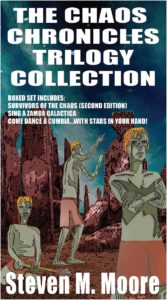
The Chaos Chronicles Trilogy Collection. Survivors of the Chaos takes the reader from a dystopian Earth dominated by mega-corporations and controlled by their mercenaries, to the 82 Eridani star system. Sing a Zamba Galactica starts with first contact with friendly ETs and the invasion of Earth by unfriendly ones, and ends with Humans saving that collective intelligence known as Swarm. In Come Dance a Cumbia…with Stars in Your Hand!, Humans and ETs combat a psycho-industrialist who dreams of being the absolute ruler of Near Earth space. Exciting sci-fi that’s bundled in a three-novel package for your enjoyment. Available on Amazon and Smashwords and all the latter’s affiliated retailers (iBooks, B&N, Kobo, etc.) and lending and library services (Scribd, Overdrive, Baker & Thomas, Gardners, etc.).

Around the world and to the stars! In libris libertas!


What’s with the combos?

May 28th, 2020

I’m an avid reader, mostly of ebooks, so I’m wondering, what’s with the combos? Ebooks are combined with audiobooks, and print book/ebook or audiobook pairings are common now. Can some reader of this blog tell me why a reader would ever want to buy such combos?

I can imagine audiobooks being useful for a commuter or jogger who can “multitask.” Whether such people are actually “reading” anything complex that way is questionable. Maybe they need the ebook or print version to go back and understand what they heard-read?

The ebook/print combos are even more a mystery. If the author signed the print version and the reader wants him to die early and increase the value of the investment, maybe it makes sense—the reader can read the ebook immediately and keep the print version pristine! But one major positive for ebooks for me is that they only take up room on my Kindle and not my sagging bookshelves. (Print books produced that nefarious effect long before ebooks and audiobooks—have you ever seen how thick Misner, Thorne, and Wheeler’s Gravitation is?). I only read print books now when someone gives me one. They kill forests!

My mongrel paranoia (as an author who is both traditionally and self-published) makes me think the print/ebook combos are just a Big Five conspiracy to get ebook readers to buy print, both of which are super-expensive compared to books not published by Big Five publishing conglomerates. To support that paranoid thought, I’ve often also seen Big Five offerings of an accompanying ebook version that’s more competitively priced than the separate ebook, which is often priced nearly as high as the print version when sold alone to protect the latter, where they make the most money.

I just don’t see how these combos are attractive to consumers. I ignore them. Now ebook bundles, those are usually bargains! Consider my ebook bundle, The Chaos Chronicles Trilogy Collection. While each novel can stand alone (and originally did!), the reader can have all three lengthy sci-fi novels in one ebook bundle for about half the cost of a Big Five ebook! I’m all for that! I won’t ever go beyond a trilogy (maybe the “Clones and Mutants Trilogy” or the “Mary Jo Melendez Mysteries” is next?); all seven Chen and Castilblanco books would be unwieldy together in one ebook bundle, as would many long series (can you imagine Grafton’s entire alphabet series in one ebook?).

How do you prefer to “read”? Do you consider an audiobook even reading material? Do you have a use for combos? Let me know. I might adjust my formats accordingly. Forget audiobooks, though. They’re just too expensive to produce, even for my small press publishers, primarily because a good narrator is required. (I wouldn’t mind having sound effects, though. That would avoid the pfft! I use to indicate a shot from a gun with a silencer!)

***

Comments are always welcome.

The Chaos Chronicles Trilogy Collection. Survivors of the Chaos takes the reader from a dystopian Earth dominated by mega-corporations and controlled by their mercenaries, to the 82 Eridani star system. Sing a Zamba Galactica starts with first contact with friendly ETs and the invasion of Earth by unfriendly ones, and ends with Humans saving that collective intelligence known as Swarm. In Come Dance a Cumbia…with Stars in Your Hand!, Humans and ETs combat a psycho-industrialist who dreams of being the absolute ruler of Near Earth space. Exciting sci-fi that’s bundled in a three-novel package for your enjoyment. Available on Amazon and Smashwords and all the latter’s affiliated retailers (iBooks, B&N, Kobo, etc.) and lending and library services (Scribd, Overdrive, Baker & Thomas, Gardners, etc.).

Around the world and to the stars! In libris libertas!

Do book reviews matter?

May 27th, 2020

This is an important question for all authors (for readers, see below). Another one is: Who writes reviews? The two questions are linked, of course, and both need to be answered.

I’ve always offered a free ebook in exchange for an honest review (print books are costly, especially for outside the US), and I thank all those good people who respond to that offer, whether directly or via NetGalley. But do those reviewers get more out of it than I do? That’s not a question reflecting a selfish quid-pro-quo philosophy. It’s only an admission that I don’t have any metrics. How do we measure whether reviews matter?

Sales figures aren’t real measures because of the time delays involved. Moreover, I’ve never seen any proof that reviews help improve them. Marketing gurus make unsubstantiated claims like, “Reviews sell books.” Huh? No, online and brick-and-mortar bookstores sell books. One can’t even say, “Reviews help sell books.” I have yet to read or hear one guru offer direct proof of that. Most books sell by word-of-mouth (person X tells family member or friend Y that some book is a great read) or at book events where the author meets and talks to readers.

And all a review does is give one person’s opinion. Most of the ones on Amazon, which is that only online bookstore many authors and marketing gurus think about, to their detriment, a little more than an unqualified thumb-up or down. Amazon has devalued their reviews so much that they ask would-be reviewers to indicate their star-ranking before even writing the review! Think about it: You rank the book and then scramble to justify that ranking in the review you write. Completely backwards!

While I’m tempted to be a bit more complete in my own reviews, I usually don’t go into how an author handles the key writing skills. I’m certainly qualified to do so. My reviews are still usually longer than other reviewers’, especially those on Amazon, so I suspect the average reader would get bored with all the details even if I added them. (It used to be that Amazon knee-capped me at five hundred words, but I’ve slipped some reviews by that are more verbose.) But do reviews matter?

Read the rest of this entry »

Op-Ed Pages #2: Guns…

May 26th, 2020

[Note from Steve: As some faithful readers of this blog already know, it originally contained op-ed articles about current issues and events as well as book and movie reviews, author interviews, and articles about reading, writing, and the publishing business (all written in op-ed style). I stopped posting the first type because they often represented too long an investment in time to find the relevant background material and fact-check as much as possible. That said, I believe it’s now time to express my opinions again, so I’ll occasionally post such articles in the future. They’ll all start with the phrase “Op-Ed Pages” so you can skip over them if you like (I prefer that you comment, though, even if you disagree). Here’s another post in this new (and old) category….]

I cringed when I saw protesters in Michigan’s capitol rotunda carrying automatic weapons. I immediately asked myself, Who do they want to kill? The governor? (Just a few days ago, a man was arrested for threatening the life of Michigan’s governor.) The legislators? Or are they just macho crazy fanatics looking for media attention? Maybe they should turn to more useful activities like helping those Michigan people threatened by the floods?

Here’s the problem with guns: In a protest or any argument (stand-your-ground laws come to mind), such weapons can lead to a slaughter. And, if both sides are armed—and FYI, Michigan crazies, the other side can bring weapons too—the slaughter will affect both sides. That’s a rather barbaric outcome for the 21st century but not unusual elsewhere (Afghanistan, India, Yemen, etc.). Maybe that’s what the knuckle-dragging knuckleheads in Michigan want? They might as well be brainless, bloodthirsty zombies. Freedom fighters they’re not!

I didn’t have answers for those questions in the first paragraph, but that didn’t matter. The whole episode just reaffirmed my belief that ordinary citizens must be protected from all fanatics, but especially NRA fanatics. We need reasonable gun control! While Donald J. Trump is the dangerous fanatic holding the nuclear codes, is he more dangerous that these protesters? Maybe. He enables them by defending them (“There are good people on both sides”). I refuse to visit states with stand-your-ground laws. While the knuckle-dragging gun fanatics aren’t likely to shoot me because they don’t like one of my books—no danger there, because most of these skinheads can’t read well and just watch Fox News while belching on the couch, both activities just like their idol’s—I still don’t want to run the risk that someone shoots me over a parking space.

Second Amendment “experts” who believe the Founding Fathers gave them the right to bear arms are ignoramuses who don’t know history. Not only do they don’t read books, they’ve never read, let alone studied, the Constitution. I guarantee most immigrants studying to get their citizenship papers know more about that famous document than most Americans, especially the gun nuts. The use of the phrases “bear arms” and “militias” in the eighteenth century was simply a recognition by the Founding Fathers that, without militias to fight the King’s Redcoats, the American Revolution would never have occurred.

A database at BYU shows exactly that. Almost every document is evidence for restricted gun use. Of course, many people ignore history. Antonin Scalia didn’t, though. He cherry-picked those documents in that database to find only those documents that make some reference to personal gun ownership. In doing so, he out-Trumped our current president: lying by omission is still lying! A cleverer way of doing it…maybe. And not that he was the first conservative judge to do so. Most SCOTUS conservative judges got to where they are by lying, mostly by ignoring precedent, i.e. lies by omission.

Read the rest of this entry »

Memorial Day Message…

May 25th, 2020

Today is the traditional day for remembering all those who have given their lives defending America in foreign wars, those courageous members of the armed forces who have made the ultimate sacrifice. We tend to confuse this day a bit with Veterans’ Day, which is fine—coming from a family of veterans, there’s nothing wrong with also recognizing those who returned. All members of the Armed Forces should be recognized and applauded for their service.

However, we are now at war within our borders and throughout the world, a war against an invisible enemy, COVID-19, so today we should also remember those healthcare workers, first responders, and all the support staff who have made the ultimate sacrifice in that war, along with those who have fought valiantly and are still fighting this pandemic.

Both groups mentioned above have tirelessly worked to keep us safe. In these trying times, we must remember all the heroes. They’ve all made America great and been tireless warriors in the battles that threaten the U.S. and the world.

Be smart…and stay safe. We will get through this.

News and Notices from the Writing Trenches #181…

May 22nd, 2020

A salute. To all those front-line workers who deserve much more than applause and cheers, I salute you. That includes doctors, nurses, maintenance workers, grocery clerks—all who are keeping things going for the rest of us. I also salute the volunteers working in food pantries and aiding in general.

Some of my readers have made many useful suggestions about how we can all help those in the frontlines of this war against the coronavirus…and each other. I’m truly impressed by the sense of community that I’m seeing in the tri-state area from most people (not so much elsewhere). Most are showing common sense, listening to the health experts, and not protesting or exhibiting rash behavior. That’s all for the greater good…and toward a speedy recovery from the state, national, and worldwide disaster this pandemic represents.

I’m in that demographic group where COVID-19 would probably kill me if I got it, so I’ve become a reluctant recluse. All I can do is stay at home, except for essentials, and read or write my stories so I won’t catch the virus or propagate it—or give it to anyone else if I get it! The writing is a small and perhaps selfish contribution compared to the above, but authors are obviously not essential employees! And it goes toward promoting that common-sense reaction to the pandemic, if only by creating entertainment that allows others to stay at home.

Reading. I’ve recently read Alex Gerlis’s Prince of Spies and Keith Steinbaum’s The Poe Consequence (for a review of these two books, see the mini-reviews section of my blog archives). I also binge-read Faith Martin’s Jenny Starling mysteries, fine stories in the British mystery tradition (I reviewed the entire seven-book series recently—see the “Book Reviews” archive of this blog).

Writing. Although I’ve finished two manuscripts, A Time-Traveler’s Guide to the Multiverse (it’s a sci-fi rom-com) and Death on the Danube (#3 in the “Esther Brookstone Art Detective” series), I had to slow down a bit because I had a pinched nerve in my right shoulder (I’m a touch-typist so I need both hands). Most of this newsletter was typed before that. I guess you could say it was caused by COVID because I was doing a lot more writing…as well as reading. I’m better now, thank God.

The Smashwords sale. What I can do as a writer is provide readers with reading material. For obvious reasons, people have more time to read. Adults, however, have a bit more patience than children and young adults in this era of stay-at-home living. Kids need exciting stories. So this month I put all of A.B. Carolan’s sci-fi mysteries for young adults on sale at Smashwords. These books have also entertained many adults who are young at heart.

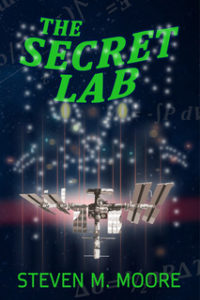
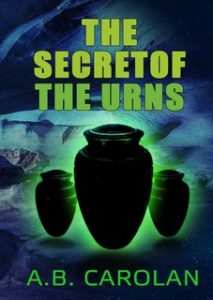
The Secret Lab is about a mutant cat and a gang of kids on the International Space Station in the future who solve a mystery that involves the origin of the cat. The Secret of the Urns is about a young girl out to save ETs whose planet is invaded by Human miners. Mind Games is about a young girl with psi powers who sets out to find her foster father’s murderer.

Note that all these books are available in ebook and print versions, but, like all my sales, the ebook is only on sale at Smashwords using the special coupon codes included in my email newsletter.

Not a member of Smashwords? Become one. It’s easy, and you’ll have access to all my ebooks as well as those from many other authors writing in many genres.

Note that all my books are inexpensive.

Free fiction. Toward the same goal of providing you reading material during these days of pandemic, check out the free fiction in the “Steve’s Shorts” and “ABC Shorts” archives of my blog. Also, you will see a list of free PDFs you can download on the “Free Stuff & Contests” web page.

Looking for a good book to read or an old movie to watch? In addition to those mentioned above, check out the “Mini-Reviews of Books,” “Book Reviews,” and “Movie Reviews” archives of this blog. (Obviously I haven’t seen a new movie recently because of COVID-19.)

Be smart…stay safe. We’ll get through this!

Around the world and to the stars! In libris libertas!


The books they ignore…

May 21st, 2020

…I often don’t. Of course, because the NY Times is part of the NYC publishing elites, dominated by the Big Five publishing conglomerates, the newspaper coddles and caters to those publishers and ignores most everything and everyone else. I sometimes peruse the NY Times Book Review to see which books to ignore (because they generally don’t entertain or enlighten me—that’s what you get from companies who are arrogant and too big); I rarely read it, though (if we still had birds as pets, a better use would be found at the bottom of the bird cage).

But it’s not only the Times editors and reviewers or Big Five conglomerate that irk me. I don’t like to be told what to read. Period. I ignore that hyped phrase “Everyone’s reading X,” or use it as a guide to what I should not read. I “discover” my own reading material. I’m also a smart consumer and value my time and money. I want to make sure my reading time isn’t wasted. I’ve learned it too often is with books from the Big Five, especially those lauded by the NY Times’s editors and reviewers associated with the Review.

So…what do I read? Books just about in every fiction genre, with the exception of bodice rippers and cozies (those are subgenres of the romance and mystery genres, although the first could also be erotica too). Lots of non-fiction books too, ones I personally choose because they interest me, not because they have a lot of hype (the latter makes me choosier—I ignore any and all ad campaigns). I recognize that reading choices are subjective; all appreciation of art is. You can make your choices; I’ll make mine. And I assure you, what you choose won’t influence me one bit (although I might say it does just to be nice).

I’m a weird chap, so our choices probably wouldn’t overlap much. I prefer books that stretch my mind with important themes or unusual plots (even better, make that “or” an “and” and I might be hooked). I find that in some recently published books (including my own, of course); I “discover” that more in “evergreen books,” ones that are as fresh and current as the day they were published (like most of mine) and happened to miss. Even as a speed-reader, I can only read so many books, so I know the number of good evergreen books is always increasing even if the number of quality current books is decreasing. I’ll always have plenty of reading material that the NY Times mostly ignores; those books won’t waste my time.

Is this attitude arrogant? Possibly. As a writer, I’m qualified to determine whether a book is worth my time, so I don’t need much help from anyone else. While I sometimes change my mind about a book’s worth after starting it, the book’s blurb and a “peek inside” are indicators that usually work well enough for me, i.e. my own browsing in either an online or brick-and-mortar bookstore or in a public library works just fine. I’m not in the habit of consulting third-party opinions, including reviewers and editors associated with the Times’s Review.

And isn’t it the epitome of arrogance, exhibited by the Times’s reviewers and many others, to tell people what they should read? I learned ago that doesn’t work for me (even before I became a full-time writer). I don’t write reviews with that in mind. I’m only providing an information service because nearly every book I read and review is one that the NY Times has ignored. And the Times’s reviews don’t provide useful information. Their reviewers are as egotistical as their restaurant reviewers.

***

Comments are always welcome.

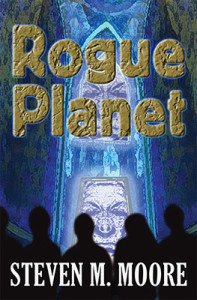
Rogue Planet. A murdered king’s son fights to free his people from an oppressive religious tyranny. An epic military and romantic sci-fi novel with Game-of-Thrones and Star Wars fantasy elements awaits you. Set in the same universe as The Chaos Chronicles Trilogy Collection and A. B. Carolan’s sci-fi mysteries for young adults, this book is available at Amazon in print and ebook versions, and at Smashwords and its affiliated retailers (iBooks, B&N, Kobo, etc.) and lending and library services (Scribd, Overdrive, Baker&Taylor, Gardners, etc.).

Around the world and to the stars! In libris libertas!