A word to the not-so-wise…

October 8th, 2025

…for authors and book promoters (and interested readers): I get offers all the time from book promoters asking me to use their promotion services, almost as many suggesting I jazz up this website. I realize the latter is getting a bit long in the tooth, but any jazzing up will be done by the same company of website gurus that I initially used to create it, Monkey C Media. The former are a bit more complex to automatically ignore, so allow me to explain. (Penny Sansevieri et al, take note.)

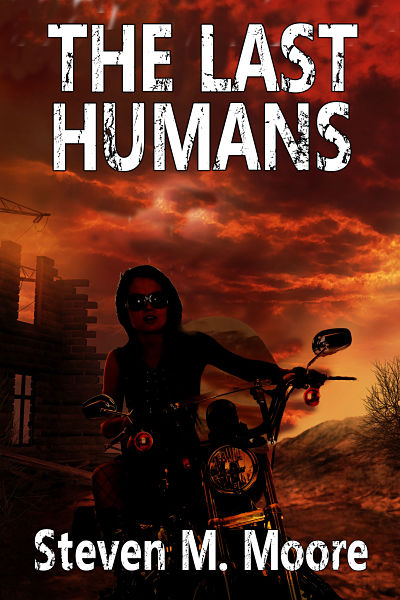
The main problem I have with book promotion services is an old one: It’s “book promotion,” and notbooks promotion”! While I might never run that marathon of writing another novel again (that’s a longer race than writing a short story or novella), I’ve already written a few! And most of them are part of a trilogy or longer series. No book promoter I know promotes entire series. (Hell, none of my traditional publishers promote series either! They don’t even promote single books!)

One would think that series represented some kind of contagion, something gross and untouchable. While I have no stats to support this boycott by book promoters, I think that some readers might be interested in series.

Has anyone ever finished a novel and wished there was a sequel, another story involving most of the same characters as the one just finished? Or maybe someone just reads mostly complete series? I do both as a prolific reader…and always have, even before the Covid pandemic. Knowing there’s a series means that I can have a lot of good reading ahead of me!

So, book promoters, I’ll ignore all your damn emails and continue to treat them as spam until you can offer me a promotional package for an entire trilogy or series. I’ve never seen such an offer from any of you, and I expect I never will. So don’t waste your time or mine!

Of course, there are probably many reasons why book promoters ignore series. I don’t know them because there are no stats comparing promos of single novels to promos of series, simply because the latter don’t exist. But I suspect the reasons are similar to why a publisher doesn’t offer contracts for a series except to a lucky few authors: It’s too much of a gamble. They want authors to take all the risks.

Series, though, must sell well simply by observing the huge sales of collections! Joffe, the British publisher, for example, seems to do well offering complete ebook collections to the reading public. (I’m a fan!) True, it’s better when the novels in the collection are “evergreen books” (the entire series was probably released book-by-book at one time, but each novel is “evergreen” because they’re still as exciting and fresh as the day they were written—i.e., they continue to entertain readers.

So here’s what I’ll offer to Joffe or any other publisher to work around stupid book promoters who don’t want to promote series: Choose any one of my series and turn it into a collection! I’m willing to do that for any of my series except “The Chaos Chronicles.” (I already made that into a collection myself.)

Ah, but will a book promoter even promote a collection? Who knows? Will it need any promotion? Again, who knows?

***

Around the world and to the stars! In libris libertas!
For your consideration: Another “evergreen book”…

October 1st, 2025

Last week I wrote about my first mystery/thriller novel, The Midas Bomb. That was my third book, so it definitely qualifies as “evergreen,” i.e., an oldie that is as current and fresh as the day I finished it (my opinion, of course—critics’ opinions might differ), but I try to make sure all my stories remain relevant for many years.

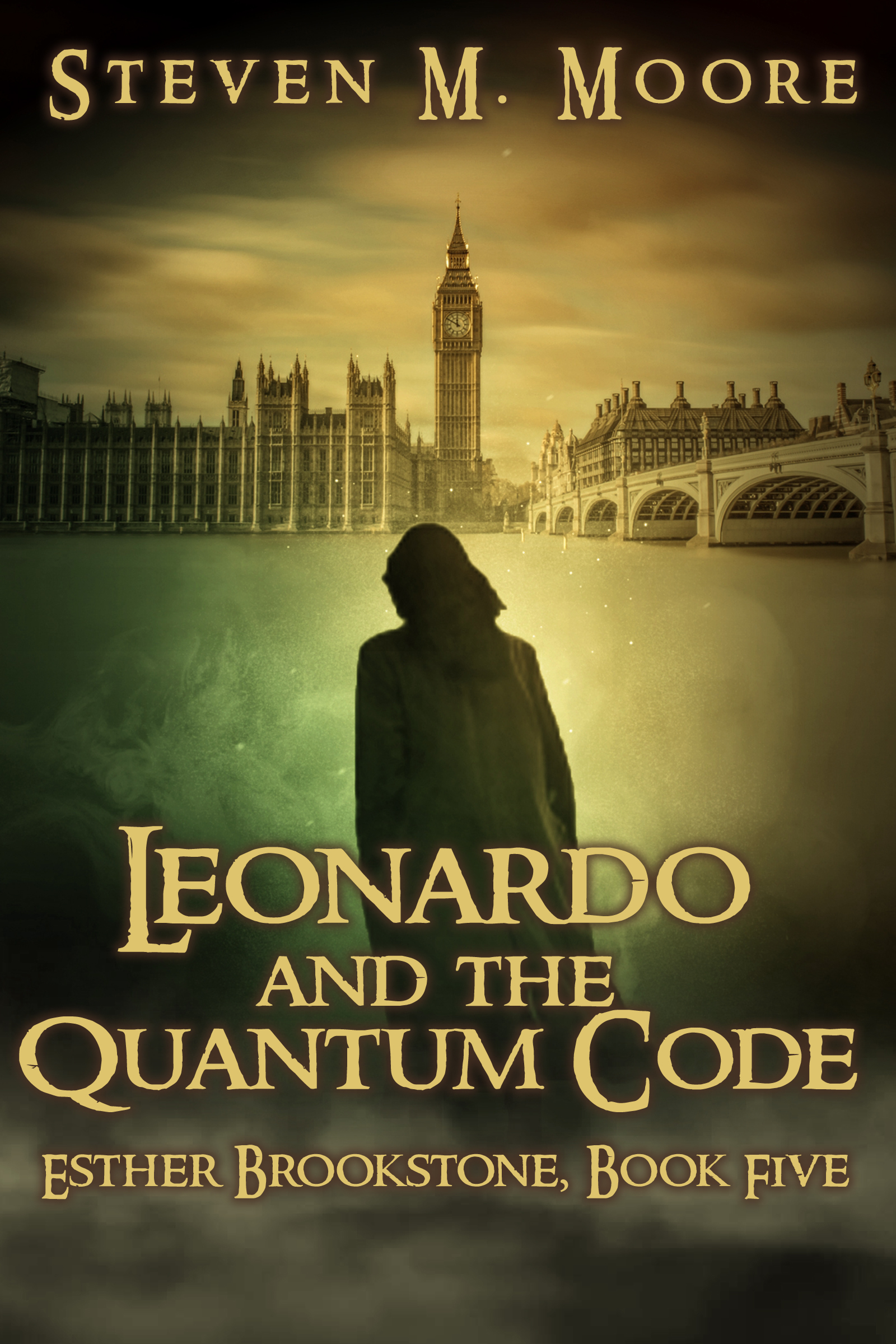
My second novel, Soldiers of God, is an “evergreen book” as well, but this sci-fi thriller turned out to be a bridge book between the “Clones and Mutants Trilogy” and the “Chaos Chronicles Trilogy.” Like The Midas Bomb, it does an acceptable job of predicting a future when the villain in The Midas Bomb (who has percolated through three other series that eventually followed the “Detectives Chen and Castilblanco” series that began with The Midas Bomb) employs religious fanatics to further his evil agenda. (In real life, the corresponding villain who has stuck around far too long is our current US president, as seen in that  huge religious revival show that recently took place in Arizona. I can probably safely assume that no readers of my book heeded the warnings contained in its plot; but that far back, there were no current events like we have now to draw attention to any fiction resembling George Orwell’s 1984 either.)

In Soldiers of God, a female FBI agent (not a female version of our current FBI director, thank God!) who fancies a crusading priest in this story set in the aftermath of a presidential assassination (not at all like the young man the far-right wants to turn into a martyr after two failed and real presidential assassination attempts). This is a complex tale about gullible religious fanatics being exploited by fascist schemers. Sound familiar?

Considering our real world where we now have a Pope from Chicago, I have some ideas for a sequel, featuring some of the same characters, that leads into the “Chaos Chronicles Trilogy” a bit better. If course, I have a long list of story ideas for a lot of novels. My problem now is finding the energy to write them. Writing a short story or novella is a dash; writing a novel is a marathon. We’ll see how it goes.

Around the world and to the stars! In libris libertas!
An “evergreen book” and series…

September 24th, 2025

After a quick review of my oeuvre recently (I often do this to avoid repetition, for example), I had to wonder, “Did I really write that?” Some readers might think that’s just an old scientist being nostalgic about his research papers written long ago during an effectively previous lifetime. But I bet if you’re reading this blog post, you’re thinking about the later version of Steven M. Moore, this crazy author of mystery, thriller, and sci-fi stories.

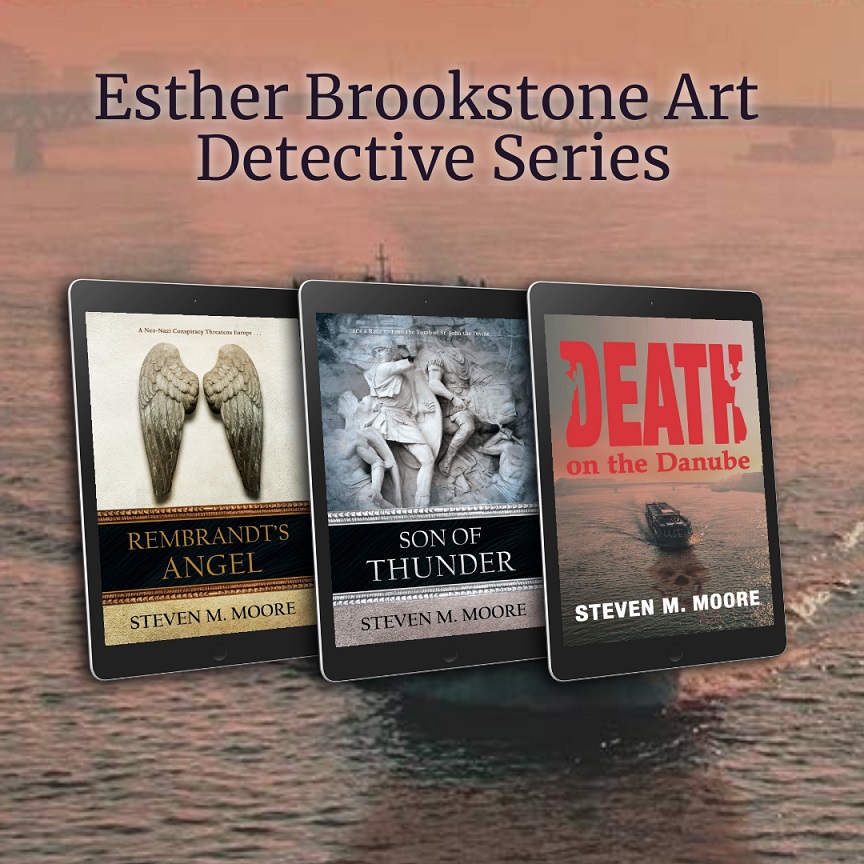
One of my favorite novels in that fictional oeuvre is The Midas Bomb, the first book in the “Detectives Chen and Castilblanco” series (and that’s also one of my favorite series). In this novel, the reader meets NYPD homicide detectives Rolando Castilblanco and Dao-Ming Chen for the first time in a very prescient story. Why prescient?

The Midas Bomb was first published in 2009, just after the bank collapses of 2008; it was my very first mystery/thriller (my previous works were both sci-fi thrillers). Set in what at the time was the future world of 2014 (i.e., six years in my future), it soon became the beginning of a fictional timeline of alternate reality through necessity, my “future history” extended super-series. (That fictional timeline now contains several additional series: “Esther Brookstone Art Detective,” “Inspector Steve Morgan Trilogy,” “Clones and Mutants Trilogy,” and “The Chaos Chronicles Trilogy,” along with the bridge books The Golden Years of Virginia Morgan, Soldiers of God, and Rogue Planet.)

I rewrote and republished a second edition of The Midas Bomb in 2015 with few changes but making an effort to match the style of the following books in the series (where Castilblanco is in first person), so, by that time, events between 2008 and 2014 had become real history. However, The Midas Bomb still remains a prescient tale!

Today’s readers will find in this novel some logical predictions about what’s now occurring in Trump’s second term: Yes, Putin’s a monstrous villain; yes, terrorism’s still a quintessential threat after 9/11; and yes, ICE is putting fear into the hearts of illegal immigrants and separating them from their families. New readers won’t find a crazy NYC mayoral race, though. (Right now, if I lived in the city, I’d probably be voting for Sliwa only because the other three are so bad!) I couldn’t imagine everything that has gone wrong, but I didn’t do too badly!

Readers will find an attempted presidential assassination. They will also find a NYC plagued by crime and violence due to budget restrictions and lack of qualified NYPD personnel. But what does that damn title mean? Maybe readers still wonder about that?

FYI: The Midas Bomb is one of my best titles…if not the best. That’s because those three words completely summarize the main plot! (I’ll leave to future readers the happy chore of figuring out how it does that.)

Some of my titles frankly suck. Come Dance a Cumbia…with Stars in Your Hand!, the title of the third novel in the “Chaos Chronicles Trilogy,” is quite a stretch; appropriate and summarizing, yes, but far too long! Angels Need Not Apply isn’t too shabby, though, for the second “Chen and Castilbanco” title.

All of my “evergreen books,” a class that includes all my oldies, are as fresh and current as the day I wrote them, but The Midas Bomb is the evergreen book par excellence because it predicts an imagined and truly ugly fascist future that’s far too close to what has actually occurred in our very crazy and dangerous real world. For that reason, The Midas Bomb will keep its new readers turning the pages; and those who have already read it, might want to do so again!

***

Around the world and to the stars! In libris libertas!
Paraguay and Uruguay on my mind…

September 17th, 2025

Long ago, mostly for personal reasons, not tourism, I visited the South American countries Argentina, Chile, Paraguay, Peru, and Uruguay. We started in Buenos Aires. I’m not sure what the Peronistas and the future Pope Francis were doing there at the time, but, as has often been the case, our dollars went a long way because of the high inflation. We met a crazy taxi driver there  (his idea of parallel parking was to get halfway into a space and then ram the rear car back out of the way), a nice porteno who agreed to haul us around the city, and even up to Asuncion and Montvideo, for a reasonable price. (Buses would probably have been more economical, but they would typically be filled with produce and poultry in addition to people. I saw this almost everywhere in Latin America. Just part of the local color!)

My lasting impressions of Argentina, Paraguay, and Uruguay? Fascism! Specifically, armed military in the streets, supposedly to maintain order, but often more dedicated to annoying people by interrogating them, checking IDs, and patting down the women. I repeat: Armed military! Regular people seemed to be chatty and friendly toward this “gringo grandote.”

Armed militia patrolled the streets, though, and they were often more numerous than the regular people who in general love to be out and about and are very friendly and sociable. I saw this in Italy too during the time when the military police patrolled the streets, airports, and bus terminals using the excuse that they were looking for Red Brigade members.

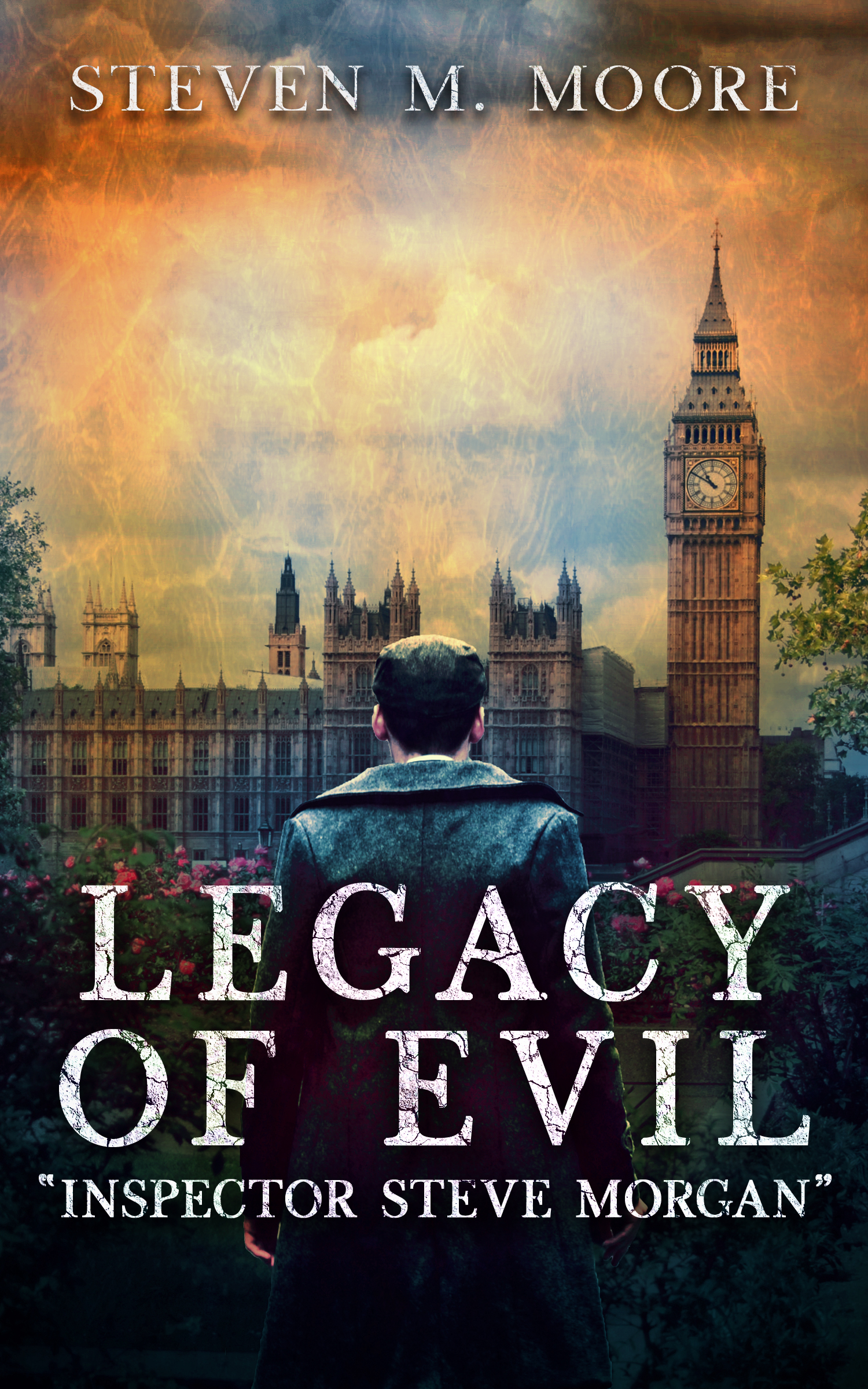
I also saw fascism on a train ride through East Berlin on my way to a conference in West Berlin: Stasi roamed the train’s aisles asking for papers from anyone who remotely looked a bit suspicious, and dog teams searched underneath the train cars for any East Germans trying to escape to the West. (Is it any wonder that my character Esther Brookstone was an MI6 spy during the Cold War, doing her part to take down that fascist government in East Germany? Note that I call these so-called communists fascists as well. There’s really no difference. Putin is a fascist, one-hundred percent! Always has been. Every Russian leader from Lenin on was a fascist.)

All this was a revelation for me: Fascism hadn’t ended with the Second World War with the defeat of Germany and Japan; it was still present in South America and Europe. Unfortunately, I’m seeing it now in Washington, DC—our nation’s capital!—and LA, both cities being places where I once lived or regularly visited without seeing fascist military patrolling the city streets.

Now, everywhere I look within the Trump administration, I’m reminded of those glimpses of evil fascism that I had long ago in Paraguay, Uruguay, and elsewhere. And now I’m fearing a fascist takeover in this country, our US, after seeing similar scenes here. Donald Jackass Trump is nothing but a puffed-up orange version of Mussolini and those Latin American fascists in the Southern Cone that the CIA once coddled. No wonder he supports Bolsonaro and loves Kim!

What can we do to stamp out this contagion that has threatened humanity for so long? I can only look for answers in my fiction…and still do! As Clancy stated, ficti0n has to seem real, and I realism now is that fascism is on the march here and abroad!

This is exactly why nearly all of my latest novels in the “Esther Brookstone Art Detective” and “Inspector Steve Morgan” contain the theme of fascism in some way. I battle fascism with my words, striking out against it in my prose. I suppose the fascist MAGA maniacs and members of the Fascist Party of America (once called the “Good Old Party” or GOP!—only a joke now!), if they can read at all (always questionable, especially our illiterate president!), aren’t readers of my books. Even in my very first published novel, Full Medical, you can see the approaching fascist fanaticism of RFK Jr. (And weren’t Putin and Chi talking about harvesting body parts to live forever? Cloning is just an extreme version of this!)

Authors of sci-fi thrillers, or even less futuristic standard mysteries and thrillers, are often fortune tellers describing the atrocities some fascist humans rain down on other humans. In that sense, we’re still in the Dark Ages. Or maybe we never left them?

***

Comments are always welcome! (Please follow the rules found on the “Join the Conversation” web page.)

Full Medical. This first novel in the prescient “Clones and Mutants” trilogy introduces the clones but also a fascist conspiracy. It takes place on a frightening future Earth that eventually leads to the Chaos portrayed in the novel Survivors of the Chaos (this novel is now only available in a second edition that’s the first novel in the Chaos Chronicles Trilogy Collection). It’s a lot scarier than any horror story because what’s portrayed here could really occur as fascism marches on in our country and the world.

Around the world and to the stars! In libris libertas!


An unappealing combination…

September 10th, 2025

Romantasy? Definition: An extremely awful and illiterate creation of a genre that’s a combination of “romance” and “fantasy” to describe the trash that authors and publishers are now dumping on the reading public. God help us! Neither genre will ever recover from this abuse.

Sappy romances have long been “bestsellers,” especially those that are replete with passionate wrestling matches that are a lazy substitute for real plots and themes. It’s mind-numbing fiction with their only claim to fame being a boost for some readers’ flagging libidos. At least a novel like Emma might have some redeeming literary qualities (not much more than Lady Chatterly’s Lover, Fanny Hill, or Tom Jones, though). Current romances are as trashy as Trump’s White House waste bins and golden toilets.

Modern fantasies aren’t much better. Forget Tolkien’s Lord of the Rings trilogy or Lewis’s Narnia series. There’s nothing remarkable about those Harry Potter books beyond Rowling’s excessive verbosity. It’s said that fantasy and sci-fi are closely related genres? No way! Today’s fantasy departs too much from reality. (I do like Ireland’s leprechauns, if only to imagine finding their pots of gold at rainbow ends, something a lot more probable than winning the Powerball lottery.) No one writes good fantasy anymore: Rowling, who’s scooped up tons of money writing her schlock, makes new rules up for her Potter world whenever she finds it convenient. I like fantasy worlds where the rules, however strange, are consistent and constant, and characters, antagonists and protagonists alike, must follow them.

“Romantasy” combines all that’s bad with today’s romance and fantasy. It’s the faddiest among all the fictional fads (cozy mysteries come close) and exists only because too many writers and publishers will flood the diminishing markets with any trash to improve sales figures by degrading their art. Too strong, you say? Discriminating readers have kept good fiction alive for centuries (many centuries, if you count caveman Ugh’s tales told around the campfire). Now some readers and publishers are killing good fiction slowly but surely by preferring to read and publish garbage. Where will it all end? With some schlock-filled romantasy based on Epstein and Maxwell’s lives?

This combination of fantasy and romance called “romantasy” can only lead to one big fantastic mess. I refuse to read this kind of garbage; I won’t write it either. And I’ll assume that any other author who does belongs in a straitjacket and locked up in a padded cell.

‘Nough said!

***

Comments are always welcome. (Please follow the rules on the “Join the Conversation” web page. If you don’t, I’ll consider your comments to be spam.)

Fantasy, romance, or sci-fi? There’s nothing wrong with writing a novel that has elements of these three genres. My novel Rogue Planet isn’t a romantasy; it’s hard sci-fi that makes a bow to the “Game of Thrones” fantasy series (far better than anything Rowling ever wrote!) and something like the musical Camelot or the tales about King Arthur’s court; but it’s more a profound statement against evil fascist theocracies like Iran’s (and what the US is becoming?). I often challenge myself in my storytelling. This is one challenge I met that I’m rather proud of. Try it to see how I did!

Around the world and to the stars! In libris libertas!

The right words…

September 3rd, 2025

After all the stories I’ve written—shorts, novellas, and novels—I’ve arrived at the point where I know I’m missing the “mot juste.” I even edit things I hear on TV now, automatically, looking for editing mistakes in word usage and better ways of saying things. Here’s a silly example: A TV reporter said, “Police investigations into what happened continue and are needed to determine what happened.” I thought when I heard that, “That first ‘happened’ is okay. It might be referring to an extended action. But the second ‘happened’ should have been changed to ‘occurred’ for two reasons: It’s over and done with, i.e. not extended action; and using ‘happened’ twice is repetitive, after all.”

Of course, I’m a forgiving fellow! You have to figure an excited reporter on the scene and orally describing an emotionally charged event (even though such events aren’t unusual in urban areas, especially those in ‘red states’). You might say, “Big deal!” Or, “So what?”

You’d be right to say that. Call it a personality aberration, failure, or quirk, but I’ve always been a perfectionist about language usage. I’m hardest on myself. (That reporter isn’t likely to learn to do better from me either, hence no names given here. Now, in fact, I spend more time tracking Trump’s blathering and outright lies because Bezos’s Washington Post no longer does it!) Call it a bad habit: If I’m chatting with you, I’m likely to be multitasking, listening to what you say but also analyzing how you say it. Same for what people write.

I think this is compatible with my belief that being a good observer of what human beings do is a necessary condition for every author who wants to be successful. (My usual measure, the number of successful stories, could be questioned: I like my own; other readers evidently not so much.) Understanding human nature, especially their idiomatic use of language, isn’t a sufficient condition, though. Psychiatrists supposedly are excellent observers of human nature, but most mental health professionals couldn’t write a novel even if they wanted to take that obvious pay cut!

Language is an important part of what we authors can observe to get background for our stories. In a complex DEI environment like the one here in the US that we live in (sorry, Donald, you can’t kill DEI by fascist fiat, so you should stop trying!), varied idiomatic use of language is as important as regional settings, plots and themes, and interesting characters (who might be all the more interesting because of the idioms they use—remember Eliza Doolittle?). An important part of my motivation for writing so many British-style mysteries was and is a fascination with the multiple language variations even in English usage present on that island found across the pond. Variations in English around the world might not be as extensive as those found in Spanish (I’m familiar with those too, having lived among Latinos all my life), but they are all fascinating…even if you aren’t a storyteller!

***

Comments are always welcome. (Please follow the rules found on the “Join the Conversation” web page.)

Mind Games. This third book in A. B. Carolan’s “Sci-Fi Mysteries for Young Adults” covers DEI in near-Earth space’s far future. You can actually get into the mind of the main character, just like she gets into the minds of others with her ESP skills, during her quest to find who’s murdered her adoptive father. It’s a heady mystery and thriller story about an insidious plot to take over ITUIP (the “Interplanetary Trade Union of Independent Planets”), something like the Earth’s EU but on a galactic scale. It will entertain young adults and many adults who are young-at-heart.

Around the world and to the stars! In libris libertas!

The logic for some book end notes…

August 27th, 2025

In my books and other offerings, especially the novels, I often include the section titled “Notes, Disclaimers, and Acknowledgements.” I might include other material as well, but that one might seem unusual to some readers. What is the logic for including this section?

Notes. These might include answers to anticipated questions readers might have as they’re reading or afterwards. Where’d I get the idea for the story (or stories)? Why did I write them? What’s their background? How did I come up with my plot, theme, characters, and settings…and why? What makes each story special and differ from others? These are all questions I often have when I finish a book, and I would like the books’ authors to answer.

Disclaimers. After I finish a manuscript, did a beta-reader or I discover any obvious errors? Did I fix them? If not, why not? (These might have appeared in previous books in a series, by the way.) Did I change certain historical facts, settings, or people’s names for literary purposes to protect the innocent? Etc. (There generally aren’t many of these, but they’re a bow to readers contributions and reactions.)

Acknowledgements. There might be some overlap here with the last item, and these might be included by many authors as a separate front note or end note, but I just throw everything into one catch-all bin. I thank beta-readers (if there are any), acquisition editors (same comment), content and copy editors (mostly MS Word’s now!), and cover artists with whom I’ve worked.

I realize a lot of readers don’t give a damn about any of this, but some (like me!) will. Knowing my characters Esther Brookstone and Bastiann van Coevorden from the “Esther Brookstone Art Detective” series came from my reading Agatha Christie’s stories about Miss Marple and Hercule Poirot and asking myself why she’d never put those two sleuths together could interest a lot of readers. Or, that my fascination for British-style mysteries helped me survive the Covid pandemic!

It’s not much of a problem for an author to add a section like this to their book. At the very least, it might motivate the reader who just finished it to look for the next one in the series!

***

Comments are always welcome! (Please follow the rules listed on the “Join the Conversation” web page.)

Free fiction. I don’t formally publish everything. Even by self0publishing with Draft2Digital/Smashwords (all my recent novels), it’s still a lot of work, and an author’s patience is worn then if they publish traditionally instead of self-publishing. This is why you’ll find a lot of free PDF downloads listed on my “Free Stuff & Contests” web page. (Just click on the title you want to download the item. There are even two Esther Brookstone novels available!). This is at least an easy low-cost way to test whether I can entertain you!  (Although, if you go to any online book dealer, you will see that even my print versions cost far less than fiction books from traditional publishers. And, at the risk of seeming to be an immodest jerk, I think my stories are as good if not better than anything traditional publishers and their famous authors produce. At least they’re stories I’d want to read!)

Around the world and to the stars! In libris libertas!


Judging a book by its cover…

August 20th, 2025

The adage says not to do this. While it’s certainly true that bad books can have good covers and bad covers can camouflage bad books—the Big Five publishing conglomerates are guilty of both sins—a better adage might be “a better cover makes any book look more attractive to read.

The “need” for a cover comes from print versions, of course. A traditional book without a good cover doesn’t look more than a manuscript, some legal document, or battle plan (“Project 2025”); in other words, it looks like an amateur project in the wide world of books! Or maybe just a preprint sample of what’s inside, a mere indication of what the final version might look like. In that last sense only, it might be useful for some editor or beta-reader looking for editing or printing errors, but it will never grace a bookstore or any reader’s shelves. Covers for ebooks seem a bit more optional.

Nowadays, though, covers have a more general purpose that ye olde bookstores in the early twentieth century never needed or even could imagine: They provide the tiny icons for the online catalogs and web ages found at internet booksellers. These are mini pics often called “thumbnail images.” A good cover is a requirement, where “good” means “looking attractive even when shrunken.”

A good cover artist probably knows that, but an author must insist on it  Too many details can disappear when a book’s cover art is turned into a thumbnail. I’d estimate that less than half of my cover images hold up well when put to this test. Image details are lost, but they might not be that important, especially if the full cover was too busy anyway as if the full cover can tell the whole story.

We can express this as a new rule for all authors (although it’s generally out of the hands of the Big Five’s victims): Make sure your cover is attractive, distinctive, and informative even when reduced to a clickable image on a commercial web page Titles and subtitles should remain legible, for example, as well as the author’s name, but the latter shouldn’t dominate. (Sorry, unless you’re someone like Stephen King, your name isn’t as important as your title or subtitle!)

The image itself can be an artistic abstraction or some scene form the story (if the latter can be made simple enough). Error towards minimalism not business.

***

Comments are always welcome. (Please follow the rules listed on the “Join the Conversation” web page.)

“The Chaos Chronicles Trilogy Collection.” This collection contains the three novels, Survivors of the Chaos, Sing a Zamba Galactica, and Come Dance a Cumbia…with Stars in Your Hand! (The first novel is a completely rewritten and re-edited second edition of the original Infinity POD version.) This is my Foundation trilogy because it covers a wide span of galactic future history, but, unlike my old hero Isaac Asimov, there be ETs in my future universe: the good, the bad, and the ugly (and some of those good, some of them bad). It begins on a dystopian Earth dominated by mega-corporations and ends with ETs and Humans teaming up to defeat my version of the Mule. (I’d call this “classic sci-fi,” but doesn’t that imply I’m dead (I’m not!) like Isaac?)

Around the world and to the stars! In libris libertas


Yesterday’s fiction is too limited…

August 13th, 2025

While I empathize with the main point that NY Times’s editorial columnist Maureen Dowd makes in her article “Attention, Men: Books are Sexy!” summarized in her column’s title (I certainly read a lot more than I write, so I’m not guilty as charged), I disagree with her implication that men should be reading irrelevant and obscure classics (especially not Jane Austen’s novels, the best cure for insomnia that I know of). I’ll also point out that on the whole neither women nor men read much anymore—the younger they are, the less they read!—because streaming video and computer games have stolen their souls.

What all people need to be doing in these troubled times is reading the non-fiction books that expose the fascist takeover in the US, including the war on culture, and the fiction books that treat variations on that theme. We learn about ourselves not by reading Jane Austen, Shakespeare, or other “classic authors” unless we translate their lessons about the human condition into modern contexts. It is far easier to read and relate to modern works that already make that translation for us.

We have to be a bit broad-minded—more so than Ms. Dowd, obviously—about what we mean by “modern,” of course. Gabo’s Autumn of the Patriarch isn’t modern, but his amalgam of banana-republic-like autocrats describes the man in the White House well. The double-speak of 1984 isn’t modern either; now we call that “alternate facts.” And we haven’t even had our Kristallnacht yet, but January 6, 2021 came awfully close.

Current fiction can remind readers about how easy it is to lose democracy, freedom, and our individual rights. It continues to provide valuable lessons and warnings that are educational, anti-fascist, and informative. Sometimes the NY Times and other news outlets can help in that process. But sorry, Maureen, you and that venerable rag blew it this time! Jane Austen isn’t going to solve any of our current problems! And, if you and they can’t see that, you’re part of the problem.

***

Comments are always welcome. (Please follow the rules listed on the “Join the Conversation” web page.)

“The Mary Jo Melendez Mysteries.” This trilogy of novels, Muddlin’ Through, Silicon Slummin’,,,and Just Getting; By, and Goin’ the Extra Mile, illustrate what I mean in the post above: Ex-USN Master-at-Arms Mary Jo Melendez fights dangerous various criminal groups and fascists in these tales, fascists from China, Russia, and the US, setting an excellent example in fiction for anti-fascism warriors everywhere. Way to go, Mary Jo! (Okay, at times the MECHs help her. They’re Mechanically Enhanced Cybernetic Humans.)

Around the world and to the stars! In libris libertas!

Posts or podcasts?

August 6th, 2025

When I launched this website not long after my first novel Full Medical was published (the website was largely the work of Monkey C Media, always helpful in my marketing efforts), podcasts didn’t exist. Tech users had barely become used to email after the physicists at CERN invented the worldwide web, after all. Websites then became the new tech toys, and they’re still the most important and ubiquitous marketing tools on the internet by far.

One could argue that podcasts are better than websites, audiovisual instead of just visual, for example. They’re also often “live,” and people can really get to know the podcaster “in person.” That’s the next best thing to a live book event for authors, some might argue.

But wait! Let’s take a look at those successful podcasters. They all have good audiovisual skills that often can attract a crowd interested in the topics and products discussed (writing and books, in the case of authors). One can argue that such skills are a necessary condition (like many things in book marketing, they’re not sufficient).

Many authors don’t have those skills, though. Too many of us are reclusive introverts (guilty as charged!) who often are uncomfortable talking about their creations. (When I gave a talk to a large audience at a local women’s club about Rembrandt’’s Angel, recorded for posterity by a local TV station, one could see I was nervous as hell and only survived the experience because I used to teach large lecture classes. I preferred the much smaller advanced courses, of course!) In most cases, authors often lack those public-speaking skills that so many podcasters seem to have (including that burning motivation to “put it out there” and get viewers excited).

Moreover, who can guarantee that viewers of a book-marketing podcast are actually readers interested in books and not just curiosity-seekers who like to make fun of authors, whatever the trolls’ motivation? Websites seem to be the better alternative for authors wanting to market their books considering all the negatives podcasts have.

This doesn’t mean an author can create their website and then proceed to ignore it. People will visit, many of them readers, only if there’s often new content: listings of new novel and short-fiction titles, posts that interest and inform other authors and curious readers (like this one, hopefully), and comments about the ins and outs of the writing business. I often spend time tinkering with this website too, and it’s full of links to others that might assist readers and other authors as well as those that might offer free fiction like I do here. Try doing that with a podcast!

It’s not hard to do all this with your website once you get into the habit. And it can become an enjoyable, leisurely paced activity to complement your storytelling activities. Finally, websites can offer unlimited content compared to any podcast.

I’m convinced an author must have a website where they’re active and informative. Podcasts aren’t so much a necessity for an author and can easily become a bad experience for viewers and creators alike.

***

Comments are always welcome. (Please follow the rules listed on the “Join the Conversation” web page.)

“Inspector Steve Morgan” trilogy. And here’s another advantage of a website’s blog: In your posts, an author can advertise an entire series! No book marketing “guru” does that (why not?). This trilogy about evil, Legacy of Evil, Cult of Evil, and Fear the Asian Evil, can be considered a continuation of the “Esther Brookstone Art Detective” series. (That series contains nine novels, including the two free PDF downloads. In fact, novel #8 in that series introduces Steve Morgan as he arrives as a transfer from London’s Met to Bristol’s PD.) These are all British-style mysteries that often involve worldwide criminal activities. You’ll find a lot of mind-bending plot twists and turns in these novels.

Around the world and to the stars! In libris libertas!